

More news on this day
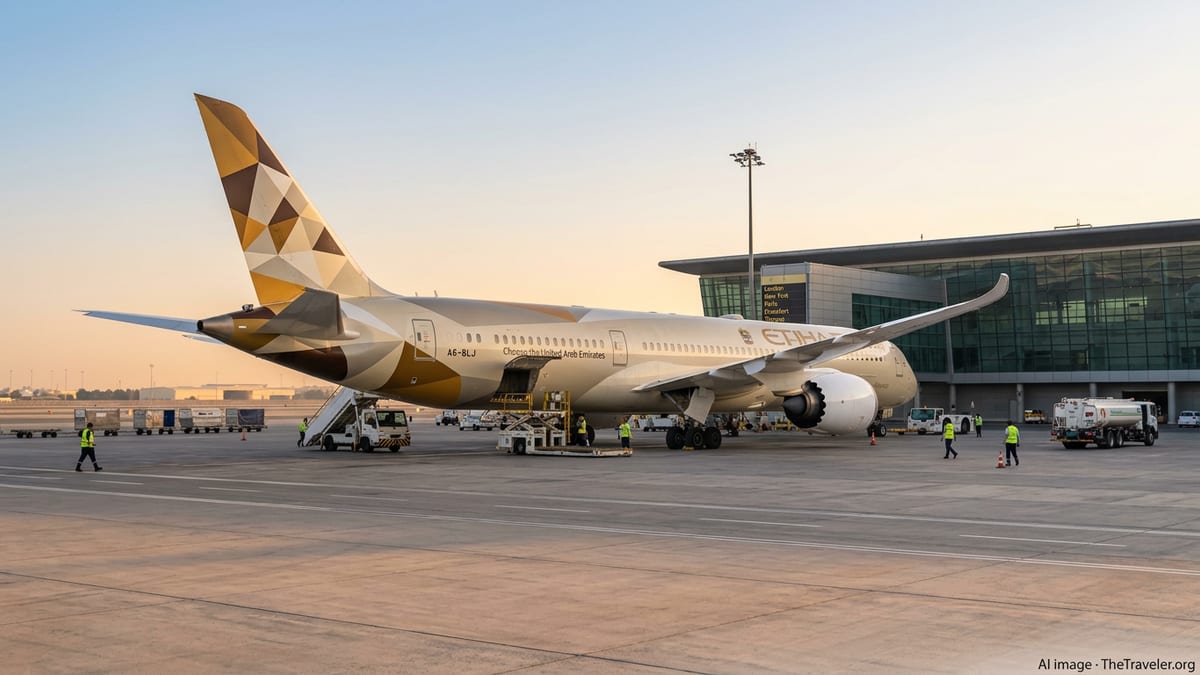
Etihad Airways will restart a limited schedule of commercial flights from Abu Dhabi to key global hubs including London, New York, Paris, Frankfurt, and Toronto from March 6, as the West Asia crisis continues to disrupt airspace and constrain capacity across one of the world’s busiest aviation corridors.
Measured Resumption After Full Suspension of Services
The move follows several days of blanket suspension of Etihad’s scheduled services to and from Abu Dhabi, imposed as regional airspace closures and security concerns intensified across West Asia. Authorities and airlines have been forced to repeatedly adjust operations as conflict zones and no-fly areas expanded along key routes linking Europe, Asia, and North America.
From March 6 through March 19, Etihad will operate a reduced but structured timetable, reconnecting Abu Dhabi with select long-haul destinations while keeping overall frequencies far below normal levels. The airline has confirmed that flights during this period will include services to London Heathrow, New York John F. Kennedy, Paris Charles de Gaulle, Frankfurt, and Toronto, alongside a broader but still limited network across Europe, Asia, and the Indian subcontinent.
Industry analysts say the controlled restart reflects both a gradual stabilisation of certain flight corridors and the urgent need to provide outbound options for stranded travellers. However, they caution that ongoing missile threats and shifting airspace restrictions mean schedules remain highly vulnerable to late changes.
Focus on Connectivity to Strategic Global Gateways
By prioritising cities such as London, New York, Paris, Frankfurt, and Toronto, Etihad is targeting major intercontinental gateways that play an outsized role in global connectivity. These hubs serve not only origin-and-destination traffic but also onward journeys for passengers seeking to reach North America, Europe, and beyond.
Etihad’s revised schedule is intended to restore at least a basic level of connectivity for residents, expatriate workers, and international visitors who were left in limbo after the blanket suspension of flights. Seats on early services are expected to be heavily subscribed, as those whose trips were cancelled rush to rebook or reposition via Abu Dhabi.
Travel agents in Europe and North America report a surge in queries from passengers looking to use the restarted Etihad routes to exit the region or return home. However, with frequencies sharply reduced and other Gulf carriers also operating scaled-back services, capacity remains tight and fare volatility is likely in the short term.
Enhanced Safety Measures and Dynamic Route Planning
Etihad has emphasised that its decision to resume a partial schedule follows extensive safety and security assessments conducted with national and international authorities. Routes have been re-evaluated to avoid active conflict areas and to comply with evolving airspace restrictions, with the airline indicating that flight paths may be lengthened or adjusted at short notice.
Operationally, the carrier is adopting a conservative stance. Flights are being loaded only once authorities confirm usable corridors, and departures may be retimed to align with airspace windows cleared for civilian traffic. Crews are receiving updated briefings on diversion plans, alternate airports, and contingency procedures.
Airport operations in Abu Dhabi have also been adapted to the new environment. Passengers are being urged to arrive only with confirmed bookings on operating flights, in order to prevent overcrowding in terminals and reduce pressure on ground-handling resources. Travellers are being told to monitor flight status closely on official channels on the day of departure.
Stranded Travellers, Rebooking Challenges, and Limited Capacity
The limited restart comes as thousands of passengers across the region continue to grapple with cancellations, missed connections, and prolonged stopovers. In recent days, travellers connecting through Abu Dhabi have reported extended hotel stays and complex rebooking experiences as they await firm confirmation of new itineraries.
Etihad has said affected customers will receive direct communication outlining their options, which may include rebooking on the new restricted schedule, alternative routings on partner airlines where available, or refunds in line with fare conditions. However, the scale of disruption means that not everyone will be able to travel on their preferred dates, particularly on high-demand routes such as Abu Dhabi to London and New York.
Travel consultants are advising passengers with flexible plans to avoid non-essential trips through the region in the coming days and to build generous buffers into any essential journeys. Those already ticketed on the newly restored Etihad flights are being urged to reconfirm details repeatedly, given the possibility of further last-minute airspace changes.
Uncertain Outlook as West Asia Crisis Continues
While the resumption of Etihad’s limited schedule is a significant step toward restoring connectivity, the broader outlook for aviation in and around West Asia remains uncertain. Regional conflicts have repeatedly demonstrated their capacity to upend flight operations, forcing airlines to divert, reroute, or abruptly suspend services.
Aviation experts note that the Gulf’s role as a global connecting hub magnifies the impact of any disruption. Carriers based in the United Arab Emirates, Qatar, and neighbouring states collectively handle a large share of traffic between Europe, Asia, Africa, and Australasia, meaning that turbulence in this region quickly ripples across international networks.
For now, Etihad’s timetable from March 6 to March 19 is being treated as a rolling framework rather than a guaranteed programme. The airline has signalled that it will expand, reduce, or further adjust services as security conditions evolve and regulators update guidance. Passengers planning to fly between Abu Dhabi and major cities such as London, New York, Paris, Frankfurt, and Toronto are being advised to stay prepared for rapid changes, even as a cautiously restored link to these key gateways comes back into view.