

More news on this day
Etihad Airways has begun restoring a limited number of flights between Abu Dhabi and the United Kingdom after a week of severe disruption triggered by Middle East airspace closures, offering a cautious lifeline to stranded travelers while warning that schedules remain highly fluid.
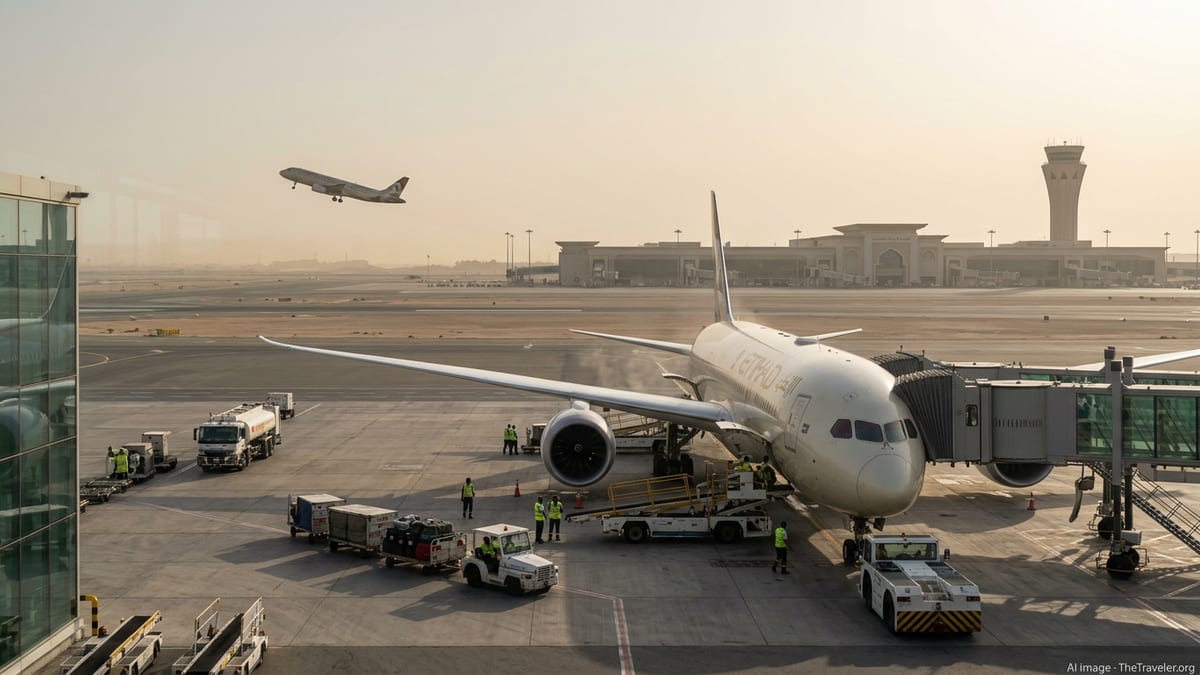
Gradual Restart After Full Suspension
Etihad was among several Gulf carriers forced to halt most operations in late February and early March after escalating conflict involving Iran, the United States and Israel led to widespread airspace closures across the region. Departures from Abu Dhabi’s Zayed International Airport were temporarily suspended, cutting off one of the world’s key hubs for travel between Europe, Asia and Africa.
The airline has since moved to a phased restart. From March 6, Etihad began operating a reduced timetable from Abu Dhabi, initially prioritising repatriation and essential travel. Travel advisories and internal schedules reviewed by regional media indicate that the carrier is now running a limited network to around 70 destinations worldwide, under a provisional schedule expected to remain in place until at least March 19.
The shift marks an important, but partial, recovery in capacity. The carrier is making clear that these services remain subject to short-notice changes depending on security assessments and the reopening of key air corridors, and has urged passengers not to travel to the airport without a confirmed booking and updated flight status.
Aviation analysts say the tentative restart underscores how vulnerable Gulf hub operations are to regional tensions. While aircraft and crews are available, planners must work around restricted or closed airspace, lengthened routings and shifting risk calculations, all of which limit the number of flights that can be operated safely each day.
Current Status of Etihad Flights to the UK
Among the destinations included in Etihad’s trimmed schedule are key European hubs, with London explicitly named by several regional outlets covering the airline’s latest updates. Services between Abu Dhabi and London Heathrow have resumed on a reduced frequency, providing critical links for passengers connecting between the UK, Asia, Australia and the Indian subcontinent.
Industry reports indicate that the UK is being treated as a priority market, but capacity remains far below pre-disruption levels. Seats on operating flights are heavily weighted toward rebooked passengers who were stranded when airspace first closed, as well as those travelling for urgent family or business reasons. Some travellers posting on consumer forums report being moved onto new Etihad departures several days later than originally planned, while others have opted to reroute via non-Gulf hubs such as Istanbul, Singapore or major European cities.
Secondary UK airports that typically see Gulf connectivity remain in a more uncertain position. While other carriers serving the UK from the region, including Emirates, have outlined plans for multiple daily services across several British airports, Etihad’s public guidance concentrates on a core set of routes, with the London pairing at the forefront. Passengers holding tickets to or from regional UK airports through Etihad codeshares are being advised to monitor their booking details closely for rerouting or schedule changes.
Travel experts caution that even where Etihad flights are shown as operating, routings and timings may be adjusted at short notice to account for changing airspace permissions. Longer flight times and unusual flight paths around restricted zones are expected to continue for the foreseeable future, potentially affecting onward connections in both directions.
Passenger Options: Rebooking, Refunds and Rerouting
To manage the fallout from the suspension and the ongoing limited schedule, Etihad has put in place a series of flexible policies for affected passengers. Travelers with tickets issued on or before late February and travel dates falling in the first three weeks of March are generally being offered complimentary rebooking onto later Etihad flights, subject to seat availability, or travel vouchers for future use.
In many cases, passengers whose original itineraries to or from the UK were cancelled are being rebooked automatically onto the next available Etihad service on the same route. However, with capacity constrained and demand high, some flyers are facing stays of several days in transit cities or at their origin point. Independent travel advisors recommend that passengers keep all receipts for accommodation and incidental expenses, as compensation rules may vary depending on the point of departure and the jurisdiction covering the ticket.
Some travellers, particularly those based in Britain or Europe, are choosing to request refunds and purchase new tickets with carriers operating via alternative hubs. European and UK consumer rules can entitle passengers whose flights were cancelled departing from British or European airports to rerouting at the earliest opportunity, though several forum reports suggest frustrations when trying to secure such arrangements amid widespread disruption.
Etihad has encouraged customers to make changes through their original booking channels, whether direct with the airline, through travel agents or via online travel agencies, rather than at airport ticket desks. Call centres and digital channels remain under heavy pressure, and passengers are being advised to check their booking status regularly in the days leading up to travel rather than assuming previously issued itineraries will operate as planned.
Official Travel Advice and Safety Considerations
The resumption of a limited flight schedule does not mean that the wider situation in the region has stabilised. Government travel advisories in the UK and other countries continue to urge caution regarding trips to parts of the Middle East, reflecting the risk of further military escalation and sudden changes to aviation security postures.
British authorities have warned that airspace restrictions and the potential for new closures could disrupt routes with little or no warning. Even transit passengers who never leave the airport in Abu Dhabi or other Gulf hubs are being asked to weigh the possibility of being stranded if flights are cancelled while they are en route. The Foreign, Commonwealth and Development Office continues to advise against all travel to areas directly affected by hostilities, and against non-essential travel to several neighbouring states.
Airlines and safety regulators stress that no commercial flights are permitted to operate without clearance that routes are considered safe at the time of departure. That has led to fragmented service patterns, where some departures are authorised while others are held back or rerouted. For travellers, this means that the decision to operate a specific Etihad flight to or from the UK may be confirmed only relatively close to departure time.
Security experts note that flight crews and dispatchers are constantly updating operational plans in response to intelligence about missile activity, drone threats and military overflights. As a result, published schedules into the UK should be read as provisional guides rather than guarantees, particularly for journeys involving tight connections or complex multi-leg itineraries.
What UK-Bound Travellers Should Do Now
For travellers in the UK planning upcoming trips via Abu Dhabi, or for those currently overseas trying to return home, the message from airlines and regulators is one of vigilance and flexibility. Passengers are being urged not to proceed to the airport unless they have received direct confirmation from Etihad that their flight is operating and have checked the latest status on the day of travel.
Travel advisors recommend building in generous connection times, ideally with at least several hours between long-haul legs, to allow for delays and reroutings. Those with urgent commitments in Britain, such as work start dates or family events, are advised to consider back-up plans, including bookings with carriers that route around the Gulf altogether.
Insurance coverage is another critical point. Policies vary widely on what is considered a covered event in the case of war-related airspace closures. UK travellers are being urged to review the fine print of their travel insurance, particularly clauses related to force majeure and government advisories, before making new bookings through Abu Dhabi.
While the return of Etihad’s Abu Dhabi to London services offers some relief to the thousands of passengers caught up in the crisis, industry observers say a full normalisation of schedules will depend on a sustained de-escalation in regional tensions. Until then, anyone relying on the Gulf as a bridge between the UK and the rest of the world should be prepared for a travel landscape defined by uncertainty.