

More news on this day
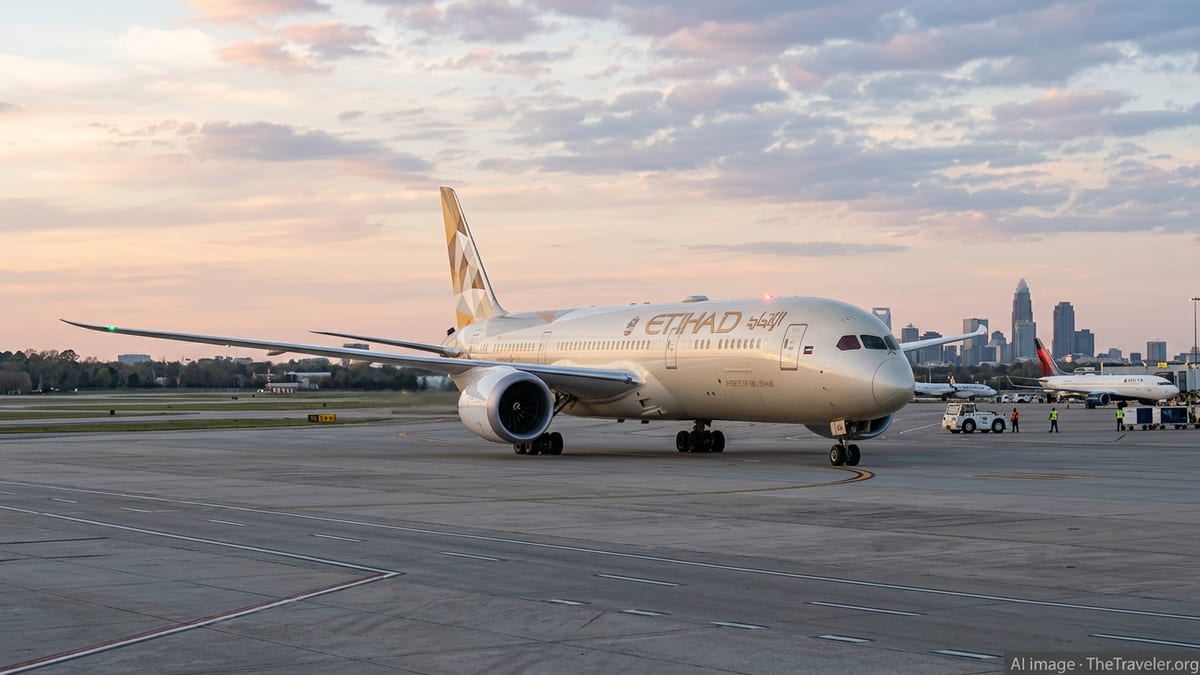
Etihad Airways is set to reshape transatlantic travel to the US Southeast with the launch of four weekly nonstop Boeing 787-9 Dreamliner flights between Abu Dhabi and Charlotte in March 2026, creating the North Carolina hub’s first direct link to the Middle East and one of its longest routes on record.
New Gulf Gateway for the US Southeast
The new Abu Dhabi–Charlotte service, scheduled to begin on March 20, 2026, will operate four times per week using Etihad’s Boeing 787-9 Dreamliner. The route will span more than 7,400 miles, instantly ranking among the longest services at Charlotte Douglas International Airport and placing the city firmly on the global long-haul map.
For Etihad, the move extends its US network to six destinations for the summer 2026 season, reflecting a broader strategy of targeting high-growth secondary hubs rather than focusing solely on the largest coastal gateways. For Charlotte, long recognized as a powerhouse domestic hub and financial center, the new link delivers long-sought non-stop access to the Gulf, South Asia and key markets across Africa.
Airport officials in Charlotte have previously highlighted the importance of securing nonstop service to a major Middle Eastern hub to support both corporate travel and growing visiting-friends-and-relatives traffic. The Etihad launch responds directly to that demand, positioning the airport as a more competitive player in the global connectivity race.
Dreamliner Comfort on One of Charlotte’s Longest Flights
Etihad plans to deploy its three-class Boeing 787-9 Dreamliner on the route, an aircraft type already central to the carrier’s long-haul strategy. The 787-9 offers modern cabin pressurization, higher humidity and larger windows designed to reduce jet lag on ultra-long journeys, a key selling point on a flight expected to exceed 13 hours in each direction.
The aircraft is configured with First, Business and Economy cabins, giving Charlotte-based travelers access to Etihad’s premium onboard product, including fully flat beds in Business and private suites in First on selected frames. Economy passengers will see features such as adjustable headrests, personal in-flight entertainment screens and a cabin layout optimized for long-haul comfort rather than dense short-haul seating.
The Dreamliner’s fuel-efficient design also underpins the economics of launching long-thin routes like Abu Dhabi–Charlotte. Lower fuel burn per seat helps the airline sustain transatlantic services to markets that might not yet justify the capacity of a larger widebody, while still offering a full-service, three-class experience.
Strategic Win for Charlotte’s Business and Banking Sectors
Charlotte’s emergence as a global financial services hub is a central factor behind Etihad’s decision. With major US banks and a growing roster of multinational firms basing operations in the city, demand for efficient links to the Middle East, India and beyond has intensified. Until now, most long-haul travelers have relied on domestic connections to larger coastal gateways before flying onward to the Gulf.
The new service will allow corporate travelers to board in Charlotte and connect in Abu Dhabi to destinations across South Asia, Southeast Asia and Africa on a single Etihad ticket. This hub-and-spoke model reduces total journey time and complexity, a benefit particularly valued by time-sensitive business passengers and globally mobile professionals.
Tourism and educational exchanges are also expected to gain. The route opens easier access for inbound visitors from the Gulf region to North Carolina’s banking corridor, tech clusters and universities, while giving local residents a one-stop journey to Abu Dhabi’s cultural attractions, desert landscapes and onward leisure destinations in Asia.
Middle East Expansion Amid Operational Headwinds
The Abu Dhabi–Charlotte announcement comes as Middle Eastern aviation navigates a volatile operating environment in early 2026, with recent regional airspace closures forcing temporary suspensions of scheduled flights to and from Abu Dhabi. While Etihad has resumed limited operations in phases, its decision to proceed with long-term network expansion to the United States signals confidence in demand fundamentals and in the eventual stabilization of regional conditions.
Industry analysts note that announcing new long-haul routes well ahead of launch allows the airline and airport partners to market the service, build awareness among corporate travel buyers, and align schedules with connecting banks at Abu Dhabi’s Zayed International Airport. By the time the inaugural Charlotte flight departs in March 2026, Etihad expects its broader North American schedule to be operating at full strength.
The timing also aligns with a broader trend of Gulf carriers targeting secondary US markets with strong corporate bases and alliance feed rather than simply layering more capacity into already crowded coastal hubs. Charlotte, with its established role as a major domestic connector and growing international aspirations, fits squarely into that strategy.
What Travelers Can Expect When Flights Take Off
Once the route launches, passengers in Charlotte will be able to depart for Abu Dhabi four days a week, with schedules designed to optimize connections to key destinations across Etihad’s network. Typical connectivity from Abu Dhabi is expected to include major cities in India, Pakistan, the wider Middle East and parts of Africa and Asia, turning a single new US route into dozens of new one-stop options for the Carolinas.
Travelers can expect full long-haul amenities onboard, including hot meal service, inflight entertainment with international film and television libraries, and Wi-Fi on selected aircraft. Premium passengers will gain access to Etihad’s lounges in Abu Dhabi and partner facilities in Charlotte, while eligible flyers will be able to earn and redeem miles across the airline’s loyalty program.
For Charlotte Douglas International Airport, the launch will be closely watched as a test of the market’s appetite for ultra-long-haul services beyond its existing transatlantic and Latin American portfolio. If successful, the route could pave the way for additional long-range connections and reinforce the city’s status as one of the fastest-rising global aviation hubs in the United States.