

More news on this day
Etihad Airways is set to redraw parts of the global aviation map in 2026, with a first ever non-stop service between Abu Dhabi and Charlotte and the resumption of flights to Kabul, two routes that highlight shifting priorities in both U.S. connectivity and regional reconstruction in Afghanistan.
Get the latest news straight to your inbox!
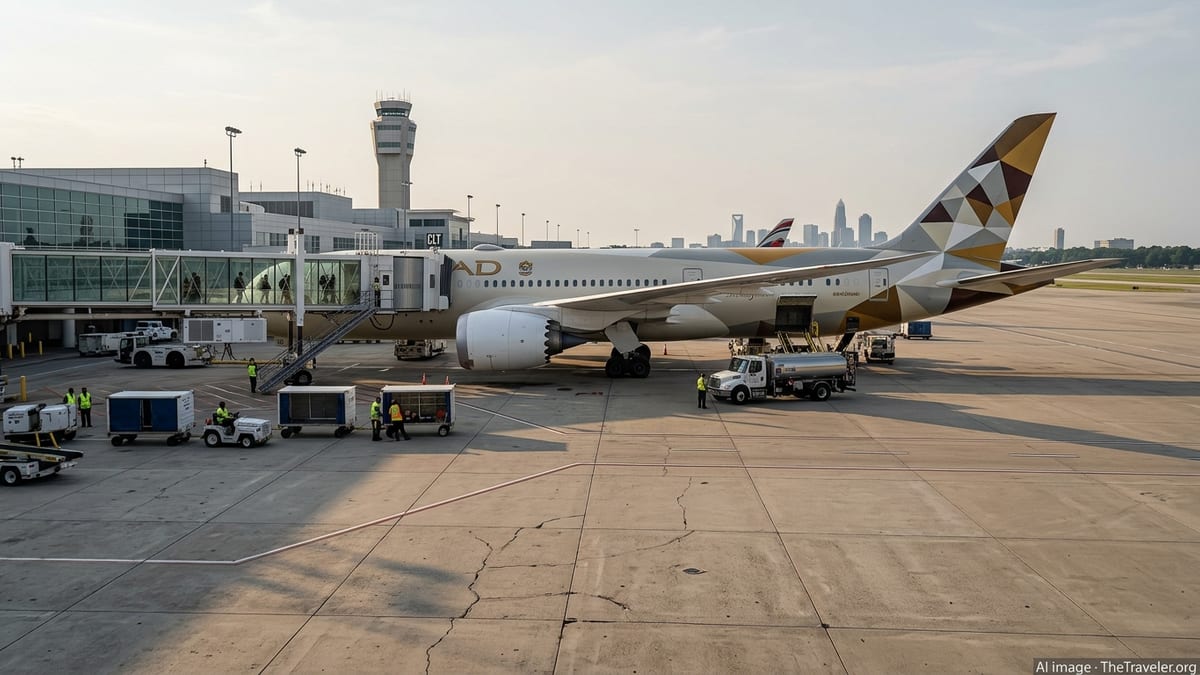
New Abu Dhabi–Charlotte Route Marks a First for the Southeast
Charlotte Douglas International Airport is poised to welcome Etihad Airways for the first time, as the Abu Dhabi based carrier prepares a new long haul service linking the United Arab Emirates with one of the fastest growing hubs in the southeastern United States. Publicly available route data lists Charlotte as a new Etihad destination, with regular passenger operations scheduled to begin in March 2026, marking the airline’s first direct connection to North Carolina.
Industry schedules show Charlotte Douglas as a fresh addition to Etihad’s North American network, alongside existing gateways such as New York, Chicago, Washington, Toronto and Boston. For Charlotte, the arrival of Etihad introduces a direct bridge to the Gulf region and beyond, giving the airport a second major Middle East link in addition to existing competition from other global carriers that serve the broader region through partner hubs.
The Abu Dhabi–Charlotte pairing is significant because it connects a rapidly expanding banking, tech and manufacturing center with a major transfer hub in the Gulf. Charlotte’s catchment area includes much of the Carolinas and neighboring states, and aviation analysts note that long haul international additions tend to draw from a wider region than the immediate metro area, particularly for travelers headed to South Asia, the Middle East and Africa.
Early reaction among travelers in local forums indicates interest from communities with strong ties to India and the wider subcontinent, who see Abu Dhabi as a convenient one stop bridge. The new service is also expected to appeal to corporate travelers linking Charlotte’s finance and energy sectors with markets across the Gulf and Asia, as well as leisure passengers seeking new options for trips to the Maldives, Southeast Asia and Australia.
Why Charlotte Matters to Etihad’s Global Strategy
Etihad’s move into Charlotte reflects a broader strategy of targeting large secondary U.S. hubs rather than focusing exclusively on the country’s biggest coastal gateways. Network maps and planning documents in the public domain show an emphasis on cities where strong local demand can be paired with alliance and codeshare connections, allowing the Gulf carrier to tap into domestic feed while offering its own long haul capacity to Abu Dhabi.
Charlotte Douglas is one of the busiest airports in the United States by passenger volume and a central node in a major U.S. carrier’s domestic network, sending large numbers of travelers onward across the country and into Latin America. By launching Abu Dhabi–Charlotte flights, Etihad inserts itself into this flow, offering new options for passengers who previously relied on connections through New York, Chicago or European hubs to reach the Gulf and South Asia.
From a competitive standpoint, the route gives Etihad a foothold in a market where nonstop long haul options have traditionally been limited compared with larger coastal cities. Aviation observers note that such moves can place downward pressure on fares and expand premium product choices, as new entrants bring their own cabin standards and loyalty propositions into a market long dominated by a small number of long haul operators.
For Charlotte’s airport planners, hosting an Abu Dhabi service aligns with a strategy of diversifying international links beyond Europe and the Americas. Long haul flights to the Middle East can help anchor demand for upgraded terminal infrastructure, support cargo opportunities tied to manufacturing and pharma, and raise the city’s profile as a globally connected business center.
Etihad’s Route to Kabul Signals a Carefully Managed Return
Alongside its North Carolina expansion, Etihad Airways is also preparing a renewed presence in Afghanistan, with Kabul listed among passenger destinations in updated public route information. The planned Abu Dhabi–Kabul service represents a cautious reintroduction of scheduled flights to a market that has experienced years of suspended or heavily restricted international links.
Available network references show Kabul as part of Etihad’s wider regional portfolio, which includes destinations across South Asia, Central Asia and the Middle East. The decision to plan regular service to the Afghan capital suggests that the airline sees a viable corridor for essential travel, including workers, aid related movement and limited business traffic, even as security and regulatory conditions remain under close international scrutiny.
Aviation analysts note that any resumption of Kabul flights typically depends on coordination among regulators, insurers, air navigation authorities and airport operators, with route launches often subject to change if risk assessments shift. As a result, industry coverage describes such services as fluid, with timetables and frequencies potentially adjusted in line with evolving operational and political considerations.
Despite those uncertainties, the inclusion of Kabul in upcoming network lists indicates that carriers like Etihad expect sustained demand from Afghan diaspora communities, regional traders and organizations engaged in reconstruction efforts. Nonstop connectivity to a Gulf hub can shorten journey times significantly compared with itineraries that require multiple transfers through regional airports.
Connectivity, Diaspora Demand and Humanitarian Travel
Both the Charlotte launch and Kabul service underline how Etihad is positioning its Abu Dhabi hub as a connector for diverse types of travel, from corporate and leisure demand in the United States to diaspora and humanitarian flows linked to Afghanistan. Publicly available schedules show that many of the airline’s South Asian and Middle Eastern destinations are timed to connect efficiently with long haul arrivals from North America, creating itineraries that minimize layover times.
For Afghan communities dispersed across the United States, Europe and the Gulf, a scheduled Abu Dhabi–Kabul service could offer a more predictable path home than ad hoc charter or multi stop routings. Travel industry observers indicate that even limited frequencies can have an outsized impact on families, small businesses and aid organizations that depend on reliable air links for personnel, supplies and remittances.
In Charlotte and the broader Carolinas region, the Abu Dhabi flight offers new one stop access to a wide range of cities in India, Pakistan and the Middle East, after years in which such journeys often required a domestic connection followed by a transatlantic or transpacific sector. Travel planners note that a single long haul leg to a Gulf hub can be especially attractive for those traveling with children or older relatives, as well as for passengers transporting significant baggage for extended trips.
These developments also highlight how airlines are recalibrating networks after recent global disruptions, prioritizing routes that combine strong origin and destination demand with opportunities for onward connectivity. By adding Charlotte and planning Kabul, Etihad is betting that its hub and spoke model can continue to attract a mix of premium and price sensitive travelers seeking alternatives to traditional transatlantic and regional gateways.
What Travelers Should Watch as Launch Dates Approach
With the Abu Dhabi–Charlotte service and the Kabul route both tied to evolving operational and geopolitical conditions, analysts advise travelers to pay close attention to schedule updates and equipment assignments as launch dates near. Public timetables and aviation databases are frequently updated to reflect changes in frequency, aircraft type or start dates, particularly on new or resumed routes.
For the Charlotte market, key indicators will include final confirmation of start-of-service dates, weekly frequency and whether the route operates year round or is adjusted seasonally. The choice of aircraft, likely from Etihad’s long haul fleet, will influence both passenger capacity and the mix of premium and economy seating, shaping how the airline positions the route for corporate accounts and leisure groups.
On the Kabul side, observers note that regulatory approvals, security assessments and insurance conditions can all influence whether planned services start as scheduled or are revised. Prospective passengers are expected to monitor official travel advisories, airport notices and airline communications, as conditions affecting Afghan airspace and airport operations may shift with limited advance warning.
Taken together, Etihad’s new links to Charlotte and its planned return to Kabul illustrate how international airlines are selectively expanding into markets that serve both commercial and social needs. The success of these routes will depend not only on local demand and ticket pricing, but also on broader questions of stability, infrastructure and traveler confidence in regions that are increasingly interconnected by long haul air travel.