

More news on this day
Etihad Airways is advising passengers to closely monitor their flight status and avoid travelling to the airport without confirmed bookings, as the Abu Dhabi based carrier continues to run a limited schedule following recent regional airspace disruptions.
Get the latest news straight to your inbox!
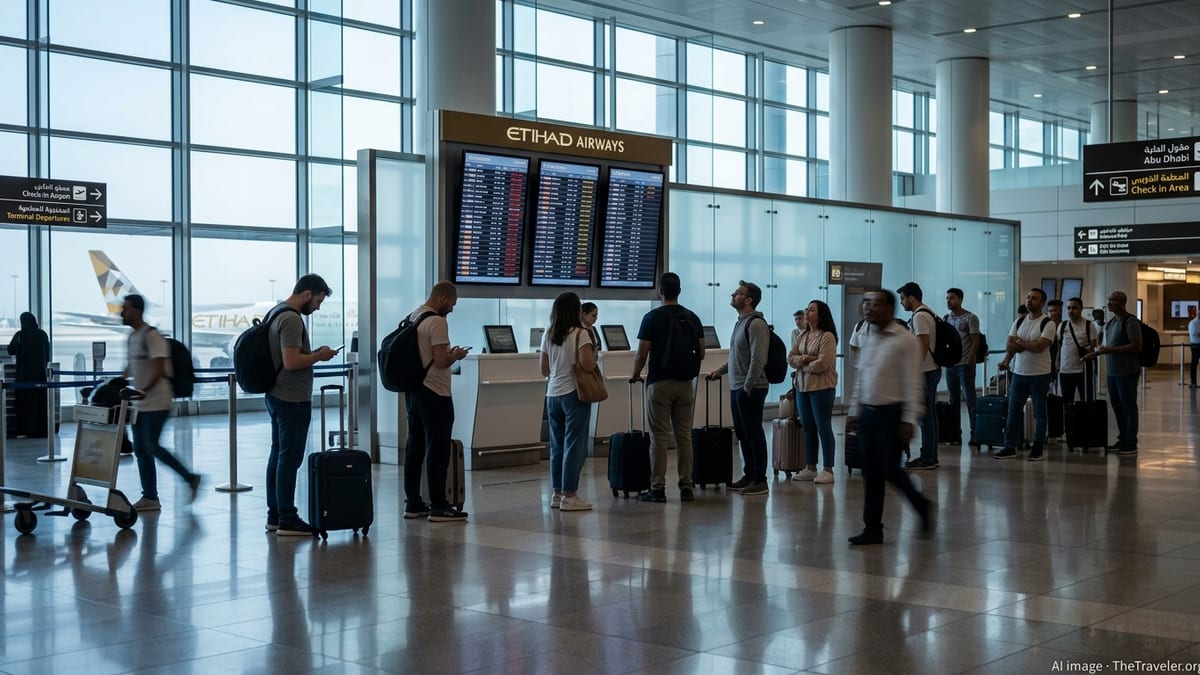
Reduced schedule continues after airspace closures
Publicly available information shows that Etihad’s operations were significantly curtailed after airspace closures in early March 2026 led to the temporary suspension of all scheduled commercial flights to and from Abu Dhabi. Subsequent updates indicate that the carrier has been gradually restoring services, but only on a restricted basis and with frequent timetable changes.
Recent notices reproduced in aviation forums and travel advisories describe a phased resumption, with specific routes prioritized and many others remaining suspended or subject to last minute adjustment. Passengers on certain long haul and regional routes have reported rebookings within short windows of a few days, while other itineraries have been cancelled outright as schedules are recalibrated.
The evolving situation means that a flight appearing in schedules is not a guarantee of departure. Timings, routings and even operating dates have been adjusted repeatedly as the airline responds to capacity constraints and changing airspace permissions, leaving many travelers uncertain about their plans until close to departure.
Etihad highlights confirmed bookings and status checks
According to published coverage of the disruption and subsequent recovery, Etihad has been emphasizing the importance of checking flight status before travelling to the airport. Advisories circulated through its website and customer communications urge guests to use online tools and apps to verify whether their specific service is operating, cancelled or retimed.
Reports shared by passengers indicate that the airline is focusing airport access on customers with confirmed bookings on flights that are scheduled to operate within the reduced network. Travelers who attempt to reach the airport without such confirmation risk being turned away or facing extended waits if their service has been removed from the schedule or shifted to a different day.
In addition to online status checks, customers are being encouraged to ensure their contact details are up to date in existing reservations. This has become particularly important as many notifications about cancellations, rebookings and schedule changes are being sent only a few days, and in some cases hours, before departure.
Limited route network and rolling schedule changes
Information shared across flight tracking platforms and traveler discussions points to a temporary network built around a defined list of cities operating to and from Abu Dhabi on specific dates. Destinations such as London, New York, Paris, Frankfurt, Toronto, Riyadh, Mumbai and several key Asian and Middle Eastern cities have featured in these limited schedules, while many other regular Etihad destinations remain suspended.
Travelers report that the list of operating routes has been updated several times as conditions evolve, with additional services added, some removed and others rescheduled. This rolling approach has made it difficult for passengers with trips planned later in March and beyond to obtain certainty about whether their flights will proceed as booked.
Some customers have highlighted that updates to the schedule often appear only a few days in advance, with cancellations and rebookings processed in short batches. As a result, travelers with itineraries outside the latest published window are being advised to monitor the situation and avoid making irreversible onward arrangements until their flights have been positively confirmed.
Flexible policies and options for affected passengers
Etihad has introduced temporary flexibility measures for travelers whose plans are disrupted by the limited operations. Summaries of these policies on consumer platforms indicate that customers holding tickets issued on or before late February 2026, for travel dates in March, may in many cases rebook without additional change fees onto Etihad operated flights within a specified future period, subject to availability.
For some itineraries, passengers are also being offered the option to request refunds when a flight is cancelled by the airline, with reimbursement typically returning to the original form of payment. The precise conditions and eligibility windows vary according to ticket type, route and date of travel, prompting travel advisers to recommend that passengers carefully review the latest terms applicable to their booking.
Feedback from travelers suggests that rebooking choices may be more limited on heavily affected routes, where capacity constraints and ongoing airspace restrictions reduce the number of alternative departures. In these cases, some passengers have opted to cancel or seek itineraries on other carriers, particularly when they need to reach their destination by a fixed date and are unable to wait for further schedule clarification.
Practical guidance for travelers with upcoming Etihad flights
Given the continued reliance on a reduced and frequently updated schedule, travel experts and consumer advocates are advising Etihad customers to take several practical steps before departure. Passengers are encouraged to check their flight status repeatedly in the days leading up to travel, including on the day of departure, and to look for any changes in flight number, departure time or connection window.
Travelers with tight connections or complex itineraries that involve other airlines are also being urged to review minimum connection times and consider the potential impact of last minute retimings on onward journeys. Where possible, building in additional buffer time or selecting more robust connections can reduce the risk of missed flights if schedules shift again.
Passengers who have not yet received any communication about flights scheduled for later in March are being told that silence does not necessarily mean their service will operate unchanged. With rolling batches of cancellations and rebookings still occurring, many observers suggest treating plans as provisional until a flight has been reconfirmed within the latest operational window.
As Etihad continues to rebuild its schedule, the overarching message for travelers remains one of vigilance and flexibility: confirm the status of each sector before leaving for the airport, keep contact details current, and be prepared to adjust plans quickly if the limited operations lead to further changes.