

More news on this day
Etihad Airways is preparing a major expansion in the United States by 2026, with publicly available data and industry analysis pointing to roughly a 40 percent increase in flights and seats across its North American network as the Abu Dhabi carrier leans into record profitability and rising transatlantic demand.
Get the latest news straight to your inbox!
A Bigger Transatlantic Footprint Anchored in Abu Dhabi
Etihad’s stepped-up push into the United States comes on the back of its strongest financial performance on record. Company results for 2024 and 2025 show sharp increases in passengers carried, available seat kilometers and profit, signaling that the airline has rebuilt capacity and demand to a level that supports renewed long-haul growth. The United States, already one of Etihad’s most important long-haul markets, is emerging as the next major focus.
By May 2026, Etihad is projected to operate more than 50 weekly services across the United States and Canada, according to sector reporting that tracks its schedules into New York, Chicago, Washington, Boston and Toronto, as well as new southern gateways. That represents a substantial rise in weekly frequencies compared with the carrier’s pre-expansion footprint, effectively lifting transatlantic capacity by around 40 percent when measured in seats.
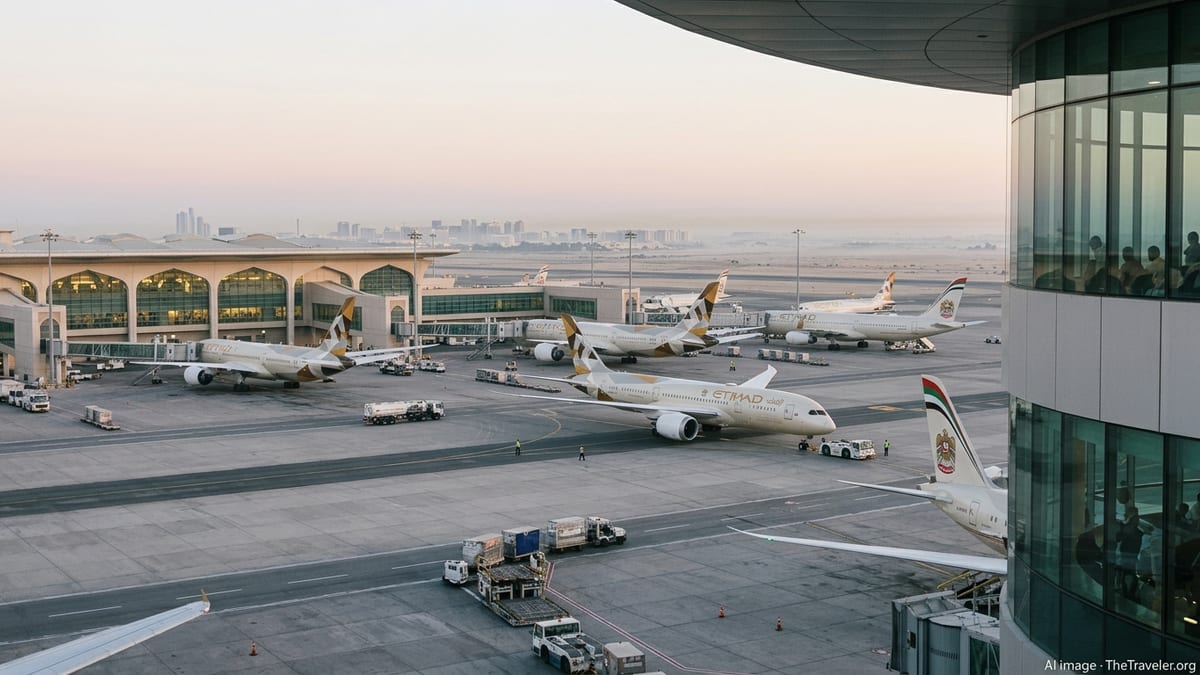
This growth is enabled by the continued ramp-up of Zayed International Airport in Abu Dhabi, whose new facilities and higher passenger capacity allow for more banked connections and longer-range operations. With more widebody aircraft returning to service and new deliveries arriving, Etihad is in a position to restore previous long-haul links and selectively add fresh markets across North America.
For the United Arab Emirates, the build-out of Etihad’s U.S. network fits into a broader strategy of expanding aviation as a pillar of economic diversification. More nonstop flights into Abu Dhabi support tourism, logistics and investment flows, tying the emirate more directly to financial centers and tech hubs across the eastern seaboard and beyond.
New U.S. Gateways and a More Balanced Network
Etihad has already been steadily adding U.S. points. Boston joined the network in 2024, initially with several weekly flights before being built toward daily service as part of a broader “double down” on North America. New York, Chicago and Washington remain the backbone of the operation, with additional frequencies and larger aircraft underpinning the capacity jump expected by 2026.
Industry coverage indicates that the next phase of expansion is centered on secondary but fast-growing markets. A new Abu Dhabi to Charlotte route scheduled for 2026, for example, will provide the first nonstop connection between the UAE capital and the southeastern United States. Operating several times per week on Boeing 787-9 aircraft, the service is forecast to add thousands of weekly seats and open a fresh flow of connecting traffic between the Carolinas, the Gulf and destinations across Asia and Australia.
Analysts expect Etihad’s U.S. schedule by mid-2026 to feature a mix of daily or double-daily flights to major coastal gateways and regular services to emerging hubs. While some former destinations on the West Coast remain absent from published schedules, the current strategy appears focused on deepening presence in markets where the airline sees strong corporate, visiting-friends-and-relatives and leisure demand, rather than simply chasing geographic coverage.
From a network-planning perspective, this mix spreads risk more evenly across multiple U.S. cities and allows Etihad to capture traffic flows that bypass the most congested airports. It also supports Abu Dhabi’s positioning as an alternative one-stop option to and from North America for travelers bound for South Asia, Southeast Asia and Oceania.
Preclearance and the Appeal of One-Stop to Asia
A key factor underpinning Etihad’s confidence in growing U.S. flying is the enhanced passenger experience at its Abu Dhabi hub. The new terminal complex includes a modern United States preclearance facility, enabling travelers to complete American immigration and customs procedures before departure from the United Arab Emirates. For passengers, this means arriving in the U.S. as a domestic traveler, often with shorter connection times and smoother onward transfers.
For the airline, preclearance is a strategic advantage when competing with other Gulf and European carriers for North American traffic. It allows Etihad to market Abu Dhabi not just as a convenient transit point, but as a streamlined gateway into the United States itself. This differentiator becomes more valuable as the number of U.S. departures grows, and as passengers increasingly weigh airport experience alongside schedule and price.
At the same time, the airline is clearly targeting the large and resilient demand between the United States and Asia. By 2026, Etihad’s network plans envision more than 125 destinations and a significantly larger widebody fleet, heavily oriented toward routes linking Europe and North America with India, the broader Indian subcontinent and key cities in East and Southeast Asia. Additional U.S. flights feed this long-haul web, making it more attractive for travelers in markets such as New York, Boston, Chicago and Charlotte to route through Abu Dhabi instead of more established hubs in Europe or the Gulf.
Travel industry data suggests that this one-stop proposition is especially compelling in price-sensitive segments, including students, migrant workers and diaspora communities, where connecting traffic can fill aircraft year-round. As Etihad scales up, a 40 percent increase in U.S. capacity gives the carrier more flexibility to adjust schedules, respond to seasonal peaks and fine-tune connections to its fastest-growing Asian and African destinations.
Competition, Capacity and the Post-Disruption Rebuild
The decision to add so much U.S. capacity by 2026 is not without risk. The North Atlantic is among the most contested long-haul markets in the world, with major European groups, United States legacies and other Gulf carriers continually adjusting their networks and pricing. Etihad’s move to expand by about 40 percent suggests a calculated bet that demand growth will outpace any cyclical softening and that Abu Dhabi can claim a durable share of connecting flows.
Reports from aviation analysts point to several tailwinds. Global long-haul demand has continued to recover and in many cases exceed pre-disruption levels, particularly in premium cabins and on routes linking financial centers. At the same time, Boeing 787s and Airbus A350s deliver better fuel efficiency and lower operating costs than previous-generation aircraft, improving route economics and giving carriers like Etihad more leeway to experiment with new cities and higher frequencies.
The expansion also comes as the airline rebuilds and re-optimizes its schedule following a period of suspended and reduced operations linked to regional instability. Since early March 2026, Etihad has been gradually restoring flights to key markets from a limited base, and industry observers view the 2026–2027 period as pivotal for re-establishing its global footprint. The planned surge in U.S. services fits into that broader recovery arc, signaling confidence that demand and operational conditions are stabilizing sufficiently to support sustained growth.
Capacity growth on this scale, however, will require close management of yields. With additional seats to fill, Etihad is likely to lean on partnerships, interline agreements and targeted promotional activity in U.S. cities to stimulate traffic. Success in doing so would not only validate the American expansion but also reinforce Abu Dhabi’s long-term ambition to stand alongside the world’s largest global hubs.
What a Bigger Etihad Presence Means for U.S. Travelers
For travelers in the United States, Etihad’s strategy translates into more choice and potentially more competitive fares on routes to the Gulf, India, Africa and Asia-Pacific. Additional nonstop options from cities such as Boston and Charlotte, coupled with higher frequencies from New York, Chicago and Washington, broaden the range of convenient connection possibilities for both leisure and business trips.
Schedule data and airline statements highlight a focus on connectivity at Abu Dhabi, with many U.S. arrivals timed to facilitate onward departures within a few hours to cities like Mumbai, Delhi, Bengaluru, Bangkok, Singapore, Sydney and Melbourne. This kind of tightly banked hub structure is designed to shorten total journey times and reduce the uncertainty of longer layovers that once characterized some ultra-long-haul itineraries.
Travel advisors and corporate travel managers are watching how the expanded Etihad network integrates with loyalty and joint-marketing arrangements, as frequent flyers often weigh alliance benefits, mileage earning and lounge access when choosing carriers. A stronger U.S. presence provides more opportunities for American-based passengers to engage with Etihad’s loyalty ecosystem and to consider Abu Dhabi as an entry point into the wider region.
If the airline successfully executes its 2026 expansion and sustains performance across its enlarged network, the 40 percent boost in U.S. flights could mark a turning point in Etihad’s role in transatlantic aviation. Rather than a niche challenger, the Abu Dhabi carrier would be positioned as a more visible and permanent fixture in U.S. skies, deepening aviation links between the United Arab Emirates and North America while reshaping long-haul travel choices for millions of passengers.