

More news on this day
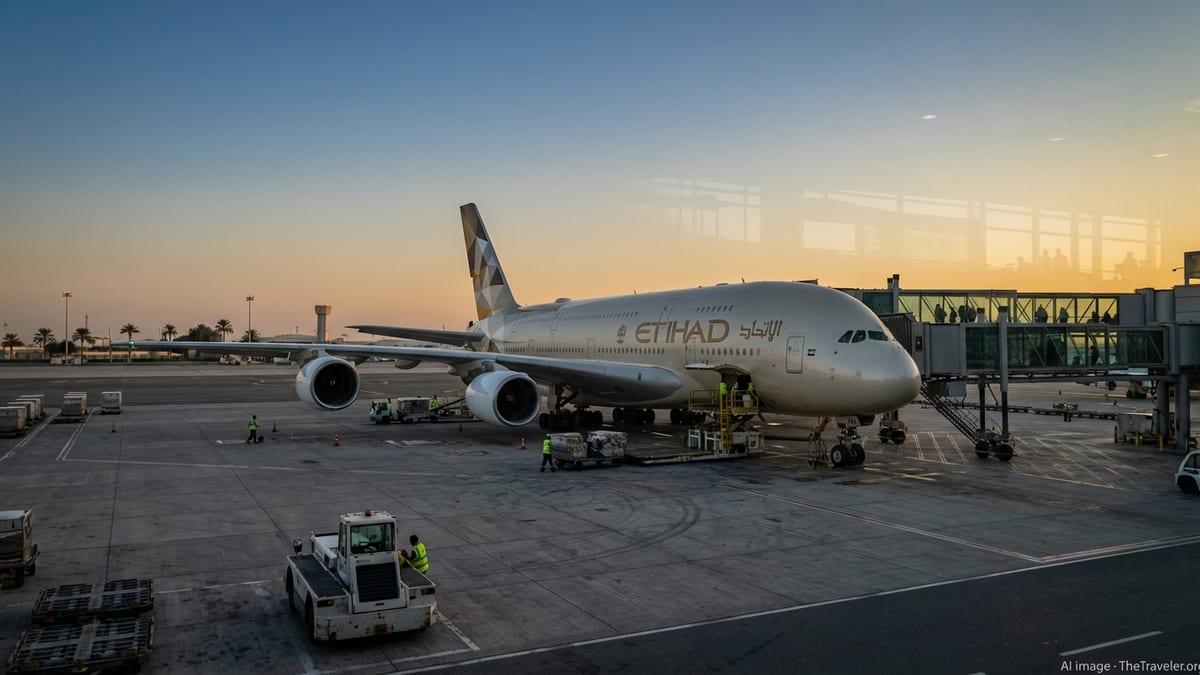
Etihad Airways will deploy its flagship Airbus A380 on daily flights between Abu Dhabi and Bangkok from October 25, 2026, a high-profile move that sharply increases premium capacity to Thailand and underscores the Gulf carrier’s bet on booming leisure demand to the kingdom.
A Superjumbo Debut on a Key Leisure Route
The A380 will operate Etihad’s evening service between Abu Dhabi’s Zayed International Airport and Bangkok Suvarnabhumi, marking the first time the double-deck jet has been scheduled to the Thai capital. From October 25, flight EY402 is set to depart Abu Dhabi at 21:20, arriving in Bangkok at 06:35 the following morning, with the return EY403 leaving Bangkok at 08:30 and touching down in Abu Dhabi at 12:20, all times local.
The decision elevates Bangkok into a select group of global cities served by Etihad’s A380, alongside destinations such as London, Paris, Singapore, Toronto and Tokyo Narita. It also replaces a Boeing 777-300ER on the daily rotation, significantly increasing both overall seat numbers and the share of high-yield premium cabins on a route already considered one of the airline’s strongest leisure performers.
For Thailand, the move sends a clear signal: the country’s tourism recovery and long-term growth prospects are strong enough to justify one of the largest and most luxurious aircraft in commercial service, operated year-round rather than as a short seasonal upgauge.
Luxury in the Sky: The Residence and Expanded Premium Cabins
At the heart of Etihad’s A380 strategy is “The Residence,” billed as the world’s only three-room suite in the sky. Situated on the upper deck, it offers a private living room, separate bedroom and an ensuite bathroom with shower, designed for up to two guests and served by a dedicated cabin team. For high-spending travellers bound for Thailand’s ultra-luxury resorts and medical tourism facilities, it creates a new top-tier option on the Abu Dhabi–Bangkok corridor.
Beyond The Residence, the aircraft features nine First Apartments, each combining a reclining leather armchair with a separate 80-inch lie-flat bed and access to a shared shower room. Seventy Business Class studios, also on the upper deck, provide fully flat beds with direct aisle access, while a social space known as The Lobby allows First and Business passengers to stretch out, work or socialise during the six-and-a-half-hour journey.
In Economy, Etihad’s A380 offers 68 Economy Space seats with additional legroom plus 337 standard Economy seats, all equipped with adjustable headrests and upgraded inflight entertainment. The layout represents a notable upgrade in comfort and capacity compared with the aircraft type it replaces, a change expected to prove attractive to both Thai outbound travellers and visitors arriving from Europe, the Middle East and North America via Abu Dhabi.
Why It Matters for Thailand’s Tourism Boom
The new A380 service is timed to begin just as Thailand enters its peak winter season, when cooler, dry weather traditionally draws millions of visitors to Bangkok and onward to the country’s beaches and northern cultural hubs. Tourism analysts say the daily superjumbo will help absorb rising demand from Europe and the Gulf, segments that are increasingly favouring premium cabins and long-stay itineraries.
By routing the A380 through Abu Dhabi, Etihad is positioning itself as a competitive alternative to nonstop European services and to rival Gulf carriers that already operate A380s to Thailand. Abu Dhabi’s growing status as a hub offers convenient one-stop connections from markets such as the United Kingdom, Germany, France, Canada and the United States, feeding traffic into Bangkok while also encouraging stopovers in the United Arab Emirates.
The additional capacity also supports Thailand’s strategy of attracting higher-spending visitors and diversifying beyond traditional mass tourism. Premium cabins on widebody aircraft tend to correlate with longer stays and greater per-trip spending, benefitting hotels, restaurants, retailers and tour operators across Bangkok and secondary destinations reachable by domestic connections.
Shaping Regional Competition and Connectivity
Etihad’s decision to deploy the A380 on a single daily Bangkok rotation comes on top of an already dense Thailand schedule that includes multiple daily services to Bangkok and expanded flights to Phuket. The superjumbo gives the Abu Dhabi-based carrier a flagship product to match rivals from Dubai and Doha on one of Southeast Asia’s most hotly contested leisure markets.
Industry observers note that having all three major Gulf carriers operating A380s into Thailand underlines the country’s strategic importance as a gateway to the wider region. From Bangkok, travellers can connect to emerging beach and cultural destinations in Cambodia, Vietnam, Laos and domestic Thai provinces, using the city as a regional hub for multi-stop itineraries across mainland Southeast Asia.
For Bangkok Suvarnabhumi Airport, the daily arrival and departure of Etihad’s largest aircraft adds to an already robust portfolio of A380 operators and further cements its status as a premier long-haul gateway in the Asia-Pacific. The move is expected to encourage continued investment in premium ground services, lounges and connectivity tailored to high-end travellers.
A Strategic Bet on Premium Leisure Travel
The Bangkok deployment forms part of a broader recalibration of Etihad’s A380 network, shifting the superjumbo from a general-purpose flagship to a targeted asset on routes where both demand and yields justify its scale. The carrier has gradually restored its A380 fleet to service and concentrated the type on a handful of trunk routes linking Abu Dhabi with major global cities.
By choosing Bangkok as the latest A380 destination, Etihad is effectively endorsing Thailand not only as a high-volume holiday market but as a premium leisure and business destination capable of sustaining its most exclusive products. Travel agents and tour operators in key origin markets are already expected to package the new A380 flights with upscale resort stays and stopover programs in Abu Dhabi.
For travellers, the daily A380 means more seats, more comfort and a visibly upgraded experience on one of the busiest corridors into Thailand. For the Thai tourism sector, it represents both a vote of confidence and a new competitive lever in the race to attract long-haul visitors in the years ahead.