

Etihad Airways has kicked off 2026 with a powerful set of traffic figures, reporting double digit growth in both passengers and cargo that extends the momentum of its record 2025 and underscores Abu Dhabi’s rapid ascent as a global aviation hub.
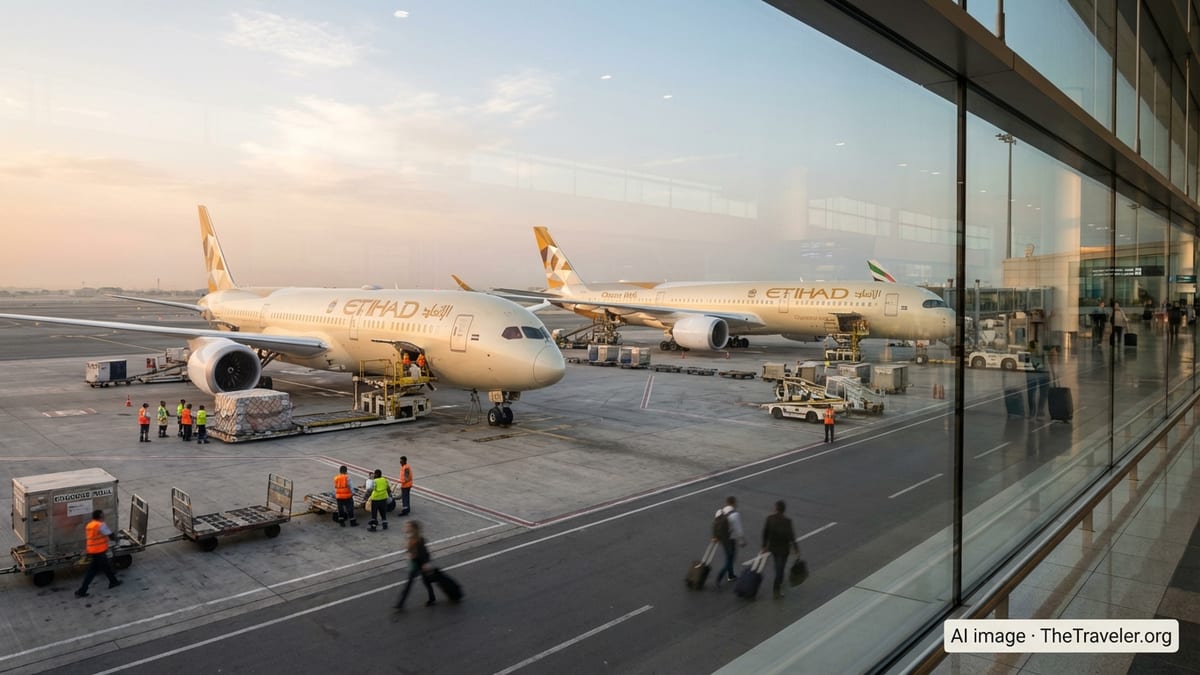
Record January Puts Etihad on Faster Growth Trajectory
The Abu Dhabi based carrier welcomed 2.2 million passengers in January 2026, according to newly released traffic data, up from 1.7 million in the same month a year earlier. The 29 percent jump follows a record 2025 in which Etihad carried 22.4 million travelers, the highest annual total in its history, and signals that demand is not only holding but accelerating into the new year.
Passenger load factor edged up to 89.9 percent for the month, compared with 89.1 percent in January 2025. That slight increase is notable because it came as Etihad added significant capacity, expanding its operating fleet from 101 to 127 aircraft year on year and growing its network to 110 destinations worldwide. Filling a larger number of seats while keeping aircraft nearly 90 percent full points to a strong underlying demand curve.
The latest figures put Etihad on an annualized run rate that would see it surpass last year’s passenger record if current trends persist. Aviation analysts say the start to 2026 reinforces the carrier’s status as one of the fastest growing international airlines, particularly in the long haul market where competition for high yielding traffic remains intense.
Industry observers note that the breadth of growth across regions and cabin segments suggests a structural shift, rather than a short lived spike in bookings. The airline is benefiting from a combination of restored global mobility, targeted network expansion and an increasingly prominent hub at Abu Dhabi’s Zayed International Airport.
Expanded Fleet and Network Underpin Capacity Gains
Etihad’s ability to deliver near 30 percent passenger growth in a single month rests heavily on the rapid build out of its fleet and network. The airline entered 2026 with 127 operating aircraft, up by 26 units compared with a year earlier, including new widebodies that are central to its long haul strategy and additional narrowbodies suited to regional growth and thinner routes.
The carrier’s route map has widened in tandem. Etihad now lists 110 destinations globally, compared with 94 at the start of 2025, giving Abu Dhabi residents and connecting passengers more options across Europe, North America, Asia and Africa. Industry reports highlight January announcements of new direct services from Abu Dhabi to Calgary in Canada and Luxembourg in Europe, both of which plug fresh city pairs into the network.
These additions are designed to diversify traffic flows beyond traditional trunk routes and to tap into secondary markets where demand for one stop connectivity to Asia and the Middle East is rising. By pairing new destinations with increased frequencies on established routes, Etihad has been able to smooth its network banks at Zayed International, improving connection times and aircraft utilization.
The fleet expansion comes as the airline continues to induct fuel efficient aircraft types and to optimize the mix of passenger and freighter capacity. Management has repeatedly stressed that growth will be calibrated to maintain profitability and protect yields, rather than chasing scale for its own sake.
Passenger Growth Anchors Abu Dhabi’s Hub Ambitions
The strong start to 2026 dovetails with a broader surge in air traffic through Abu Dhabi. Airport operator figures show more than 33 million passengers passed through the emirate’s airports in 2025, with Zayed International Airport emerging as one of the fastest growing mega hubs in the Europe, Middle East and Africa region based on recent traffic data. Etihad, as the home carrier, is central to that trajectory.
Higher throughput is already reshaping the travel ecosystem in and around the UAE capital. Hoteliers report solid forward bookings linked to increased connecting traffic converting into stopovers and short breaks, while inbound tour operators are expanding itineraries built around Abu Dhabi’s cultural and leisure attractions. Travel retailers and duty free operators at Zayed International have also pointed to rising spend per passenger as volumes climb.
Government officials see the airline’s January performance as another data point in support of Abu Dhabi’s long term strategy to position itself as a leading aviation, tourism and trade hub. The growth in international arrivals and connections feeds directly into wider economic diversification goals, including the development of conferences, events and high value tourism segments.
For travelers, the consolidation of Abu Dhabi’s hub role is translating into more competitive fares on key international routes and a wider choice of schedules, especially for journeys between Europe, the Middle East and Asia Pacific. As the hub grows, more city pairs become accessible with a single connection, a key factor in winning market share from rival gateways in the region.
Cargo Performance Adds Depth to Etihad’s Recovery
While passenger growth is grabbing headlines, Etihad’s cargo division has also entered 2026 in solid shape. Industry summaries of the airline’s performance indicate that freight volumes in January held up well despite a softer global air cargo market, with tonnage supported by strong flows across e commerce, pharmaceuticals and time sensitive industrial shipments.
The airline operates dedicated freighters alongside bellyhold capacity in its passenger fleet, using Abu Dhabi as a consolidation point on core east west trade lanes. Analysts say this dual role allows Etihad to flex capacity between passenger and cargo demand, helping to stabilize overall revenues and support fleet utilization, particularly in off peak passenger periods.
Middle East carriers, including Etihad, gained cargo share during the pandemic years and have worked to retain that position through investments in handling facilities, digitization and specialized products. At Zayed International, upgraded cargo infrastructure and improved processes for temperature controlled and high value goods are enabling the airline to pursue higher yielding freight business.
The robust start to 2026 suggests that cargo will continue to be an important pillar of Etihad’s financial performance even as passenger revenues become a larger share of the total. It also reinforces the UAE’s role as a logistics and transshipment hub linking manufacturers and consumers across Europe, Asia and Africa.
Competitive Landscape: Gulf and Global Rivals Step Up
Etihad’s January performance comes amid intensifying competition among full service carriers, especially in the Gulf region where rivals are also reporting strong traffic growth. Airports across the wider region have logged record or near record volumes as international travel demand rebounds, pushing airlines to add capacity while maintaining discipline on yields.
Industry experts say Etihad’s strategy differs from some of its larger neighbors in that it focuses on measured growth and network specialization rather than aiming to be the largest global connector by sheer scale. The airline has trimmed less profitable routes in recent years and is now selectively adding destinations that feed its Abu Dhabi hub and align with the emirate’s economic priorities.
Against this backdrop, maintaining a passenger load factor close to 90 percent while ramping up capacity is seen as a strong competitive signal. It suggests Etihad is calibrating growth to match demand, limiting the risk of fare dilution even as it courts new customer segments and geographies. The steady improvement in traffic metrics also strengthens the airline’s negotiating position with partners across alliances, code shares and joint ventures.
For corporate and premium leisure travelers, intensifying rivalry among carriers is likely to bring continued investment in product and service upgrades. Etihad has already refreshed cabins on key aircraft types and sharpened its loyalty proposition, moves that will be important in defending and growing its share of high value traffic flowing through Abu Dhabi.
Operational Efficiency and Customer Metrics in Focus
Beyond headline traffic numbers, Etihad’s early 2026 results are being closely watched for signs of operational resilience as the airline scales up. After widespread disruption across parts of the global air transport system in recent years, carriers are under pressure to demonstrate they can grow without compromising reliability or customer satisfaction.
Internal metrics highlighted by the airline point to continued high on time performance and a further improvement in guest satisfaction scores, building on record levels reported through much of 2025. Industry analysts argue that maintaining this trajectory will be essential if Etihad is to convert first time passengers into repeat customers and to build a reputation that can support premium pricing on key routes.
Etihad has invested in digital tools to smooth the travel journey, from booking and check in to disruption management. These initiatives, along with upgrades at Zayed International such as streamlined security and immigration processing, are intended to keep transfer times competitive with rival hubs and to reduce friction for connecting passengers.
At the same time, the airline is tightening its focus on unit costs and fuel efficiency as it deploys newer aircraft and optimizes schedules. The combination of higher load factors, disciplined cost control and stable yields is central to the carrier’s ambition to sustain profitability through the current growth phase.
Implications for 2026 Outlook and Beyond
The strong January print provides an early data point for forecasting Etihad’s performance for the rest of 2026. If demand remains robust and operational conditions stay broadly stable, analysts expect the airline to comfortably exceed last year’s passenger tally and to deepen its role in funneling traffic through Abu Dhabi.
Scheduled fleet deliveries and potential additional route announcements through the year could further lift capacity. However, management has signaled that any acceleration will be tempered by a focus on sustainable growth, with flexibility to adapt if macroeconomic conditions or geopolitical factors affect demand on key corridors.
For the wider aviation sector, Etihad’s trajectory highlights the continuing shift of global air traffic flows toward the Gulf and broader Middle East region. With airports in Abu Dhabi and neighboring hubs investing heavily in capacity and passenger experience, competition for transfer traffic linking Europe, Asia, Africa and the Americas is set to intensify through the remainder of the decade.
Travelers and cargo customers alike are likely to benefit from that rivalry in the form of more route options, upgraded products and sharper pricing. For Etihad, the challenge will be to convert its record breaking start to 2026 into a durable advantage, cementing its status as a carrier that combines rapid growth with operational reliability and a strong customer proposition.