

More news on this day
Etihad Airways is set to expand its United States footprint in 2026 with a new nonstop route between Abu Dhabi and Charlotte, a move that strengthens transatlantic connectivity and introduces the first direct link between the North Carolina hub and the Middle East.
Get the latest news straight to your inbox!
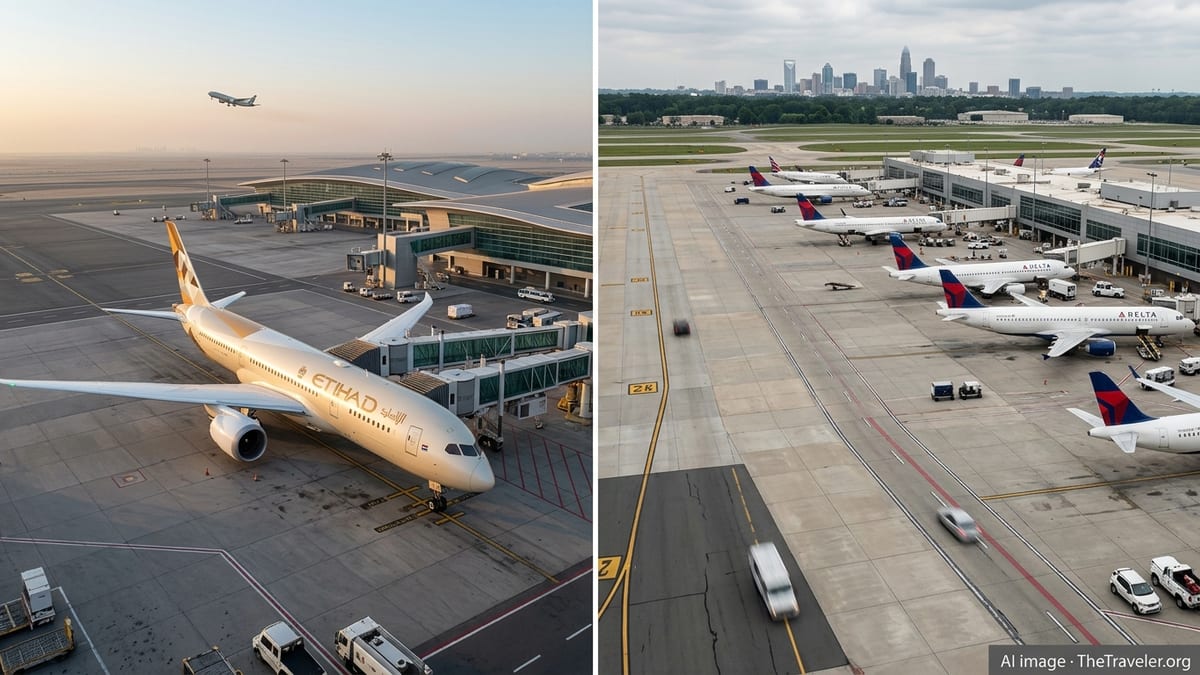
Earlier Launch Positions Charlotte as Etihad’s Next U.S. Gateway
Publicly available information shows that Etihad Airways plans to begin nonstop service between Abu Dhabi’s Zayed International Airport and Charlotte Douglas International Airport on March 20, 2026, several weeks earlier than its initially announced May start date. The adjustment accelerates the carrier’s entry into the Carolinas market and brings forward what is expected to be Charlotte’s longest regularly scheduled passenger flight.
Reports indicate that the route was first outlined with a May 4, 2026 launch, before later updates advanced the start into March to capture earlier demand and align more closely with the busy spring and summer travel period. The new operation will mark Etihad’s first service to North Carolina and establish Charlotte as the airline’s sixth destination in the United States, alongside existing gateways such as New York, Washington, Chicago, Boston and Atlanta.
Airport and industry coverage describes the addition as a milestone for Charlotte Douglas, which has sought deeper long-haul connectivity beyond its extensive domestic and transatlantic network. The Abu Dhabi link introduces a direct connection to the Gulf region, opening new options for travelers from the U.S. Southeast heading to the Middle East, South Asia and beyond.
Service Details: Long-Haul Link Between Two Growing Hubs
According to published schedules, the Abu Dhabi–Charlotte route will operate several times per week using a Boeing 787-9 Dreamliner, Etihad’s long-haul workhorse. The roughly 15-hour westbound sector will rank among the longest flights from Charlotte, reflecting growing demand for nonstop options that bypass traditional East Coast gateways.
The Dreamliner configuration is expected to offer a mix of business and economy cabins, in line with Etihad’s existing U.S. services. Business-class travelers can typically expect lie-flat seating and enhanced privacy for the ultra-long-haul journey, while economy cabins are designed to balance density with comfort for leisure and visiting-friends-and-relatives traffic.
Operating from Abu Dhabi’s modern Zayed International Airport, the route will leverage the UAE capital’s role as a transfer hub for connecting traffic bound for India, Pakistan, Southeast Asia and parts of Africa. For Charlotte, home to one of the country’s largest banking centers and a strong corporate base, the new service is expected to appeal to business travelers seeking one-stop access to a wide swath of emerging markets.
Travel industry analysis suggests that the schedule is being built to provide same-day onward connections over Abu Dhabi in both directions. This timing is intended to make the route competitive with existing one-stop itineraries via European or other Gulf hubs, narrowing total journey times and simplifying transfers.
Strategic Move in Etihad’s Wider U.S. and Global Network Plan
Etihad’s decision to add Charlotte follows a period of measured expansion in its North American network, including the introduction of Boston service in 2024 and ongoing adjustments to existing U.S. routes. Publicly available corporate updates describe a strategy focused on strengthening key long-haul markets while using the new terminal facilities in Abu Dhabi to improve the overall customer experience.
Industry commentary links the Charlotte launch to a broader growth plan in which Etihad targets increased profitability and a more diversified destination portfolio by 2030. The airline has highlighted North America as a core long-haul region, balancing traffic flows between Europe, Asia and the Middle East through Abu Dhabi.
By choosing Charlotte, Etihad is tapping into an airport that combines strong domestic feed with a growing roster of international services. Recent years have seen Charlotte add or restore links to major European capitals, and the arrival of a Gulf carrier is viewed in aviation analysis as a natural next step in the city’s evolution as a global gateway.
The move also positions Etihad competitively against other Middle Eastern airlines that have focused expansion on larger coastal hubs. A presence in the U.S. Southeast, beyond traditional entry points, gives the Abu Dhabi-based carrier direct access to a broad catchment that includes North Carolina, South Carolina, Georgia, Tennessee and parts of Virginia.
Benefits for Leisure, Business and Connecting Travelers
Travel market assessments suggest the new Abu Dhabi–Charlotte service will support a mix of segments, from corporate travelers to leisure visitors and students. Charlotte’s status as a financial hub and its growing technology and energy sectors generate steady business demand to the Gulf, India and wider Asia, markets where Abu Dhabi offers one-stop connections.
For leisure travelers, the route opens simpler access to the United Arab Emirates’ beaches, cultural sites and desert landscapes, as well as popular onward destinations such as the Maldives, Sri Lanka and Thailand via Abu Dhabi. Tour operators and online travel agencies are expected to package Charlotte-origin itineraries that take advantage of the new nonstop flight and Etihad’s broader network.
The service is also likely to appeal to diaspora communities across the Carolinas and neighboring states who regularly travel to South Asia and the Middle East. Eliminating an additional domestic or transatlantic connection can reduce total travel time, cut missed-connection risk and make longer journeys more manageable for families.
Observers note that Abu Dhabi’s role as a hub extends beyond tourism and business, with the city hosting major conferences, sporting events and cultural festivals. The Charlotte route is therefore expected to see traffic peaks coinciding with large-scale events in the UAE capital, supported by coordinated schedules and promotional fares.
Preclearance and Airport Facilities Aim to Streamline the Journey
A key feature of Etihad’s U.S. operations is the presence of a U.S. Customs and Border Protection preclearance facility at Zayed International Airport. Publicly available information indicates that U.S.-bound passengers on Etihad clear immigration and customs in Abu Dhabi prior to departure, arriving in the United States as domestic passengers.
For Charlotte-bound travelers, this arrangement is expected to reduce arrival processing times and simplify onward domestic connections. Aviation analysts point out that preclearance can be particularly attractive for business travelers and families, offering more predictable arrival experiences relative to traditional international processing.
Within Abu Dhabi, the new Terminal A has been designed to handle growing long-haul and connecting traffic, with expanded gate capacity, upgraded lounges and improved wayfinding. Coupled with Etihad’s long-haul product on the Boeing 787-9, the infrastructure is intended to support the carrier’s push to attract travelers from secondary U.S. markets such as Charlotte.
On the U.S. side, Charlotte Douglas has invested in concourse upgrades and airfield improvements to accommodate a rising number of international services. The arrival of Etihad is viewed in airport-focused reporting as a validation of those efforts, signalling that the North Carolina hub is increasingly on the radar of global full-service carriers planning future network growth.