

More news on this day
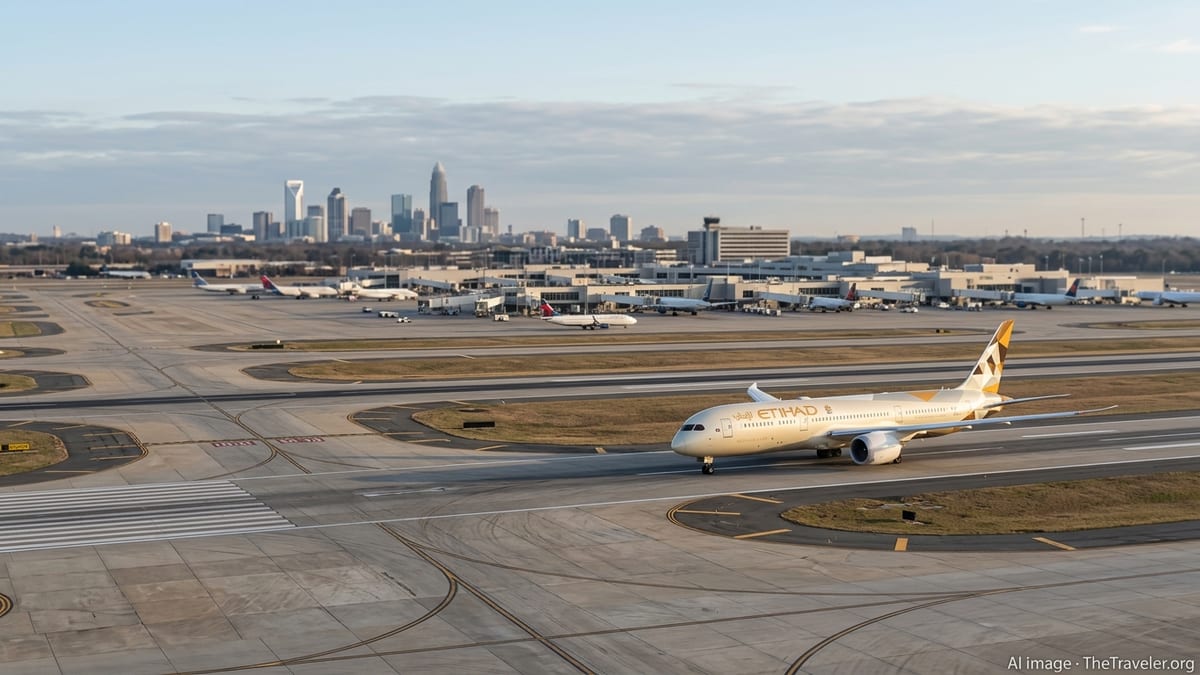
Etihad Airways is preparing to launch nonstop service between Abu Dhabi and Charlotte in March 2026, a new transcontinental link that pairs the United Arab Emirates’ flagship carrier with one of the fastest‑growing hubs in the southeastern United States and raises expectations for long‑haul comfort and connectivity.
Get the latest news straight to your inbox!
A Strategic New Bridge Between the UAE and the U.S. Southeast
The Abu Dhabi–Charlotte route is scheduled to begin on 20 March 2026, after Etihad moved the launch forward from an originally announced May start. The service will mark the first nonstop connection between Charlotte Douglas International Airport and the Middle East, positioning the North Carolina hub as a new gateway for travelers bound for the Gulf region and beyond.
Publicly available information from Etihad and Charlotte Douglas indicates that the airline plans four weekly flights, creating a roughly 15‑hour link between Zayed International Airport in Abu Dhabi and Charlotte. Industry coverage notes that Charlotte will become Etihad’s sixth destination in the United States, joining existing services to New York, Chicago, Washington and Boston, along with Atlanta, which is due to launch earlier in 2026.
The decision reflects both the rapid growth of Charlotte’s air traffic and the continued expansion of premium long‑haul offerings from Gulf carriers into secondary U.S. markets. Airport statistics for recent years show record passenger volumes, strengthening the case for a wide‑body connection that taps regional business demand and growing outbound leisure travel from the Carolinas.
For Abu Dhabi, the new route supports the emirate’s strategy of using Zayed International Airport as a global transfer hub. The link to Charlotte adds another spoke in Etihad’s North American network, feeding traffic into Asia, Africa and the Indian subcontinent while offering travelers from the southeastern United States an alternative to more congested northeastern gateways.
Dreamliner Comfort on One of Charlotte’s Longest Flights
Reports on the route configuration indicate that Etihad plans to operate the Abu Dhabi–Charlotte service with its Boeing 787‑9 Dreamliner, an aircraft type long associated with the carrier’s focus on cabin innovation. With a capacity of just over 300 seats in Etihad’s typical layout, the aircraft is designed to balance range, fuel efficiency and passenger comfort on ultra‑long sectors.
The 787‑9 is expected to feature Etihad’s latest generation of business class suites, offering lie‑flat beds, direct aisle access and enhanced privacy. Economy cabins on the type are configured with ergonomically designed seats and modern inflight entertainment systems, while premium economy style products on some long‑haul aircraft give travelers additional legroom and upgraded amenities without the cost of a full business class ticket.
Combined with the 787’s lower cabin altitude and improved humidity levels, the onboard product positions the Abu Dhabi–Charlotte flight as one of the more comfortable options for travelers making transcontinental journeys between the Middle East and the U.S. interior. Travel analysts note that the route will instantly rank among Charlotte’s longest nonstop services, underscoring the need for an aircraft focused on passenger well‑being over extended durations.
Etihad has also invested in modern digital services that support the onboard experience, from advance seat selection and special meals to enhanced Wi‑Fi on many long‑haul aircraft. For travelers connecting in Abu Dhabi, real‑time rebooking tools and updated gate information aim to smooth the transition between continents.
Luxury, Connectivity and the Abu Dhabi Transfer Experience
At the Abu Dhabi end of the route, the service will plug directly into Etihad’s growing network at Zayed International Airport, which recently consolidated the airline’s operations and introduced an upgraded U.S. preclearance facility. Publicly available airport data shows that travelers on many Etihad services to the United States can complete immigration and customs formalities before boarding, arriving in the country as domestic passengers and often reducing onward connection times.
Premium travelers on the Abu Dhabi–Charlotte flight are expected to benefit from Etihad’s flagship lounges, which feature quiet workspaces, dining areas and shower facilities. The combination of lounge access, priority security and boarding, and a high‑specification business class cabin reflects the airline’s longer‑term strategy of targeting high‑yield corporate and premium leisure traffic on key long‑haul routes.
For passengers beginning their journey in Charlotte, the new route offers one‑stop access to a wide array of destinations across the Middle East, South Asia and East Africa that previously required multiple connections. According to route analyses from aviation industry publications, Etihad’s network strengths include major Indian cities, routes to Pakistan and Sri Lanka, and links to key commercial centers across the Gulf Cooperation Council states.
This combination of premium ground services, onboard comfort and network breadth is central to the carrier’s effort to redefine expectations for passengers traveling between mid‑sized U.S. cities and global destinations. Rather than routing through crowded coastal hubs, travelers in the Carolinas will gain a direct bridge to Abu Dhabi’s curated transfer environment.
Economic Implications for Charlotte and the Wider Region
The arrival of Etihad Airways as Charlotte Douglas International Airport’s fourth long‑haul international carrier is seen in regional business coverage as a validation of the city’s emergence as a global commercial and financial center. The nonstop service to Abu Dhabi links North Carolina’s banking, energy and manufacturing sectors with investment and trade opportunities across the Gulf and wider Middle East.
Local economic analyses suggest that long‑haul international routes tend to generate outsized impacts by attracting foreign direct investment, supporting convention and tourism activity, and encouraging multinational firms to place regional offices in well‑connected cities. The Abu Dhabi–Charlotte route is expected to facilitate executive travel, technical visits and project work related to infrastructure, technology and higher education partnerships.
Tourism boards and travel industry observers also highlight the potential for inbound visitation from the UAE and connecting markets. Charlotte’s mix of professional sports, expanding cultural offerings and proximity to both the Blue Ridge Mountains and Carolina coastlines may appeal to travelers seeking multi‑center U.S. itineraries anchored in the Southeast.
As airlines re‑evaluate networks in the aftermath of recent global disruptions, the addition of a high‑profile Middle Eastern carrier at Charlotte further diversifies the airport’s portfolio and signals confidence in the city’s long‑term demand profile. The route’s performance will likely be closely watched by other international airlines considering expansion into the region.
What This Means for Long‑Haul Travelers in 2026
For travelers, the most immediate impact of Etihad’s new service will be greater choice and upgraded comfort on journeys that previously involved multiple stops or less modern aircraft. The combination of a next‑generation Dreamliner, enhanced cabin products and Abu Dhabi’s role as a well‑equipped transfer hub is expected to appeal to both business and leisure passengers.
Industry reports note that the flight timings associated with the Abu Dhabi–Charlotte schedule are designed to support onward connections across Asia and the Indian subcontinent, allowing travelers to make same‑day transfers in both directions. That structure can significantly reduce total journey times compared with itineraries that require passing through congested hubs in Europe or the northeastern United States.
The launch also underlines a broader trend in which Gulf carriers are building out networks that connect emerging U.S. business centers directly to global markets, shifting the focus away from a small number of traditional gateway cities. If successful, the Abu Dhabi–Charlotte route could accelerate interest in similar links that prioritize comfort, connectivity and premium service on long sectors.
As March 2026 approaches, booking data and schedule updates will indicate how quickly travelers adopt the new option. For now, the announcement alone signals an increasingly competitive era for transcontinental travel in which luxury, efficiency and network design play a central role in shaping passenger choice.