

More news on this day
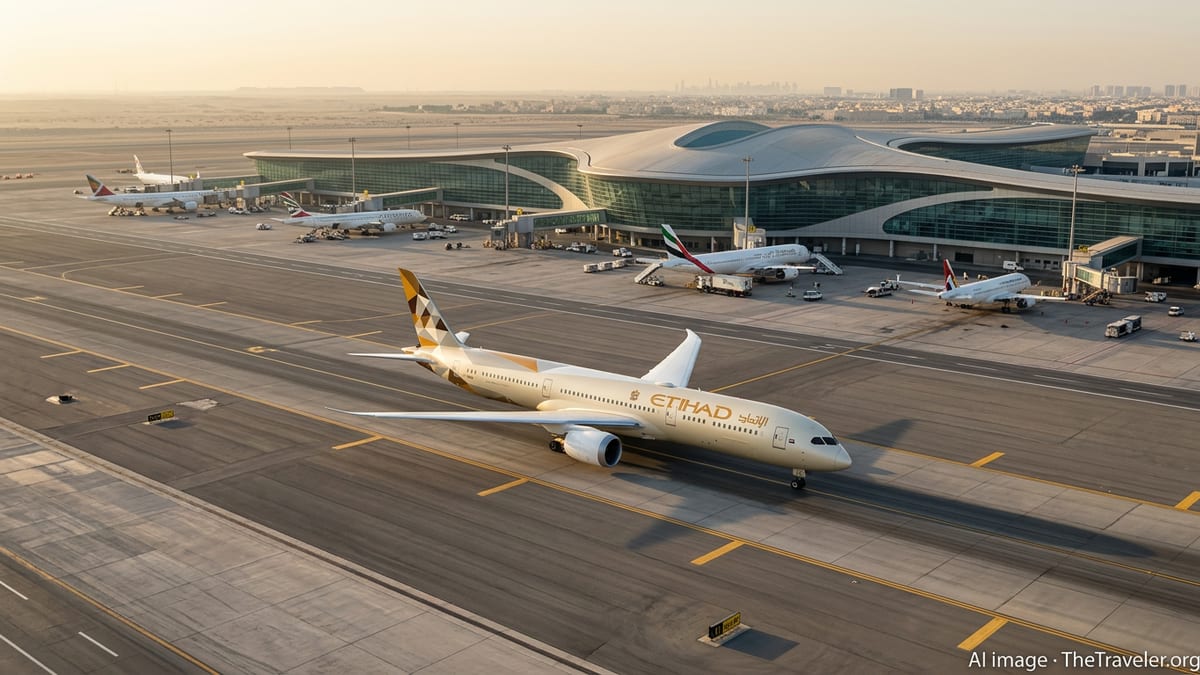
Etihad Airways is accelerating its transformation from regional carrier to global heavyweight, posting record results, signing major aircraft deals and expanding its network in ways that are reshaping Abu Dhabi’s role on the world aviation map.
Get the latest news straight to your inbox!
Record Profits and Passenger Growth Signal a New Era
Etihad Airways has entered 2026 on the back of its strongest financial and operational performance to date, underscoring how central the Abu Dhabi-based airline has become to the United Arab Emirates’ aviation ambitions. The carrier reported a record profit of around AED 2.6 billion in 2025, its best result in 22 years of operations and a sharp improvement on already solid earnings in 2024.
Passenger numbers have surged alongside profitability. Etihad carried 22.4 million travelers in 2025, up 21 percent year-on-year and the highest annual total in its history, with a load factor above 88 percent. That growth accounted for roughly half of all incremental passenger traffic in the UAE, reinforcing Abu Dhabi’s rise as a gateway competing directly with more established hubs across the Gulf.
Executives describe the results as a validation of a multi-year restructuring and growth strategy that shifted Etihad from a period of painful retrenchment to tightly managed expansion. Capacity increases have been focused on high-yield markets and strategic long-haul routes designed to funnel more visitors and trade flows through the UAE capital.
Fleet Expansion Anchored by Major Airbus and Boeing Orders
To sustain its trajectory, Etihad is investing heavily in next-generation aircraft. The airline recently confirmed a major order for 32 additional Airbus widebodies, including A350s and A330neos, scheduled for delivery from 2027. This follows an agreement for 28 more Boeing widebody jets earlier in 2025, bringing its new long-haul aircraft commitments for the year to about 60 across both manufacturers.
The expanded pipeline will give Etihad one of the most versatile twin-aisle fleets in the industry, with A380s, the A350 family, the A330neo and new Boeing types all playing specific roles on trunk and secondary long-haul routes. The airline is also rolling out Airbus A321LR jets, bringing lie-flat premium cabins and greater range to short and medium-haul markets that feed the Abu Dhabi hub.
July 2025 was the busiest month for aircraft deliveries in Etihad’s history, a milestone that signaled the pace at which the airline is gearing up for further growth. Management has set a target of carrying between 33 and 38 million passengers by 2030, roughly tripling volumes over the decade, supported by a modern, fuel-efficient fleet aligned with the UAE’s broader sustainability goals.
New Routes and Partnerships Extend Abu Dhabi’s Global Reach
Network expansion sits at the heart of Etihad’s strategy to position Abu Dhabi as a leading global connector between east and west. Over the past year the airline has unveiled a wave of new routes across Europe, Asia and Africa, targeting both fast-growing outbound markets and crucial inbound tourism and business flows.
In Europe, Etihad has upgraded services to cities such as Düsseldorf and is adding new destinations including Warsaw and Prague, enhancing its presence in Central and Eastern Europe. Across Asia and Africa, recent launches to cities such as Medan in Indonesia, Phnom Penh in Cambodia, Addis Ababa in Ethiopia and additional points in Southeast Asia have broadened its reach into high-growth regions.
Strategic partnerships are amplifying that expansion. A joint venture with Ethiopian Airlines, which sees both carriers launching flights between Addis Ababa and Abu Dhabi, opens up extensive two-way connectivity between East Africa and the Gulf, India and wider Asia. Similar collaborations with European and Asian partners extend Etihad’s virtual network far beyond the destinations it serves directly, while still channeling traffic through its Abu Dhabi hub.
The airline’s updated route map now spans more than 80 destinations, with further additions scheduled into 2026, including increased frequencies to the Caucasus, Central Asia and Eastern Europe. The strategy is to build a dense web of routes within a five-hour radius of Abu Dhabi, while maintaining strong links to North America, Europe and Northeast Asia.
Zayed International Airport and Abu Dhabi’s Hub Infrastructure
Abu Dhabi’s aviation ambitions are underpinned by rapid investment in ground infrastructure, centered on Zayed International Airport, previously known as Abu Dhabi International. The opening of the vast Terminal A in late 2023 provided a step change in capacity and passenger experience, offering a modern hub environment designed around Etihad’s connecting traffic model.
The terminal consolidates Etihad and most other carriers under one roof, with expanded check-in, security and immigration facilities as well as upgraded lounges and retail. For long-haul travelers, features such as an enhanced United States preclearance facility, now located in Terminal A, streamline journeys and give Etihad a competitive edge on key transatlantic routes.
Beyond the airport itself, Abu Dhabi is weaving aviation into a broader urban and transport plan. New surface links, including a planned tram line connecting Yas Island, Zayed International Airport and Etihad’s headquarters district, are intended to ease transfers and integrate the hub with emerging business and tourism zones. The airport’s proximity to major industrial and logistics areas such as Khalifa Economic Zones Abu Dhabi adds another dimension, supporting air cargo growth and supply-chain connectivity.
Supporting Abu Dhabi’s Tourism and Economic Vision 2030
Etihad’s resurgence is closely aligned with Abu Dhabi’s long-term economic diversification agenda, which seeks to reduce dependence on hydrocarbons by developing tourism, trade, logistics and financial services. The airline’s “Journey 2030” roadmap is explicitly framed around attracting millions of additional point-to-point visitors to the capital while also capturing a larger share of connecting traffic between Asia, Europe, Africa and the Americas.
Officials say the carrier is already a crucial contributor to non-oil gross domestic product, with its recent growth driving hotel occupancy, retail spending and investment tied to conferences, sporting events and cultural attractions. The Formula 1 Etihad Airways Abu Dhabi Grand Prix, hosted annually at Yas Marina Circuit, has become a showcase of the emirate’s aviation and tourism proposition, drawing global audiences and reinforcing brand visibility.
Industry analysts note that Abu Dhabi is emerging as a formidable rival to established Gulf hubs in Dubai and Doha, even as new competitors such as Riyadh invest heavily in their own aviation ecosystems. Etihad’s combination of disciplined growth, a modern fleet and a sharply focused hub strategy gives the airline, and the city it serves, a strong platform to capture the next wave of global air travel demand.
With record-breaking financials, aggressive fleet investment and a growing web of routes, Etihad Airways is not only transforming its own fortunes. It is helping to cement Abu Dhabi’s status as one of the world’s most dynamic aviation powerhouses, reshaping global air corridors in the process.