

More news on this day
Record-breaking queues of up to seven hours at Lisbon and severe delays at Geneva have exposed serious weaknesses in Europe’s new biometric border regime, with Portugal forced to suspend the system at its busiest airport and furious travellers accusing EU states of sleepwalking into avoidable chaos.
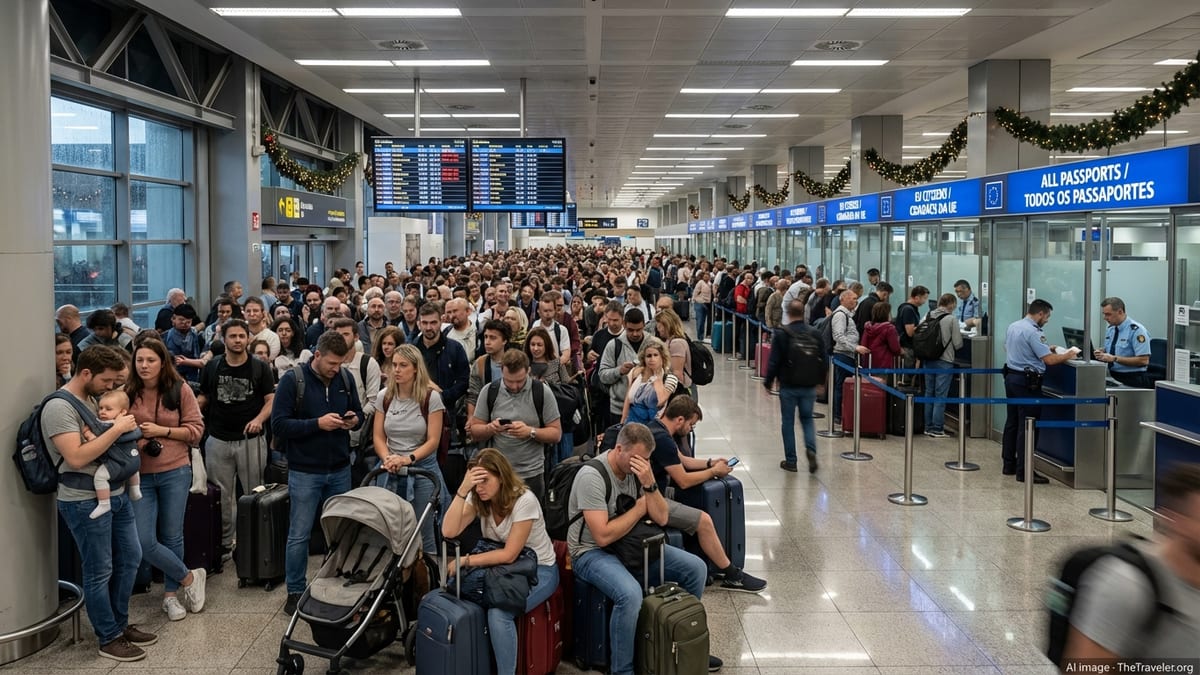
Lisbon Holiday Meltdown Forces Suspension of EU Biometric Checks
Lisbon’s Humberto Delgado Airport became the emblem of Europe’s border crisis over the 2025–2026 holiday period, as non EU passengers arriving from long haul destinations found themselves trapped in snaking lines that in some cases barely moved for hours. Reports from late December and early January described travellers waiting more than seven hours to clear passport control, missing onward connections and in some cases spending the night in the terminal.
The trigger was the aggressive roll out of the European Union’s new Entry Exit System, or EES, which replaces passport stamping with biometric registration for most non EU visitors. Introduced at Lisbon in October and expanded in December, the system requires each new traveller to have fingerprints and a facial image captured and verified against central databases. At peak times the combination of high passenger volumes, limited space in the arrivals hall and technical glitches in the kiosks caused processing times to balloon.
Confronted with mounting anger, Portugal’s government moved in early January to suspend EES at Lisbon for three months and revert to manual passport stamping for non EU arrivals. Officials acknowledged that the infrastructure at the airport, already operating far beyond its design capacity, could not cope with the new procedures during the busiest travel weeks of the year. Additional police officers and even military status GNR personnel were drafted in to stabilise operations and restore basic passenger flow.
Authorities insist the pause is temporary and designed to allow more equipment to be installed, staff to be trained and new queue management plans to be put in place. But the decision to halt a flagship EU project, just months after launch, has raised questions in Brussels about whether member states were adequately prepared for the shift to biometric controls.
Geneva’s Alpine Gateway Struggles Under New EU Rules
While Lisbon drew the most dramatic headlines, Geneva Airport also emerged as a trouble spot in the early phase of EES. The Swiss hub, a key entry point for winter sports travellers heading to Alpine resorts across France, Italy and Switzerland, saw waiting times at passport control stretch to four hours for some non EU passengers as the system bedded in.
At Geneva, border police reported that average processing times rose by around 70 percent once biometric registration became mandatory for a share of arrivals. Even though only a minority of passengers were being enrolled during the initial rollout, banks of kiosks quickly filled with confused tourists struggling to understand on screen instructions and complete fingerprint scans correctly. With limited staff available to assist and reroute flows, queues built rapidly through the arrival concourse.
In response, Swiss and EU authorities quietly scaled back use of the biometric checks at Geneva on several peak days, temporarily disabling parts of the system to clear accumulated backlogs. Local tourism businesses, heavily reliant on weekend city and ski traffic, warned that recurring scenes of gridlock risk undermining the region’s reputation for smooth, efficient travel just as competition from non European destinations intensifies.
Officials at Geneva now talk about a phased and flexible deployment, with the ability to switch off or reduce EES during the busiest banks of flights if congestion reaches critical levels. Yet industry bodies caution that without major investment in staff and infrastructure before the next peak season, the airport could again face damaging bottlenecks.
Spain’s Capacity Gap and a Wider Schengen Shock
Behind the visible queues in Portugal and Switzerland, airline and airport groups point to a deeper structural problem: chronic understaffing and uneven preparation at key Schengen border points, particularly in Spain, which has some of Europe’s heaviest flows of non EU holiday traffic. Carriers serving Spanish hubs say that for months they have warned of a looming crunch as EES layered complex new procedures on top of already stretched passport control operations.
Spanish authorities began introducing biometric checks at major airports from October, focusing initially on a portion of arrivals to test equipment and procedures. But travel industry associations report that staffing levels at many control points have not kept pace with the extra time needed to capture and verify biometric data. On busy days, flights arriving from long haul markets can land almost simultaneously, funnelling hundreds of passengers into narrow corridors with too few staffed booths.
When problems ripple through the system, the impact is felt well beyond Spanish soil. Travellers connecting via Madrid or Barcelona to other Schengen destinations who experience delays during initial biometric enrolment may arrive late into onward EU hubs such as Lisbon or Geneva, compressing already tight arrival waves and contributing to fresh congestion there. Airlines say this cascading effect has been especially acute during the winter peak, when bad weather and air traffic control restrictions leave little slack in schedules.
Industry leaders argue that Spain’s slow ramp up of border staffing has effectively exported some of the pain of EES implementation to partner states. They are calling on Madrid and other capitals to treat border control as critical transport infrastructure, warning that inconsistent resourcing risks undermining confidence in the entire Schengen travel area.
Travellers Furious as Missed Flights and Safety Fears Mount
For passengers caught in the queues, the institutional debates in Brussels and national capitals offer little comfort. Social media feeds over the holiday period were filled with images of crowds pressed shoulder to shoulder in sweltering corridors at Lisbon, families with small children perched on suitcases and elderly travellers forced to stand for hours with no clear information on when they would be processed.
Some passengers reported missing long planned cruises and ski trips after waiting in line at border control only to see their connecting flights depart. Others complained of inadequate ventilation and a lack of seating, food and water in the arrivals hall. Airport staff did distribute refreshments during the worst peaks, but union representatives warned that constant pressure to move the line faster risked encouraging shortcuts in checks that could undermine security.
Consumer groups say they have been inundated with complaints, with travellers demanding clearer guidance on their rights to rebooking and compensation when missed connections are caused by border delays rather than airline operational problems. Legal experts note that the question of liability in such cases remains murky, given that EES is an EU mandated system implemented by national authorities rather than carriers.
Travel advisors are already urging customers planning trips for Easter and summer 2026 to allow significantly longer connection times at Schengen hubs, particularly when first entering the zone from non EU countries. Some tour operators are beginning to adjust itineraries and flight choices to avoid the most congested entry points, even if that means slightly longer overall journey times.
Brussels Under Pressure to Rethink the Rollout
The scenes at Lisbon and Geneva have sharpened criticism of how the Entry Exit System has been introduced across Europe. The European Commission maintains that the new regime is essential to tighten external border controls, improve the enforcement of short stay rules and modernise a patchwork of manual processes. Officials point out that once a traveller has been registered, subsequent crossings should be faster and more reliable.
However, airport associations and airlines argue that the initial registration itself was always likely to create a bottleneck and accuse EU institutions and national governments of underestimating the scale of the challenge. They say problems at Lisbon and Geneva are not isolated incidents but symptoms of a wider failure to align technology, staffing and physical space with the ambitions of the new system.
In response to mounting pressure from industry and member states, Brussels has already accepted that full enforcement of EES will need to be phased in more slowly than first planned. Flexibility clauses allow border authorities to suspend or limit biometric checks temporarily when queues become unmanageable, and some countries are lobbying for these safeguards to be used more consistently during peak travel periods.
For now, the EU insists that it remains committed to EES and that the disruptions of the past few months should be seen as a painful but temporary adjustment. But with summer 2026 looming and traveller patience wearing thin, the experience at Lisbon and Geneva has become a test case of whether Europe can deliver secure borders without sacrificing the seamless travel that has long been one of its greatest assets.