

More news on this day
UK travellers heading to Europe in 2026 will face a transformed border experience, as the European Union’s biometric Entry/Exit System is now fully operational across Schengen external borders.
Get the latest news straight to your inbox!
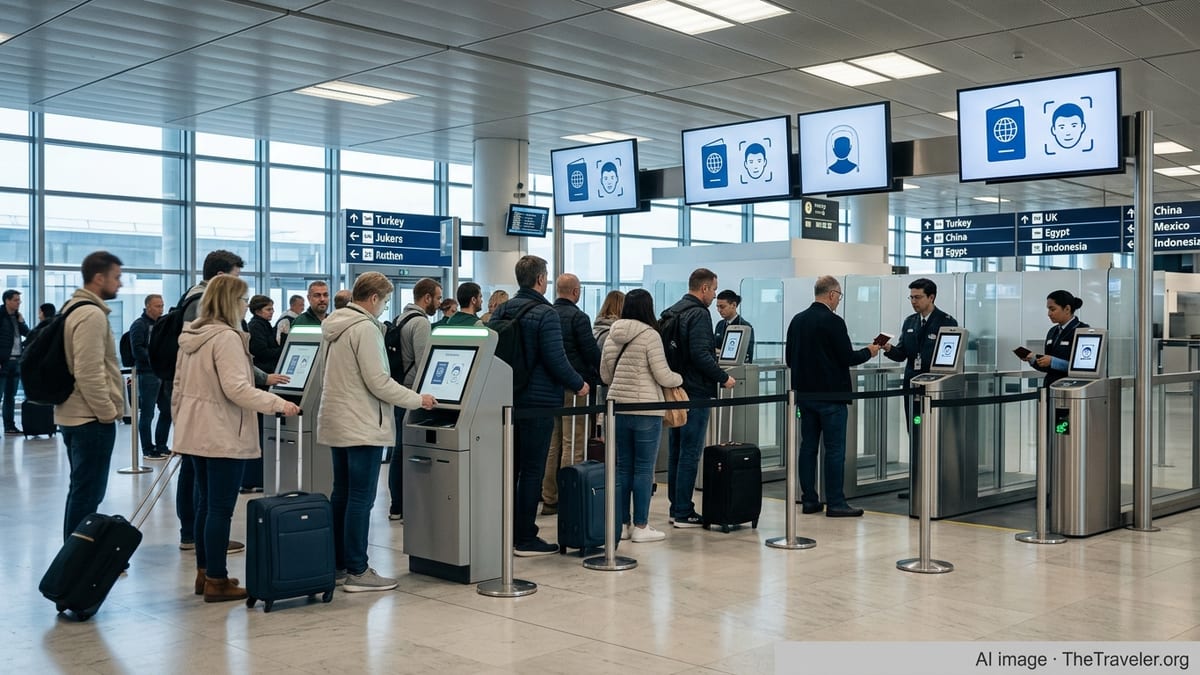
What the EU’s Entry/Exit System Actually Does
As of 10 April 2026, the EU’s Entry/Exit System, widely known as EES, is in full use at all external border crossing points of participating countries. Publicly available EU information explains that the system records the time and place of each entry and exit for non EU and non Schengen nationals, along with key passport details and biometric data. This includes a facial image and, in many cases, fingerprints.
The EES replaces the old practice of manually stamping passports when travellers enter or leave the Schengen area for a short stay. Instead of ink stamps, entries and exits are stored electronically in a central database. The database is designed to show immediately whether someone has exceeded the standard 90 days in any rolling 180 day period allowed for most visa exempt visitors.
For UK citizens, who are now treated as third country nationals for Schengen border purposes, this means every arrival and departure at an external Schengen frontier is logged digitally. The move is intended to tighten control of overstays, improve security checks and speed up future crossings for travellers whose details are already on file.
The system covers 29 European countries that apply Schengen rules in full or in part, including major UK holiday destinations such as France, Spain, Italy, Greece and Portugal, as well as non EU members Iceland, Norway, Switzerland and Liechtenstein.
Biometric Checks: What UK Travellers Will Experience
For most UK visitors, the most noticeable change will be the requirement to provide biometrics on the first trip to a Schengen country after EES implementation. According to EU institutional briefings and airline guidance, first time registration involves scanning the passport, capturing a facial image at a kiosk or border booth, and in many cases providing four fingerprints.
This initial registration happens at the first external Schengen border reached on a journey, whether that is a ferry port in northern France, the passport control zone at a Spanish or Greek airport, or the juxtaposed controls at Eurostar terminals in London, Paris or Brussels. Once recorded, biometric data are expected to remain valid for multiple years, so repeat visitors should face shorter processing times on later trips.
Reports from the phased rollout since October 2025 indicate that extra time may be needed during the early months, particularly at busy holiday peaks. Travel industry updates have warned of potential queues as passengers complete self service steps, answer short entry questions on screens and wait for biometric capture. Families with children and travellers who are unfamiliar with automated gates may take longer to process.
However, the long term goal is more predictable and efficient checks. With biometric and travel data already stored, border officers can verify identity faster and focus on targeted questions. Over time, many frequent UK visitors are expected to complete most steps at kiosks before a brief final inspection by a human guard.
Border Requirements, Passports and Overstay Rules
The launch of EES does not change the fundamental entry rules for UK tourists and business visitors, but it makes enforcement far more systematic. Britons can still spend up to 90 days in any 180 day period within the Schengen area without a visa, provided they are visiting for tourism, certain business activities or short term study.
What does change is how those 90 days are counted. Instead of relying on manual passport stamps, the EES automatically tracks the length of each stay. Travellers who move between multiple Schengen states on one trip will see all those movements treated as a single continuous stay, ending only when they leave the external border area entirely, for example when returning to the UK, Ireland or another non Schengen destination.
Airlines and border agencies have been advising passengers to pay closer attention to the rolling 180 day rule, since the new system makes unintentional overstays easier to detect. Overstaying can lead to fines, refusal of entry on subsequent trips or entry bans. UK travellers who work remotely from Europe for extended periods or make frequent weekend visits are being urged by travel advisers to keep their own records aligned with EES counts.
Passport validity rules also remain critical. Most Schengen countries expect a UK passport to be valid for at least three months beyond the planned departure date, and to be less than 10 years old on the date of entry. With the end of manual stamps, border staff and airline check in systems rely heavily on passport data and the EES record to confirm eligibility before boarding.
New Tools and Procedures, Including the Travel to Europe App
To support the rollout, the EU has introduced the Travel to Europe mobile app, promoted in recent European media coverage as a way for non EU travellers to pre register some details before arrival. The app does not replace an in person check at the border, but allows users to scan their passport, upload a compliant facial photograph and answer basic entry questions up to 72 hours in advance.
For UK travellers who are comfortable with digital tools, pre registering via the app is intended to shorten the time spent at kiosks or counters, particularly at airports with heavy holiday traffic. Early commentary from travel operators suggests the app may be especially useful for families and for those changing planes within the Schengen area, where transit time is tight.
On the ground, more airports, seaports and rail hubs have now deployed automated kiosks, e gates and separate lanes for EES registration. Passengers are often directed first to a self service machine to scan the passport and complete standard questions, then to a staffed position where biometrics are captured and the final decision on entry is made.
Because procedures can differ between countries and individual border points, travellers are being advised by airlines, ferry firms and rail operators to check pre departure emails and airport signage carefully. Some ports may require all third country nationals to use kiosks, while others still handle certain categories, such as families with young children, entirely at staffed booths.
Looking Ahead: ETIAS and Planning Trips Beyond 2026
Alongside EES, UK travellers are preparing for another major change, the European Travel Information and Authorisation System, known as ETIAS. According to the official ETIAS information portal and recent European press reporting, ETIAS is now expected to start operations in the final quarter of 2026, with a grace period before the authorisation becomes mandatory.
ETIAS will operate in a similar way to systems such as the United States ESTA or the UK’s own Electronic Travel Authorisation. Most visa exempt travellers, including UK citizens, will need to apply online before their trip, pay a modest fee for adults and receive an approval electronically linked to their passport. Border systems will then check both the ETIAS approval and the EES record when passengers arrive.
For now, however, the key immediate change for UK visitors in 2026 is the full activation of the Entry/Exit System itself. The combination of biometric checks, automated logging of entries and exits, and new digital tools marks a significant shift from the paper stamp era that many travellers were used to before Brexit.
With summer travel plans under way, industry bodies and consumer groups are urging UK holidaymakers to allow more time at ports and airports, ensure their passports meet Schengen validity rules and familiarise themselves with the 90 day limit. While the early months of EES may involve longer queues at some crossings, specialists in border technology expect the system to deliver smoother, more predictable journeys once travellers and staff have adapted.