

More news on this day
Europe’s plans to expand a permanent fleet of amphibious firefighting aircraft have received a significant funding boost, strengthening aerial wildfire defenses as the continent braces for longer, more intense fire seasons.
Get the latest news straight to your inbox!
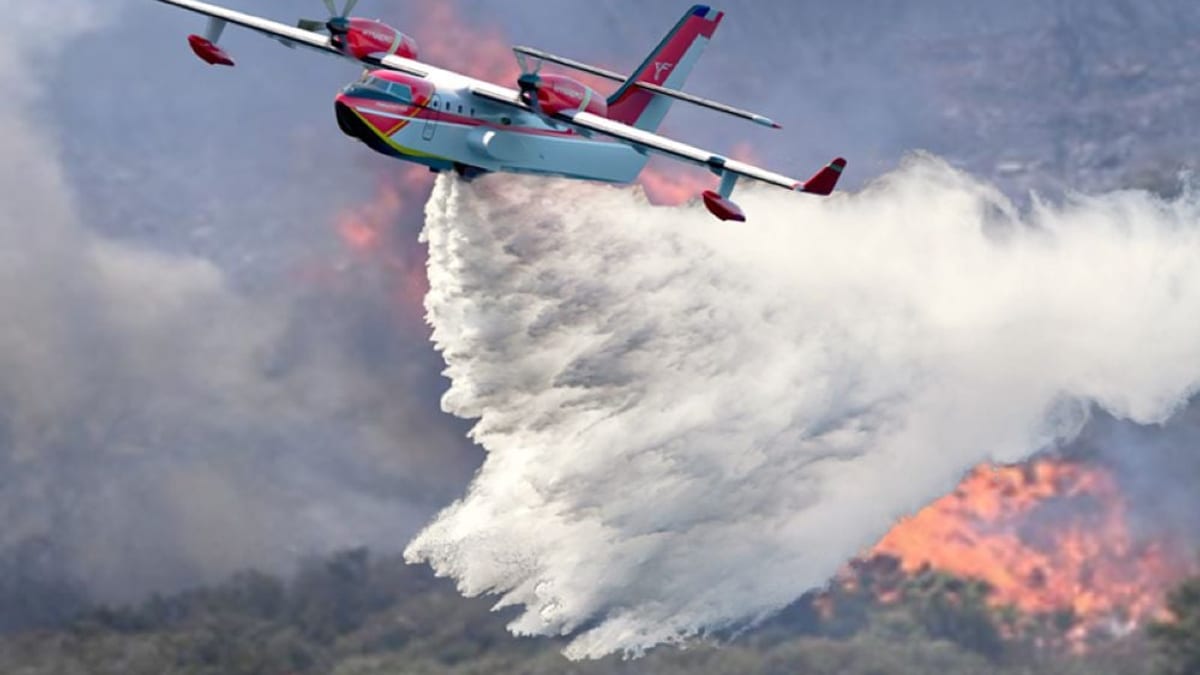
Image by AWN RSS by content source
New Money for Amphibious “Scooper” Aircraft
Publicly available information from European Union institutions shows that the bloc has committed around 600 million euros to procure a new generation of amphibious water‑bombing planes for its rescEU reserve, a strategic pool of shared civil protection assets. The investment is focused on medium amphibious aircraft capable of skimming lakes, rivers and coastal waters to refill their tanks in seconds, allowing rapid, repeated drops on fast‑moving wildfires.
The funding is tied to contracts signed with Canadian manufacturers to deliver 12 new amphibious aircraft that will form a core permanent fleet. These platforms build on the Canadair CL‑215 and CL‑415 “Super Scooper” lineage and are now marketed in Europe as the DHC‑515 Firefighter, featuring modern avionics and improved corrosion protection for repeated salt‑water operations.
EU documents and recent parliamentary questions indicate that the aircraft will be stationed across a group of member states considered particularly exposed to seasonal wildfire risk. The aim is to ensure that when national capacities are overwhelmed, additional amphibious bombers can be deployed quickly under the EU Civil Protection Mechanism, without the delays and uncertainty of ad‑hoc leasing.
The decision to channel substantial funds into amphibious designs reflects their specific value in Europe’s geography. In rugged Mediterranean terrain where ground access is limited, scooper aircraft can shuttle between sea and fire line in tight cycles, delivering thousands of liters of water or foam with each pass.
RescEU Fleet Takes Shape Across the Mediterranean
The rescEU aerial fleet is gradually taking physical form along the Mediterranean arc, where some of the continent’s most destructive wildfires have occurred in recent years. According to published coverage by European civil protection bodies, the 12 new amphibious aircraft will be distributed among at least six host countries that include Portugal, Spain, Greece, Croatia, Italy and France.
Individual national programs are dovetailing with the EU‑level investment. Spain has announced plans to add seven DHC‑515 amphibious aircraft to its own fleet, with part of that order supported through the European Civil Protection Mechanism. Similar arrangements are in place or under negotiation in Portugal and other states, allowing the EU contribution to leverage national budgets into a larger regional capacity.
Recent reporting from wildfire‑prone countries underscores how these assets are expected to operate beyond national borders. During peak summer months, amphibious bombers based in one member state can be redeployed to neighboring territories when fires surge, creating a mobile “air bridge” of scooper aircraft over hotspots from the Iberian Peninsula to the Balkans.
Data released by the European Commission on recent fire seasons shows that such pooled assets are increasingly requested when long heatwaves and droughts push multiple countries close to their limits at the same time. The new funding is intended to ensure that those mutual‑aid missions are backed by aircraft owned or co‑financed at EU level, rather than relying predominantly on short‑term leases.
National Fleets Modernize Around Next‑Generation Amphibians
Beyond the EU‑owned reserve, several European governments are channeling fresh money into mixed fleets that combine amphibious bombers with land‑based air tankers and helicopters. In Greece, for example, recent aviation news reports describe a 155 million euro package that includes amphibious “Fire Boss” aircraft derived from the Air Tractor AT‑802 platform, financed partly through EU recovery funds and loans from the European Investment Bank.
Portugal has confirmed the purchase of DHC‑515 Firefighter aircraft under the same European civil protection framework, positioning them alongside helicopters and contracted land‑based tankers. Public information from Portugal’s interior ministry highlights the ability of the new amphibious aircraft to scoop from the Atlantic and inland reservoirs, a capability seen as critical in remote forested regions.
In France, specialist aviation publications report that the long‑serving Canadair CL‑415 fleet operated by civil security services is set to be gradually reinforced by newly procured DHC‑515s toward the end of this decade. The updated models are designed to improve payload, range and maintainability while retaining the familiar flight profiles and tactics used by French crews for decades.
Across the region, these investments share a common objective: reduce reliance on aging aircraft and seasonal leases, while ensuring that amphibious bombers remain a central pillar of national and cross‑border firefighting plans as climate trends point to more frequent extreme fire weather.
Bridging the Gap Until the Full Fleet Arrives
Despite the funding boost, European institutions acknowledge that there is a multi‑year gap between financial commitments and the full availability of newly built amphibious aircraft. Official decisions adopted by the Council of the European Union extend transitional measures that allow member states to receive EU co‑financing for leasing firefighting planes and helicopters until at least the end of 2027.
This bridge financing is intended to keep aerial capacity at workable levels while manufacturers ramp up production of the new amphibious fleet. Market assessments commissioned by the European Commission indicate that supply constraints and certification timelines make it difficult to deliver large numbers of specialized scooper aircraft in the very short term.
In practice, this means Europe is likely to operate a hybrid model for several fire seasons: a growing core of EU‑financed amphibious aircraft, complemented by leased platforms and national fleets composed of both modern and legacy types. Civil protection planners describe this as an incremental transition rather than a sudden overhaul.
As part of that transition, the Emergency Response Coordination Centre in Brussels continues to pre‑position seasonal aircraft across high‑risk regions each summer. Public data from recent years shows that in 2025 the EU coordinated more than twenty fixed‑wing firefighting planes and several helicopters for potential deployment, a mix that will increasingly tilt toward amphibious designs as the rescEU fleet arrives.
Climate Pressure Keeps Demand on the Rise
Scientific assessments and EU climate risk reports point to hotter, drier summers and longer fire seasons across southern and central Europe. Years marked by record‑breaking temperatures and severe drought have already produced megafires in countries from Portugal to Greece, straining national emergency services and exposing capacity gaps in aerial response.
Against this backdrop, the funding boost for amphibious firefighting aircraft is framed in policy documents as an adaptation measure rather than a one‑off emergency purchase. The ability of scooper aircraft to reload quickly from coastal waters or lakes allows them to deliver sustained attack on fast‑spreading crown fires, buying time for ground crews to establish control lines.
Analysts note that the European approach is also shaped by the continent’s dense population and tourism economy. Rapid suppression of wildfires near coastal resorts, historical towns and critical infrastructure has become a core safety and economic priority, and amphibious aircraft are seen as a cost‑effective way to protect those assets.
While the new investments will not eliminate wildfire risk, they mark a significant scaling‑up of Europe’s aerial toolkit. Over the next few years, travelers across Mediterranean destinations are likely to see more bright‑yellow amphibious bombers skimming the waves, visible symbols of a continent adapting its firefighting strategy to a changing climate.