

More news on this day
The European Union has moved to suspend visa-free travel for Georgian diplomats, service passport holders and senior officials, citing a pattern of democratic backsliding, mounting human rights violations and a brutal crackdown on mass protests that has shaken the South Caucasus nation since late 2024.
A Targeted Freeze on Official Mobility
The decision, announced in Brussels on March 6, immediately halts visa-free entry to the Schengen area for holders of Georgian diplomatic, service and official passports for an initial period of 12 months. Those traveling on official business must now apply for Schengen visas, facing the same scrutiny as other third-country nationals.
Under the revised EU visa suspension mechanism, the measure can be extended to a total of 24 months if the bloc judges that the situation in Georgia has not improved. European officials stressed that the step is narrowly tailored to those representing the state, rather than ordinary Georgian citizens, who still retain visa-free access for short stays.
EU foreign policy chief Kaja Kallas framed the move as a direct response to the conduct of the ruling Georgian Dream party, arguing that a government accused of attacking its own people, silencing journalists and eroding basic freedoms cannot continue to enjoy privileged access to the union’s borderless travel zone.
Alongside the suspension, Brussels has issued detailed guidance to member state consulates and border guards, urging heightened checks on all Georgian nationals crossing the EU’s external frontiers, with particular attention to travelers linked to state institutions and security agencies.
Crackdown on Protests Fuels European Backlash
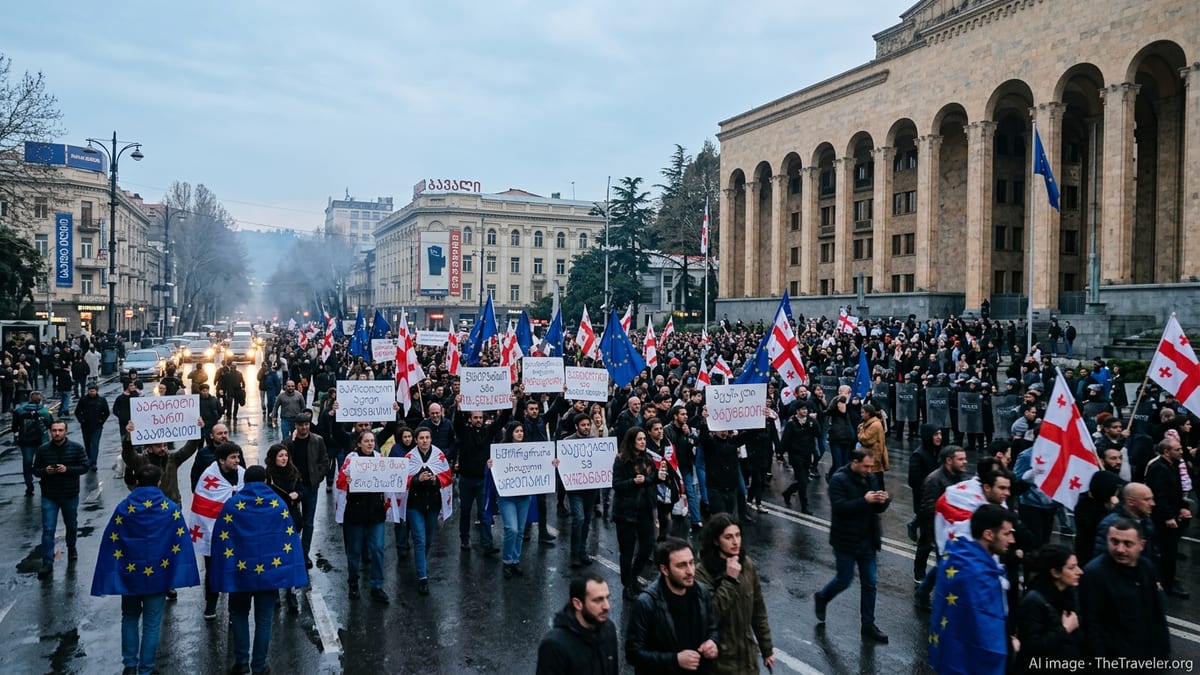
The travel measure is the culmination of more than a year of escalating concern in European capitals over events in Georgia. Since October 2024, when Georgian Dream claimed victory in parliamentary elections that opposition parties denounced as rigged, the country has been shaken by large, often youth-led demonstrations demanding a clear path toward EU membership.
Those protests, centered on Tbilisi but echoed in regional cities, have been met with heavy-handed responses from security forces. Rights groups and independent media have documented widespread use of tear gas, rubber bullets and water cannons, as well as mass detentions, beatings in custody and intimidation campaigns against activists, opposition politicians and critical journalists.
European institutions repeatedly warned that the crackdown, combined with new restrictive laws on public assembly and media, placed Georgia in breach of its commitments made under the original visa liberalization road map. In several resolutions, members of the European Parliament called for the activation of the visa suspension mechanism if the authorities failed to reverse course.
Diplomats say the latest decision reflects a consensus that the Georgian leadership has not only ignored those warnings but has deepened its confrontational stance, abruptly halting EU accession talks and reviving rhetoric that paints European partners as hostile to Georgian sovereignty.
Implications for EU–Georgia Relations and Travelers
For now, the impact on leisure and business travelers from Georgia remains indirect. Holders of ordinary biometric passports can still enter the Schengen area without a visa for short stays, although they may experience longer checks at border crossings as member states apply the European Commission’s new screening guidance more strictly.
The signal to Tbilisi, however, is stark. Visa liberalization has long been one of the most tangible benefits of the country’s pro-European orientation, prized by students, entrepreneurs and the large Georgian diaspora across the continent. By selectively targeting the political class and state representatives, the EU is attempting to separate its support for Georgian society from its growing distrust of the current government.
European officials emphasize that cooperation on trade, connectivity and people-to-people exchanges can continue, but warn that deeper integration, including any reopening of accession talks, will depend on clear progress on rule of law, judicial independence and protection of fundamental rights.
Travel industry observers say the move could have ripple effects on official delegations, cultural exchanges and tourism promotion events, as Georgian agencies now face additional bureaucracy and potential refusals for trips that previously required only a passport and plane ticket.
Georgian Government Defiant as Opposition Hails EU Pressure
The Georgian government has reacted with defiance, accusing Brussels of politicizing the visa issue and unfairly punishing a country it has long described as a committed partner. Officials in Tbilisi argue that law enforcement responses to recent protests were proportionate and necessary to maintain public order, dismissing European criticisms as biased and influenced by opposition narratives.
Prime Ministerial and ruling party statements in recent months have portrayed the EU’s stance as an attempt to coerce Georgia on sensitive domestic issues, including controversial legislation affecting non-governmental organizations and media outlets. Senior figures have suggested that the country will not accept what they describe as external interference in its internal affairs.
Opposition parties and civil society leaders have welcomed the suspension as a long overdue wake-up call. While many regret that relations with Brussels have sunk to this low point, they argue that targeted pressure on elites is one of the few remaining tools the EU has to deter further repression and keep the prospect of a European future alive for ordinary Georgians.
In Tbilisi, protesters who have filled Rustaveli Avenue for months holding EU flags alongside Georgian ones say the travel decision confirms their fears that the ruling party is steering the country away from Europe and closer to Moscow, even as public opinion polls consistently show strong majority support for EU integration.
What Comes Next for Europe-Bound Travel From Georgia
The suspension, which took effect on March 6, will be reviewed regularly over the coming year. European officials say they will look for concrete steps from the Georgian authorities, including an end to violence against demonstrators, the release of those detained on politically motivated charges and the repeal or revision of laws deemed incompatible with international human rights standards.
If such changes materialize, the Commission could recommend lifting the restrictions on official travel and easing the enhanced checks at borders. Conversely, a further deterioration in democratic norms, or renewed surges in irregular migration or security concerns, could prompt an extension of the measure or additional, more far-reaching steps.
For travelers planning trips between Georgia and the EU, the immediate advice is to pay close attention to documentation requirements and allow extra time for border procedures. Travel organizers and airlines are expected to update guidance for official delegations, as previously visa-free trips by government representatives will now require advance planning and consular appointments.
As the standoff unfolds, the skies and border crossings between Georgia and the European Union are becoming a visible barometer of the broader political rift, turning the once-celebrated freedom of movement into a frontline of a deepening dispute over rights, democracy and the country’s geopolitical direction.