

More news on this day
Italy is tightening the rules of mass tourism as Rome, Venice and other destinations roll out new fees, caps and conduct regulations aimed at protecting fragile landmarks from overwhelming visitor numbers.
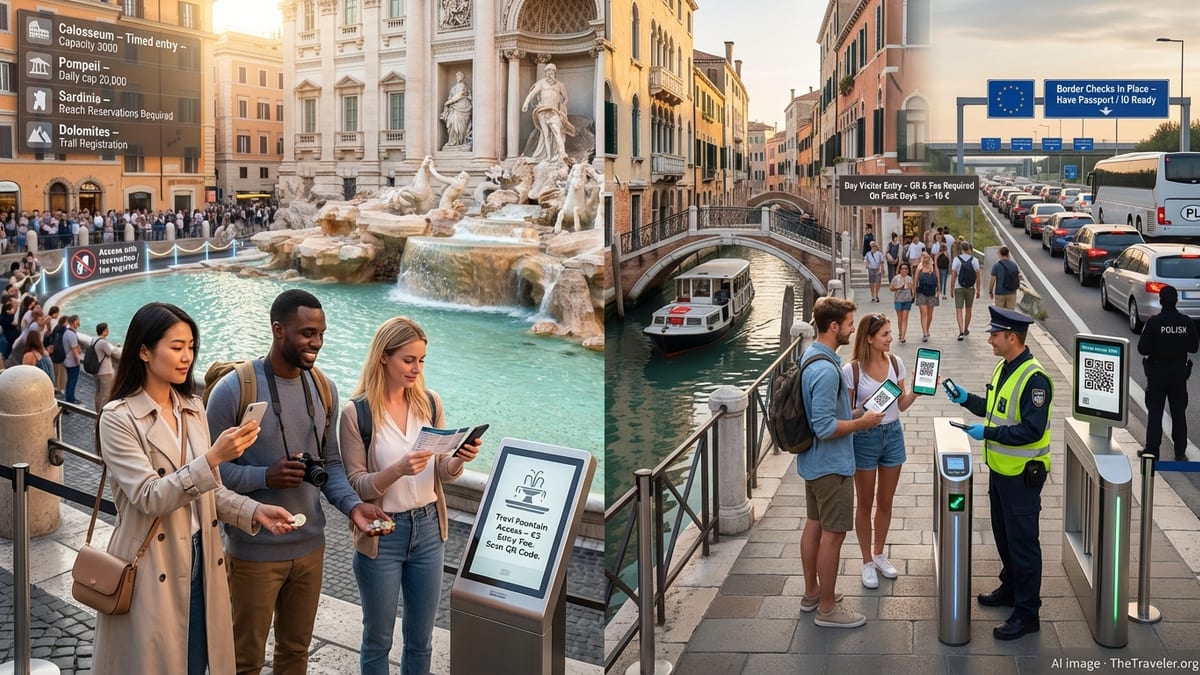
The latest moves, including a new access levy at Rome’s Trevi Fountain and an expanded entry fee regime for Venice, come as Poland joins a growing list of European countries reintroducing internal border checks and other travel frictions. Together, these developments signal a new phase for travel in Europe where tourists face more barriers, but also a more deliberate push toward sustainability and preservation.
More News
- TSA Rolls Out $45 ConfirmID Fee for Travelers Without REAL ID at Security
- Flying Blue Launches February 25% Promo Rewards on Transatlantic and Regional Routes
- United Fast-Tracks Starlink Wi‑Fi Across Fleet, Free for MileagePlus Members
Italy’s New Tourist Levy: From Trevi Fountain To National Hotspots
Italy has become a global laboratory for tourism regulation, responding to record-breaking visitor numbers with an unprecedented mix of local levies and access rules. The newest symbol of this shift is Rome’s Trevi Fountain, where from 2 February 2026 visitors must now pay a modest fee to descend to the basin area and get close enough to toss a coin. The charge applies for most of the daytime and evening hours, and authorities say the revenue will be earmarked for maintenance and security at the fountain and other heritage sites in the capital.
Officials in Rome argue that the fee, just a few euros per person, is less about raising money than restoring order at an attraction that drew around 10 million visitors in 2025, with up to 70,000 people passing through the cramped piazza on peak days. Viral social media posts and influencer-led photo shoots have exacerbated crowding around the basin, leading to fights over vantage points and repeated incidents of tourists climbing into the water or staging stunts on the historic stonework.
The Trevi measure follows earlier steps to charge admission at the Pantheon and to enforce bans on eating on monument steps, walking shirtless near major sites and attaching “love locks” to bridges. Across Italy, the same logic is being applied from Pompeii to Sardinia’s beaches and the Dolomites: tourists are still welcome, but access will increasingly come with a price tag and stricter rules, especially in the most sensitive areas.
Venice Expands Its Access Fee As Visitor Numbers Surge
Nowhere embodies the tension between mass tourism and local livability more acutely than Venice. After finally launching a day-tripper entry fee in 2024 on a trial basis, the city extended the program to 54 peak days in 2025 and has confirmed an even broader roll out for 2026, with around 60 chargeable days concentrated between April and July. Day visitors arriving during the busiest hours must register in advance, obtain a QR code and pay an access contribution that is lower with early booking and higher for last-minute planners.
The fee, typically 5 euros when paid several days ahead and 10 euros for late bookings, applies to those who enter the historic center for a single day without staying overnight. Hotel guests are exempt because they already pay a separate lodging tax, a reminder that Venice is layering its tools to both generate funds and better track visitor flows. Those who ignore the system risk spot checks and fines that can reach hundreds of euros, though city leaders continue to describe the scheme as an experiment rather than a permanent toll.
Despite these measures, Venice continues to see intense day-tripper traffic that can reach 30,000 to 40,000 people on a single day, clogging narrow alleyways and vaporetto docks while the resident population falls below 50,000. Supporters of the access fee say it provides vital data on arrivals and helps nudge tourists toward less congested dates and times. Critics counter that it has not significantly reduced numbers and warn that the city risks becoming a gated theme park. For future visitors, the practical effect is clear: visiting Venice is still possible, but increasingly requires advance planning and extra budget.
From Rome To Sardinia: Sustainability Rules To Curb Overtourism
Beyond new levies, Italy is tightening non-monetary rules in an effort to preserve landscapes and improve quality of life for residents. The archaeological park of Pompeii, which welcomed more than four million visitors in 2024, has introduced a daily cap of 20,000 entrants. Authorities encourage pre-booking online to avoid long queues and to spread arrivals throughout the day, hoping to ease pressure on ancient streets and frescoed interiors already stressed by time and weather.
In Rome, visitor caps now apply at the Colosseum, where no more than about 3,000 people may be inside at any one time. Timed-entry tickets and limited groups are designed to protect the structure and prevent the gridlock that once plagued the monument’s corridors and viewing platforms. Combined with stricter fines for climbing on ruins or vandalizing walls, the new regime signals a tougher stance against bad behavior that occasionally grabs global headlines.
Coastal and alpine regions are adopting equally firm measures. On Sardinia, several famed beaches operate with daily quotas and mandatory reservations, while the island’s iconic pink-sand Spiaggia Rosa remains closed to the public, with fines for trespassers. In the northern region of Trentino Alto Adige, authorities have capped overnight beds at 2019 levels and introduced pre-registration for popular hiking areas such as the Alpe di Siusi. These policies are framed as necessary to prevent erosion, protect wildlife and keep small communities from being swamped in peak season.
Poland Joins Germany, France And Others In Reinstating Border Checks
While Italy focuses on local crowd control, another front in Europe’s changing travel landscape is reopening at national borders. Poland has extended temporary internal checks at crossings with Germany and Lithuania into early April 2026, invoking emergency provisions of the Schengen Borders Code that allow for the reintroduction of controls within the normally passport-free zone. The move places Poland among nearly ten Schengen countries that have revived spot checks in response to security and migration concerns.
For travelers accustomed to crossing by train or car with no formalities, the return of controls introduces a layer of unpredictability. Polish border guards are focusing on buses, minibuses and high-occupancy cars, particularly along busy motorway corridors, leading to occasional queues and delays. Airlines and rail operators advise passengers to carry passports or national identity cards even on short hops that once required no documents at all.
Germany, France, Austria and the Nordic Schengen states have likewise prolonged internal checks on certain frontiers or at specific transport nodes, arguing that the measure is needed to tackle irregular migration, cross-border crime and terrorism risks. While the controls fall short of the full border infrastructure that existed before Schengen, they nonetheless erode some of the frictionless freedom of movement that helped fuel Europe’s boom in weekend city breaks and multi-country itineraries.
Rising Tourist Taxes Across Europe: Germany, France, Spain, Iceland And Beyond
Outside of border checks, many European destinations are quietly turning to higher tourist taxes as a way to offset the costs of visitor infrastructure and fund sustainability projects. France has implemented a tiered system in which guests at luxury “palace” hotels pay significantly more per night in local tax than those staying in budget accommodation or campsites. The logic is to align contributions with both spending power and environmental impact, while still keeping the base tax modest for most travelers.
Germany’s major cities, from Berlin to Munich, have refined their own overnight levies in recent years, in some cases broadening the tax base to include business travelers. Revenues are typically earmarked for cultural events, public transport and marketing campaigns that promote off-season visits or lesser-known districts. Similar city-level surcharges have spread across Austria and the Nordic countries, where governments also emphasize climate goals and the need to shift visitors away from the most overburdened hotspots.
Island destinations, including Iceland and regions of Spain such as the Balearic Islands, are sharpening their eco-taxes to reflect mounting strain on fragile ecosystems. In parts of Spain the nightly sustainability charge for high-season stays has risen, and cruise passengers now pay more for short stopovers that generate crowding but relatively little local spending. In parallel, talk of caps on cruise calls and new port fees is intensifying from the fjords of Norway to the caldera of Santorini.
What The New Barriers Mean For Travelers In 2026
For holidaymakers planning European itineraries in 2026, the emerging reality is not one of closed doors, but of more conditional access. In practice, this means that a long weekend in Rome might now include timed tickets for the Colosseum, a pre-purchased city tax built into hotel bills and a modest additional charge for close-up access to Trevi Fountain. A day in Venice could require an advance booking on specific peak dates, with a QR code in hand and a surcharge if plans change at the last minute.
At the continental scale, reintroduced border checks mean that cross-border legs might need extra buffer time. Travelers who once planned tight rail connections when moving between Germany and Poland, or Austria and its eastern neighbors, may now budget for potential spot controls. Carrying official identification at all times is no longer just a best practice, but in many cases a legal requirement.
These shifts have not dampened demand so far. Tourist arrival figures across much of Europe remain robust, and many destinations expect another strong year. Instead, authorities hope that the combination of fees, caps and rules will nudge behavior: encouraging longer stays over quick-hit visits, dispersing crowds across seasons and locations, and discouraging the kinds of stunts that damage historic sites. For travelers, the trade-off is a more regulated experience that may, in some cases, offer a calmer atmosphere at the world’s most famous landmarks.
Balancing Local Backlash And Tourism Dependence
Behind every new levy or restriction lies a delicate political calculation. Cities such as Venice, Florence and Rome rely heavily on tourism revenue, yet local residents increasingly fear being priced out of housing and everyday life. Florence has moved to limit short-term rentals in its historic center, citing the hollowing out of neighborhoods and a surge in visitor-only apartments. Venice is under pressure to go further on regulating cruise traffic and holiday lettings, even as business groups warn against measures that could push visitors elsewhere.
In smaller communities, from Alpine valleys to seaside villages, the strain shows up in crowded roads, water shortages and closed-off access to once-public spaces. Residents complain that traditional shops are replaced by souvenir stands, and that seasonal jobs in hospitality leave little room for diversified local economies. Municipal leaders are therefore framing taxes and access fees not as anti-tourist tools, but as ways to keep services functioning and to fund preservation projects that would otherwise be unaffordable.
Traveler reaction has been mixed but gradually shifting. While some grumble about the rising cost of city breaks and the paperwork of QR codes and time slots, others express support for policies that promise less jostling at monuments and more respect for local life. Survey data from several pilot programs suggest that many visitors are willing to pay small extra charges if the money is clearly reinvested in conservation and crowd management. The challenge for authorities is to maintain transparency and effectiveness so that these schemes are seen as legitimate, not merely as cash grabs.
FAQ
Q1. Do I now have to pay to see Rome’s Trevi Fountain?
Visitors can still view the Trevi Fountain for free from the surrounding streets, but as of February 2026 there is a small fee to access the lower area near the basin during set hours, especially if you wish to get close enough to toss a coin.
Q2. How does the Venice day-tripper fee work in 2026?
On around 60 peak days between spring and midsummer, day visitors entering Venice’s historic center during daytime hours must register online, obtain a QR code and pay an access contribution, which is lower if paid several days in advance and higher for last-minute bookings.
Q3. Are hotel guests in Venice exempt from the new access fee?
Yes. Travelers staying at registered accommodation in Venice already pay a lodging tax through their hotel or rental, so they are typically exempt from the separate day-tripper access fee but still need to register to show their exemption.
Q4. What kind of sustainability rules might I encounter at Italian attractions?
You may face daily visitor caps at sites like Pompeii, timed-entry tickets at monuments such as the Colosseum, reservation systems for popular beaches and hiking areas, and fines for behaviors like climbing on ruins, eating on monument steps or trespassing in protected zones.
Q5. Why has Poland reintroduced border checks within the Schengen Area?
Poland has extended temporary controls at some internal borders, citing security and migration concerns, which places it alongside several other Schengen countries that have brought back targeted checks while formally remaining within the passport-free zone.
Q6. How will these border checks affect my trip between Poland and neighboring countries?
Travel is still allowed, but you should expect possible spot checks on roads and at some transport hubs, carry your passport or national ID at all times, and allow extra time for border crossings in case of queues.
Q7. Are tourist taxes in places like France and Germany new?
Overnight levies have existed for years, but many destinations are now updating or increasing them, often introducing tiered rates based on accommodation type and using some of the revenue to fund cultural programs and sustainability initiatives.
Q8. Will these new fees and rules actually reduce overcrowding?
Early evidence suggests that fees alone rarely cut visitor numbers dramatically, but they can help spread demand across days and seasons, generate funds for management and infrastructure, and discourage the most disruptive “hit and run” tourism patterns.
Q9. How can I plan ahead to avoid surprises from levies and restrictions?
Before traveling, check official tourism or municipal information for each destination, note any dates with access fees or caps, pre-book popular attractions and budget for local tourist taxes that are often added separately to accommodation bills.
Q10. Is Europe becoming less welcoming to tourists overall?
European destinations remain eager to host visitors, but are increasingly focused on making tourism more sustainable for residents and the environment, which means more structured access, modest new charges and clearer expectations about respectful behavior.