

More news on this day
Thousands of airline passengers across Europe faced extensive disruption today as 82 flights were canceled and 1,532 delayed, with major hubs in France, the United Kingdom, Germany, Sweden and Spain reporting rolling knock-on effects for carriers including British Airways, easyJet, Air France, Lufthansa, KLM, Qatar Airways and others.
Get the latest news straight to your inbox!
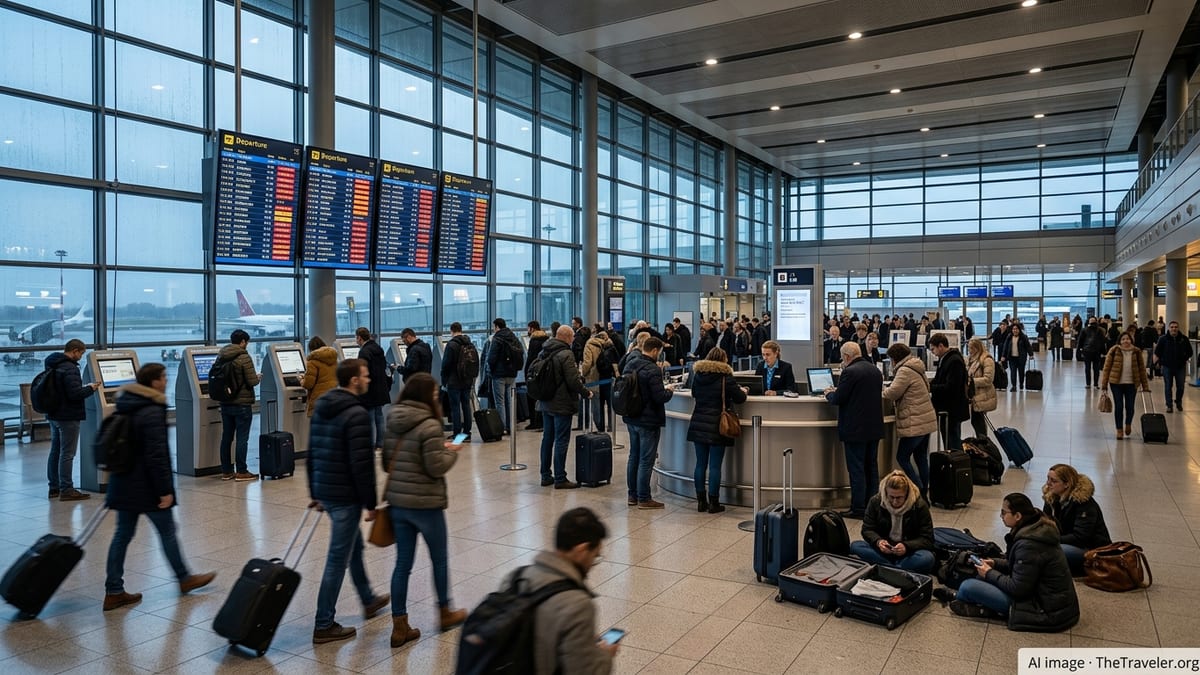
Major Hubs From Paris to Madrid Hit by Rolling Disruptions
The latest disruption wave is centered on some of Europe’s busiest airports, including Paris Charles de Gaulle and Orly, London Heathrow and Gatwick, Frankfurt, Stockholm Arlanda and Madrid Barajas. Publicly available tracking data shows cancellations and delays rippling across these hubs throughout the day, with peak congestion building around morning and late-afternoon departure banks.
At Paris and London, a mix of weather-related constraints, airspace reroutings and traffic management measures contributed to a sharp build-up in delayed departures and missed connection windows. Frankfurt, one of Europe’s primary long-haul transfer points, reported growing queues at border control and rebooking desks as disrupted passengers attempted to secure alternative itineraries.
In Stockholm and Madrid, the impact has been more concentrated in specific time windows but still significant for passengers connecting onward to other European or long-haul destinations. Reports indicate that late-arriving inbound aircraft have cascaded into further outbound delays, affecting both point-to-point and transfer traffic.
Smaller regional airports feeding into these hubs are also seeing secondary effects, as aircraft and crews arrive late or are repositioned to cover disrupted rotations, adding further unpredictability to schedules.
Multiple Airlines Struggle With Knock-On Effects
The disruption is affecting a wide range of carriers, from network airlines to low-cost operators. Among the most heavily impacted are British Airways, easyJet, Air France, Lufthansa and KLM, along with selected services by Qatar Airways and other long-haul operators that rely on European hubs for onward connections.
Low-cost carriers such as easyJet, which operate tight, high-frequency schedules across short-haul European routes, are especially vulnerable to cumulative delays when early-morning services run late. Publicly available operational data suggests that once the first rotations are disrupted, recovery can take much of the day, leading to widespread schedule changes and late arrivals.
Network carriers including Air France, Lufthansa and KLM face added complexity due to intricate connecting banks at their main hubs. Even a limited number of cancellations can force large-scale rebooking efforts as passengers miss onward flights to long-haul destinations in North America, the Middle East, Africa and Asia.
Long-haul operators such as Qatar Airways, which interline extensively with European partners, are also encountering ripple effects. Changes to departure slots in Europe can disrupt carefully timed connections in the Gulf and beyond, contributing to further schedule adjustments and equipment changes downstream.
Weather, Airspace Constraints and Capacity Issues Intersect
While no single cause fully explains the scale of today’s disruption, available coverage points to a combination of adverse weather, constrained airspace and capacity bottlenecks in Europe’s aviation system. Recent windstorms and unsettled conditions across parts of western and northern Europe have led to stricter safety margins, reduced airport capacity and occasional temporary runway restrictions.
At the same time, ongoing airspace constraints and reroutings related to geopolitical tensions have added distance and complexity to many flight paths linking Europe with Asia and the Middle East. This can increase flight times, fuel burn and crew duty pressures, leaving less margin to absorb additional weather or operational delays.
Industry analyses published in recent months have highlighted how high traffic volumes, airport capacity limits and air traffic control staffing pressures continue to leave Europe’s network vulnerable to disruption. When several factors align on a busy travel day, the margin between a manageable delay pattern and a large-scale operational challenge can quickly disappear.
Today’s figures, with 82 flights canceled outright and more than 1,500 delayed, illustrate how even a relatively small share of the total daily schedule can still translate into severe inconvenience for tens of thousands of travelers.
Impact on Passengers: Missed Connections and Overnight Stays
For travelers, the most immediate consequences have been long queues at check-in, security and customer service points, along with missed connections and unexpected overnight stays. Social media posts and passenger reports describe crowded terminal areas at key hubs, with many travelers attempting to rebook at airline desks or via mobile apps.
Missed onward flights at Frankfurt, Paris and London are particularly disruptive for passengers heading to long-haul destinations. Once a long-haul bank has departed, replacement options can be limited, especially on heavily booked routes or on days when capacity is already tight due to earlier disruptions.
Hotels near major hubs have reported elevated demand from stranded passengers seeking last-minute rooms. Publicly available information indicates that some airlines are providing accommodation and meal vouchers where required, while others are encouraging passengers to arrange their own lodging and claim reimbursement where regulations apply.
Travelers on multi-sector itineraries, including those combining low-cost and full-service airlines on separate tickets, face added challenges, as protections are generally weaker outside a single through-ticket. In such cases, delays on one segment can result in full forfeiture of subsequent flights, requiring new bookings at short notice.
Passenger Rights and What Travelers Can Do Now
For flights departing from European Union and United Kingdom airports, or operated by carriers based in those jurisdictions, air passenger rights frameworks such as Regulation 261 in the EU and its UK equivalent provide protections in cases of long delays and cancellations. These rules can entitle passengers to care, re-routing and in some circumstances financial compensation, depending on the cause of disruption and the length of delay.
Compensation is typically linked to flight distance and delay duration, with long delays on arrival or short-notice cancellations sometimes qualifying for fixed-sum payments. However, there are exemptions for situations considered to be extraordinary circumstances, such as certain severe weather events or airspace closures, where airlines may still have a duty of care but not a duty to pay compensation.
Travel advocates recommend that affected passengers keep boarding passes, booking confirmations and receipts for essential expenses, as these documents may be required when submitting claims. Many airlines provide online claim forms, and independent claim services and consumer agencies also offer guidance on how to proceed.
In the short term, travelers are advised to monitor flight status frequently, use airline apps where available, and consider arriving at the airport earlier than usual in case of longer security or check-in queues. With schedules still under pressure, further delays and rolling cancellations remain possible as airlines work to restore normal operations across Europe’s congested skies.