

More news on this day
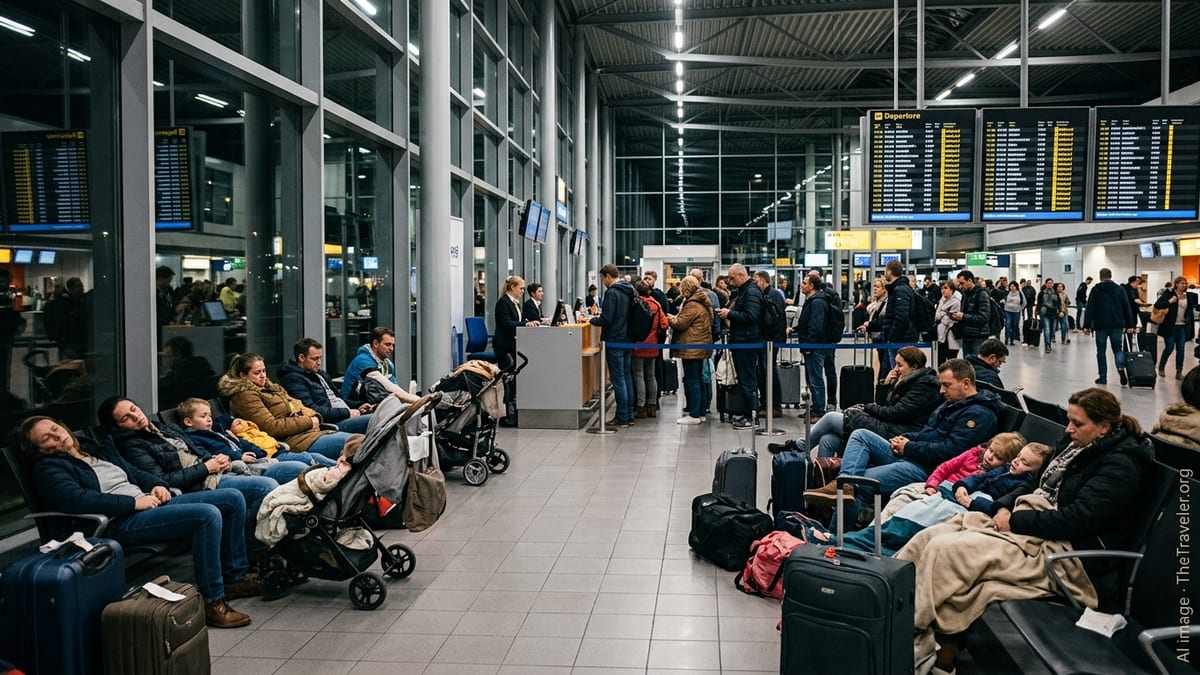
Hundreds of families were left sleeping in terminals across Europe after a fresh wave of disruption saw 1,838 flights run late in a single day, straining airport facilities, airline schedules and passengers’ patience at some of the continent’s busiest hubs.
Get the latest news straight to your inbox!
Major Hubs Buckle Under a New Wave of Delays
Flight tracking and disruption reports indicate that several of Europe’s largest airports, including London Heathrow, Paris Charles de Gaulle, Amsterdam Schiphol, Frankfurt and Barcelona, experienced unusually high levels of late-running services as the latest operational squeeze rippled through the continent’s aviation network. Across the region, 1,838 flights were recorded as delayed within a 24 hour period, with knock on effects stretching into the following day.
Published coverage from passenger rights platforms and aviation data providers shows that the disruption was heavily concentrated at major transfer hubs where tight turnaround times and dense schedules leave little room to absorb late arrivals. At some airports, more than a quarter of departures left behind schedule, triggering missed connections and forcing airlines to rebook large numbers of passengers on already busy services.
Low cost and network carriers alike were affected. Reports highlight delays across airlines such as British Airways, Lufthansa, Air France, KLM, Vueling, Iberia, Ryanair and easyJet, mirroring wider trends seen in recent seasons where European punctuality has struggled to keep pace with near pre pandemic traffic levels. Industry analyses in recent months have already pointed to a doubling of average delays in Europe over the past decade, with reactionary disruption from late inbound flights now one of the main drivers of schedule slippage.
The scale of the latest episode underlines how even relatively modest weather or capacity constraints can snowball into a continent wide issue when airspace, staffing and airport infrastructure are already running close to their limits. Once departure banks start to slip, aircraft arrive late, crews approach duty time limits and subsequent rotations fall further behind, creating a rolling backlog throughout the day.
Families Face Overnight Stranding and Terminal Sleepovers
The sharp rise in late running flights left many families with young children facing overnight stays in airport terminals, particularly where the last departures of the evening were delayed beyond curfew windows or missed connection opportunities. Social media posts and passenger accounts collected in recent coverage describe long lines at transfer desks, makeshift bedding on gate area floors and parents attempting to settle children on rows of plastic chairs while waiting for new travel arrangements.
At several European hubs, hotels near the airport quickly reached capacity as disruptions mounted, leaving some passengers without immediate access to accommodation. Publicly available information from consumer groups notes that in such circumstances airlines are expected to provide meals, refreshments and, where possible, overnight lodging, but that in practice families are sometimes advised to make their own arrangements and seek reimbursement later, a process that can be confusing and time consuming for infrequent travelers.
Reports from recent disruption events show that families on multi leg itineraries are especially vulnerable. When an initial short haul sector departs late, onward long haul flights may be missed with few remaining seats available the same day. In this latest bout of delays, some passengers travelling from regional airports via major hubs were rebooked on next day services, effectively turning a planned same day connection into an unplanned overnight layover.
Passenger advocacy organizations in Europe have repeatedly highlighted the emotional and financial strain that such episodes impose, particularly during school holidays when family travel peaks. Parents balancing work commitments at home with limited vacation days can find that a single day of network wide disruption disrupts carefully planned trips, adds unexpected expenses and shortens time at their final destination.
Weather, Airspace Constraints and Network Fragility
Operational data and prior analyses by European aviation bodies suggest that the latest spike in delays is part of a broader pattern of fragility in the region’s air transport system. Over recent seasons, a combination of constrained airspace, staffing challenges, local weather and technical issues has created repeated pressure points that quickly turn into wide scale delays when traffic levels are high.
Parts of European airspace remain restricted or heavily reconfigured due to geopolitical tensions, forcing airlines and air navigation service providers to concentrate traffic through narrower corridors. Industry reporting has noted that this has increased pressure on certain control sectors and airports, leading to more frequent flow management regulations that slow departures and build queues both on the ground and in the air.
Seasonal storms and strong winds have further complicated operations, particularly at coastal and northern airports where crosswinds and low visibility can reduce runway capacity. Recent winter and early spring weather systems have already produced waves of cancellations and delays at hubs such as Amsterdam and London, leaving airlines with limited flexibility when additional issues arise.
Technical problems have also played a role in recent years, with breakdowns in air traffic control and airline IT systems triggering mass cancellations and delays across multiple countries. While the latest tally of 1,838 delayed flights appears to stem primarily from cumulative operational and capacity pressures rather than a single catastrophic failure, analysts note that the underlying picture is of a network in which small disturbances can still produce outsized impacts.
Passenger Rights and What Stranded Travelers Can Claim
For families caught up in the disruption, one of the most pressing questions is what assistance and compensation they are entitled to receive. Under European Union Regulation 261/2004 on air passenger rights, travelers departing from an EU airport, or flying into the EU on an EU based carrier, generally have a right to care and, in many cases, financial compensation when flights are significantly delayed or cancelled.
Publicly available guidance explains that when a delay stretches beyond certain thresholds, airlines must provide meals, drinks, access to communication and, if an overnight stay becomes necessary, hotel accommodation and transport between the airport and the hotel where reasonably available. These obligations apply regardless of the cause of the delay, though monetary compensation for arrival delays of more than three hours can be excluded if the airline can demonstrate that the disruption was caused by extraordinary circumstances such as severe weather or air traffic control strikes.
Consumer advocates recommend that passengers keep boarding passes, booking confirmations, meal and hotel receipts, and records of actual arrival times to support any later claims. Specialized claims firms and national enforcement bodies provide online tools that help travelers assess their eligibility, but many emphasize that claims can also be filed directly with airlines, albeit sometimes with longer processing times.
Recent debates at the European level over potential revisions to passenger rights rules have focused on whether the current compensation thresholds for delays should be adjusted, reflecting concerns from both consumer groups and the aviation industry about costs and clarity. For now, however, the existing framework remains in place, offering at least some recourse to the families who spent the night on airport floors after Europe’s latest day of mass delays.
Calls for More Resilient Schedules and Better Communication
The latest disruption has renewed scrutiny of how European airlines and airports plan schedules, manage capacity bottlenecks and communicate with passengers when things go wrong. Industry reports have shown that average delay minutes per flight in Europe have risen significantly over the past decade, even as airlines have attempted to tighten turnaround times and maximize aircraft utilization.
Aviation analysts argue that building more buffer into schedules, particularly at congested hubs, could help reduce cascading reactionary delays when an early wave of flights runs late. However, they also note that this would likely increase operating costs and potentially reduce the number of frequencies airlines can offer on popular routes, a trade off that carriers have so far been reluctant to make.
Passenger feedback from recent disruption episodes frequently highlights inconsistent or delayed communication as a major source of frustration. Reports describe departure boards that lag behind actual gate information, last minute gate changes and limited proactive updates via apps or text messages when connecting flights are at risk. When hundreds of flights are delayed on the same day, call centers and airport customer service desks can quickly become overwhelmed, leaving many travelers unsure of their options.
Travel experts suggest that passengers facing European flight disruptions should check airline apps and independent flight tracking tools in parallel, monitor their rights under EU rules and, where possible, proactively seek rebooking before queues at airport desks grow too long. As Europe’s aviation system heads into another busy travel period with chronic capacity constraints still in place, the experience of families stranded overnight by 1,838 late running flights is likely to intensify pressure on policymakers and industry leaders to strengthen resilience across the network.