

More news on this day
Thousands of passengers across Europe faced widespread disruption on April 7, 2026, as airports in Germany, the United Kingdom, Denmark, Spain, France and several other countries reported more than 150 flight cancellations and well over 1,600 delays, snarling schedules for airlines including British Airways, Swiss, Virgin Atlantic and KLM at major hubs such as Paris, London, Oslo and Amsterdam.
Get the latest news straight to your inbox!
Storm Systems and Strained Operations Collide
Publicly available aviation data and recent travel advisories indicate that the latest wave of disruption is closely linked to a powerful Atlantic storm system tracking across northern and western Europe, combining with already stretched ground operations at several busy hubs. Meteorological reports describe high winds, heavy rain and low cloud affecting approaches into the United Kingdom, France, the Low Countries and Scandinavia, forcing flow restrictions and slower runway use.
Across Germany, the United Kingdom, Denmark, Spain and France, a tally of airport movement data and industry coverage points to roughly 154 cancellations and about 1,691 delays over a 24-hour period. These figures reflect a mix of short-haul and long-haul services, with many flights technically departing but outside their scheduled slots, creating rolling knock-on effects throughout the day.
Analysts following the European aviation sector note that this week’s pattern resembles other recent episodes of disruption that have swept through the continent since early April, driven by an overlap of severe weather, congestion in key air corridors and limited spare capacity in airline networks. As aircraft and crews fall out of position, the impact quickly spreads well beyond the immediate storm zone, affecting cities that may be experiencing relatively benign local conditions.
Operational reports suggest that air traffic control restrictions have compounded the weather challenges. Capacity reductions over parts of northern Europe, together with temporary holds on transatlantic arrivals during the worst of the gusts, reduced the number of aircraft allowed to land per hour at some major gateways, forcing airlines to delay or cancel rotations they could no longer operate within curfew and duty-time limits.
Major Hubs from London to Amsterdam Hit Hard
The disruption has been particularly visible at key European hubs. Data collated from airport departure boards and published travel advisories shows that London Heathrow and other major UK airports, including Manchester and Birmingham, have been operating with significantly elevated delay levels, with British Airways and Virgin Atlantic among the most affected carriers on trunk routes to Europe and North America.
In the Netherlands, Amsterdam Schiphol has once again emerged as one of the most disrupted airports in Europe, with reports indicating well over one hundred delayed flights and a notable number of cancellations as KLM’s hub-and-spoke operation struggled to absorb weather-related slowdowns. Similar patterns of secondary disruption are evident at Oslo Gardermoen, where delays on arrivals from continental Europe and the UK have cascaded into onward Scandinavian services.
French hubs have also been under pressure. Recent coverage of Paris Charles de Gaulle and Paris Orly highlights a cluster of cancellations combined with extensive delays, affecting services operated by Air France, British Airways, KLM, Icelandair, easyJet, Royal Air Maroc and others. At Nice, a smaller but still significant number of disrupted movements has complicated travel along France’s Mediterranean corridor, especially for leisure passengers heading into the spring holiday period.
Elsewhere, airports in Germany, Denmark and Spain have reported a steady stream of delays across both intra-European and long-haul flights. Frankfurt and Munich in Germany, Copenhagen in Denmark, and Barcelona and Madrid in Spain have all seen schedules elongated as ground handlers, air traffic control units and airline operations centers work through backlogs generated during the morning and early afternoon peak periods.
Airlines Scramble to Rebuild Schedules
For airlines, the disruption has presented a familiar but complex challenge. Public updates from major European carriers show rolling adjustments to schedules, with some operators canceling selected rotations in order to protect the rest of their networks and free capacity for stranded passengers. British Airways, Swiss, Virgin Atlantic and KLM, along with other flag and low-cost carriers, have all been named in recent travel alerts and media coverage as experiencing elevated levels of delays and cancellations across their European operations.
Industry observers describe a network in recovery mode. Aircraft and crews displaced by earlier cancellations in the UK, Germany and the Nordic region must be repositioned before normal patterns can resume, a process that often takes several days when disruption is widespread. In such conditions, even relatively small additional issues, such as minor technical faults or localized staffing constraints, can trigger further cancellations as operators prioritize safety margins and regulatory compliance.
Some airlines have been encouraging customers to use digital channels to manage their journeys, with online portals and mobile apps enabling passengers to rebook, request refunds or track the latest flight status without joining long queues at airport service desks. Travel advisories note that same-day rebooking options may be limited on the most affected routes, especially where aircraft are already operating at or near full capacity due to school holiday demand.
Travel sector commentators point out that this episode follows closely on the heels of earlier disruption across Europe in recent days, including significant delays and cancellations at airports in Iceland, Sweden, Ireland and Greece. The recurrent nature of these events, coupled with sustained high passenger volumes, is contributing to a sense of fragility in the aviation system as it heads into the core spring and summer seasons.
Passengers Face Long Queues and Tight Connections
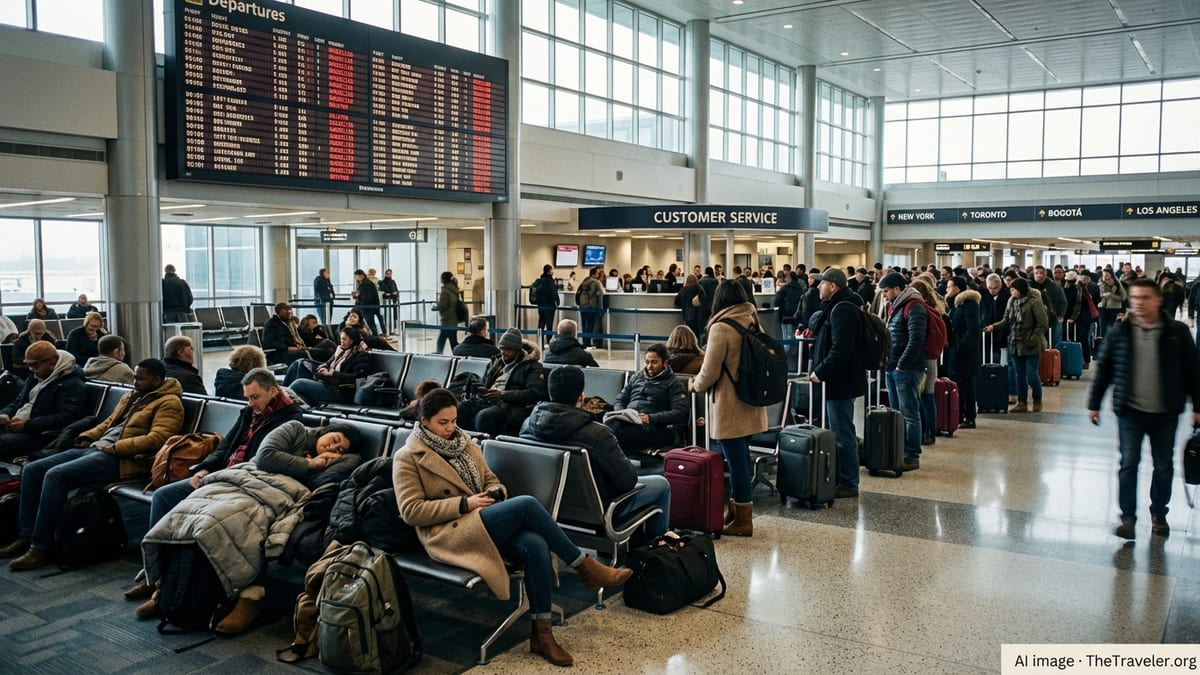
For travelers, the operational statistics translate into very tangible difficulties. Reports from airports including London, Paris, Amsterdam and Oslo describe long queues at check in and security, crowded departure lounges and busy information desks as passengers seek clarity on revised departure times and onward connections. In some cases, missed connections in European hubs have resulted in overnight stays or rerouting via secondary airports.
Passenger accounts and travel industry reporting suggest that delays of one to three hours have been common across many short-haul routes, with some long-haul departures slipping further as aircraft arrive late from previous sectors. Where turn-around times have been compressed in an attempt to recover schedules, ground handling teams have faced added pressure to maintain safety standards while working at speed in poor weather.
Families and business travelers alike have been affected. With Easter and school holiday traffic still flowing through many airports, the pool of spare seats on alternative flights is limited, making it harder for disrupted passengers to find quick rebooking options. This has heightened the importance of timely communication from airlines and airports, as travelers weigh whether to proceed to the airport or remain at home or in hotels until their flights are confirmed.
Travel advisors recommend that affected passengers monitor their flight status frequently on official airline channels, arrive early if their departure is still scheduled, and keep documentation such as boarding passes, receipts and notification emails that may be relevant for any subsequent claims under European and UK passenger rights frameworks.
What This Means for Spring and Summer Travel
The latest round of mass delays and cancellations is being viewed by many in the travel industry as a warning sign for the months ahead. With airlines operating at high load factors and airports still dealing with staffing and infrastructure constraints, the system has limited flexibility to absorb the kind of weather and airspace shocks that have characterized the early weeks of April.
Analysts note that similar episodes in recent years have tended to cluster around periods of unsettled Atlantic weather, prompting calls for closer coordination between airlines, airports and air navigation service providers to smooth traffic flows during high-risk windows. While improvements in forecasting and planning tools are being rolled out, the events of this week illustrate how quickly disruption can propagate across multiple countries once a major hub begins to struggle.
For travelers planning trips over the coming weeks, the evolving situation underscores the value of building buffers into itineraries, especially where critical connections depend on short transfer times in European hubs such as London Heathrow, Amsterdam Schiphol, Paris Charles de Gaulle, Frankfurt or Madrid. Flexible tickets, comprehensive travel insurance and a clear understanding of airline policies may all help mitigate the impact of any further disruption.
As operations gradually stabilize following this latest wave of cancellations and delays, attention is likely to focus on lessons that carriers and infrastructure providers can draw ahead of the peak summer season. For now, publicly available information shows that thousands of passengers across Germany, the UK, Denmark, Spain, France and neighboring countries continue to feel the impact of disrupted flights, with residual knock-on effects expected to linger for several days.