

More news on this day
Thousands of passengers across Europe faced severe disruption on February 20 as a powerful winter weather system triggered major air travel chaos, with at least 1,322 flights delayed and 70 cancelled across Austria, Belgium, Norway and several neighbouring countries, hitting key hubs including Vienna, Oslo and Brussels and affecting operations at major carriers such as Ryanair, easyJet and British Airways.
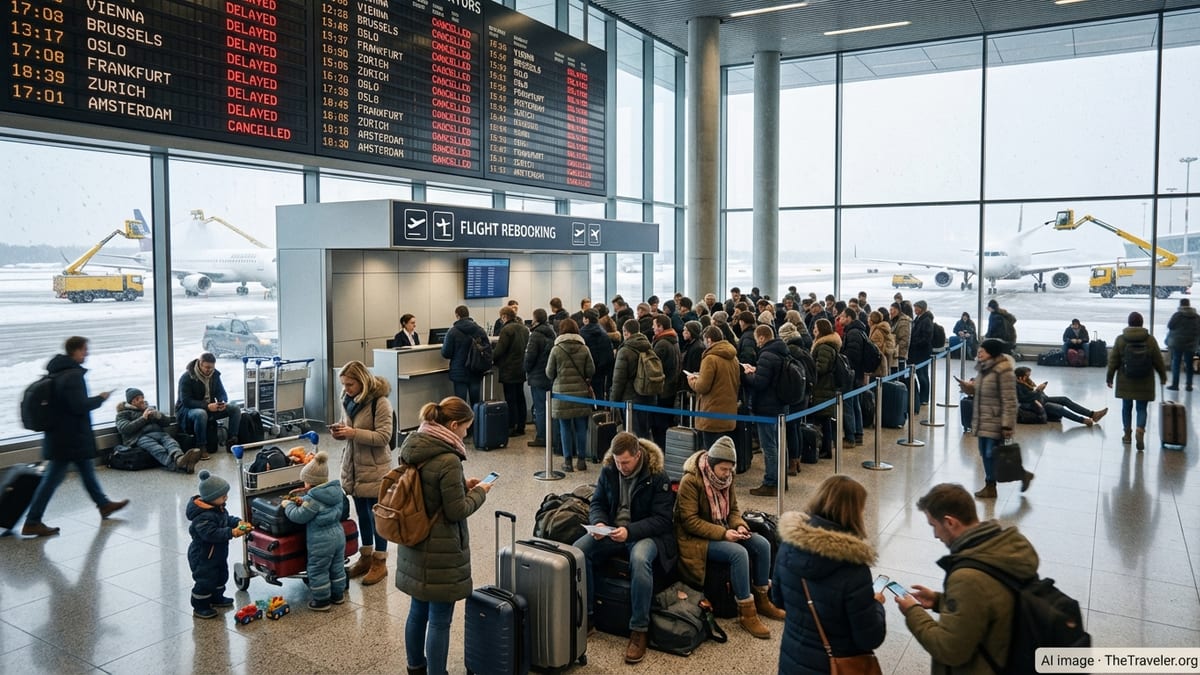
Storm System Paralyzes Key European Hubs
The latest wave of disruption comes as a broad band of snow, ice and low cloud continues to sweep across northern and central Europe, creating hazardous conditions for airport operations. In affected regions, ground crews have struggled to keep runways clear, while low visibility has forced air traffic controllers to impose spacing restrictions and flow controls that ripple through airline schedules.
By Friday morning, operational data from major European airports indicated that 70 flights had been cancelled outright while a further 1,322 had been delayed, many by more than an hour. The knock-on impact extended well beyond the initially impacted cities, as aircraft and crews scheduled for later rotations struggled to get back on time, compounding the disruption into the evening peak.
The situation follows a similarly turbulent day on February 19, when at least 210 flights were cancelled and more than 2,700 delayed across the Netherlands, the United Kingdom, Germany, Spain, Italy, Belgium and Austria, underscoring how persistent winter weather has turned this week into one of the most challenging periods of the season for European aviation.
Airports and airlines warned that while weather conditions were expected to gradually improve, residual delays would likely linger through the weekend as networks recovered and stranded passengers were rebooked onto already busy services.
Vienna, Brussels and Oslo Among Worst Affected
In central Europe, Vienna International Airport faced a wave of schedule changes as snow and intermittent freezing drizzle reduced runway capacity and slowed de-icing operations. Delays spread across short-haul routes into Germany, Italy and the United Kingdom, while evening departures to hubs such as London and Amsterdam were held on the ground as air traffic control implemented flow restrictions.
Belgian airspace also suffered significant disruption. Brussels Airport, which had already been heavily affected by Thursday’s storm, reported a fresh round of delayed departures and arrivals, particularly on intra-European routes. Airlines were forced at times to hold aircraft on remote stands while crews waited for clearance to taxi or for stands to free up, leading to lengthy turnaround times and missed connections for transit passengers.
Further north, Oslo Gardermoen continued to grapple with strong winds, snow showers and temperature swings that complicated runway treatment and de-icing. Earlier this month, the airport recorded more than 130 delayed flights in a single day, and this latest weather system has again highlighted the vulnerability of even well-equipped Nordic hubs when severe winter conditions coincide with peak traffic periods.
Secondary airports feeding into these hubs, including regional gateways in Denmark and Germany, reported their own chains of delays as traffic bound for Vienna, Brussels and Oslo was held or rerouted. With many of these airports operating near capacity on busy winter travel days, even modest flow restrictions quickly translated into extended waits for passengers across the network.
Ryanair, easyJet, British Airways and Others Forced to Cut and Delay Services
Low cost and full service carriers alike have been unable to escape the turmoil. Ryanair, which maintains dense short-haul networks from Vienna and across Belgium, experienced a wave of delays as aircraft arrived late from weather-affected bases and had to queue for de-icing before departure. Some rotations were cancelled outright where turnaround times became untenable or where crew duty limits were in danger of being exceeded.
EasyJet, with extensive operations from the UK into continental Europe, also suffered significant disruption. Flights linking London with key mainland hubs such as Amsterdam, Brussels, Milan and Vienna faced cascading delays as the storm system moved eastward. At several points on Thursday and Friday, airline schedules showed clusters of flights departing more than two hours behind schedule, forcing last-minute rebookings and overnight accommodation for some passengers.
British Airways, which concentrates much of its European flying through London Heathrow, saw its schedules squeezed as crosswinds, low visibility and knock-on congestion from mainland airports limited its ability to recover time between rotations. Services into Belgium, Austria and Scandinavia were among those to experience extended holding, with some aircraft forced to divert temporarily when weather thresholds were breached at destination airports.
Flag carriers including KLM, Lufthansa, SAS, Iberia and Air France also reported widespread disruption, particularly on feeder routes that supply long-haul banks at their home hubs. With aircraft stuck out of position and inbound services arriving late from affected cities such as Vienna, Brussels and Oslo, airlines were frequently compelled to consolidate flights or downsize aircraft to keep at least some capacity moving.
Passengers Face Long Queues, Overnight Stays and Missed Connections
For passengers, the operational challenges translated into long queues, missed connections and in many cases overnight stays. At Vienna and Brussels, travellers reported crowded terminals, with lines stretching from airline service desks as customers sought rerouting options or information on their rights to refunds and compensation under European regulations.
At Oslo Gardermoen, ground staff worked to provide temporary assistance, including bottled water, snacks and basic amenity kits, while local hotels near the airport filled quickly as airlines issued accommodation vouchers for stranded passengers. With many winter flights already operating close to full, rebooking options were limited, leaving some travellers facing waits of a day or more for the next available seats on popular routes.
Families returning from school holiday trips and business travellers heading to key meetings were among those most affected. Social media posts from stranded passengers highlighted confusion over changing gate information and repeated boarding-time revisions, as airlines tried to keep flights on the departure board while physically constrained by de-icing bottlenecks and runway spacing restrictions.
At major hubs, the impact extended to connecting traffic. Travellers arriving late from secondary cities found that onward flights to long-haul destinations had already departed, forcing complex reroutings via alternative hubs or even different airlines as carriers engaged in interline arrangements to prevent travellers being stranded far from home.
Weather, Capacity and Aging Infrastructure Expose System Fragility
Industry analysts say the latest wave of disruption underscores the vulnerability of Europe’s tightly scheduled short-haul networks when confronted with prolonged bouts of severe weather. Winter storms are an expected feature of the season, but when snow, ice and low visibility extend across multiple days and countries, the cumulative effect can outstrip the built-in buffers of airline timetables.
Many European airports operate close to capacity during morning and evening peaks, leaving little margin when runway throughput is reduced for de-icing or when crosswinds and poor visibility force wider separation between aircraft. Once a significant number of flights are delayed early in the day, the lack of spare aircraft and crew makes it difficult for airlines to reset schedules without cancelling services.
Analysts also point to the role of aging or constrained infrastructure at several major hubs. Some airports have limited de-icing equipment or insufficient remote stands to handle the volume of aircraft needing treatment in sub-zero conditions, while terminal layouts at older facilities can make it difficult to manage large crowds of disrupted passengers or to provide clear, timely information when situations change rapidly.
Climate scientists note that climate change is expected to increase weather volatility, with more frequent swings between unseasonably mild and sharply cold conditions in parts of Europe. This variability can create challenging icing conditions and sudden snow events that are harder for airports and airlines to anticipate using traditional seasonal planning assumptions.
What Stranded Passengers Are Entitled To Under EU Rules
For travellers caught up in the disruption, one of the most pressing questions is what compensation and assistance they can claim. Under European Union rules governing air passenger rights, those whose flights are cancelled or severely delayed may be entitled to meals, refreshments, hotel stays and in some cases cash compensation, depending on the circumstances and the cause of the disruption.
The regulations require airlines to offer passengers on cancelled flights a choice between rerouting at the earliest opportunity, travel at a later date convenient to the passenger, or a refund of the unused portion of their ticket. For long delays, airlines must provide care and assistance once waiting times exceed specified thresholds related to flight distance, including food vouchers, access to communication and hotel accommodation if an overnight stay becomes necessary.
Cash compensation is more complex in cases of severe weather. When cancellations and long delays are caused by conditions considered to be extraordinary and beyond the control of the airline, carriers may not be required to provide financial compensation, even though they must still offer rerouting and care. Consumer groups nonetheless urge passengers to keep detailed records of delays, retain receipts for additional expenses and consider filing claims, as eligibility can depend on the specifics of each flight and the measures the airline took to mitigate disruption.
Passengers are also encouraged to check whether their travel insurance covers weather-related delays. Some policies offer fixed payouts after a certain number of hours, or reimburse costs for missed prepaid accommodation and tours, which can help ease the financial burden of unexpected extra nights in hotels or rebooked ground transport.
How Airports and Airlines Are Working to Restore Schedules
Airport operators across the affected countries say they have deployed all available resources to speed up recovery. In Vienna and Brussels, ground handling teams have been working extended shifts to clear snow, treat taxiways and stands with anti-icing agents and rotate de-icing vehicles between stands as quickly as possible. Priority has been given to long-haul departures and flights carrying large numbers of connecting passengers, in a bid to minimize secondary disruption.
In Norway, Oslo Gardermoen has drawn on established winter operations protocols, including the use of specialist snow removal trains and centralized de-icing platforms designed to move aircraft through in a more controlled flow. While these measures have helped avoid full closures, airport managers acknowledge that maintaining capacity during sustained snowfall remains a significant challenge, especially during peak traffic windows.
Airlines, for their part, have activated irregular-operations control centres to oversee network-wide recovery. Carriers such as Ryanair, easyJet and British Airways have proactively cancelled some flights to create breathing space in their schedules, allowing remaining rotations to operate with fewer delays. They have also increased the use of contingency crews and stood-up reserve aircraft where available, though the scale of the disruption has limited the effectiveness of these measures in some markets.
Digital tools, including real-time notifications via airline apps and messaging services, have played a larger role in communicating changes to passengers. Many travellers received push alerts about cancellations and gate changes before arriving at the airport, reducing pressure on check-in counters and allowing some to adjust plans or postpone their journeys altogether.
Advice for Travellers Heading to or Through Affected Airports
With backlogs expected to take time to clear, travel experts recommend that anyone with flights to or through Vienna, Brussels, Oslo and other heavily affected hubs build additional flexibility into their plans over the coming days. Passengers are advised to check their flight status repeatedly, starting 24 hours before departure and again before leaving for the airport, as schedules can change at short notice while airlines rebalance aircraft and crew.
Arriving at the airport earlier than usual can also be prudent, particularly where security queues and check-in lines may lengthen due to the volume of disrupted passengers seeking assistance. Travellers should ensure they have essential items such as medications, chargers and a change of clothes in their carry-on baggage in case they become separated from checked luggage due to missed connections or overnight delays.
Industry bodies stress the importance of maintaining up-to-date contact details in airline bookings so that carriers can reach passengers quickly with rebooking offers or information about alternative travel options. Where possible, travellers are encouraged to accept self-service rebooking through apps or kiosks to avoid waiting in long queues and to keep lines free for those with more complex itineraries or special assistance needs.
For those yet to book, considering routings that avoid the most severely affected hubs, or allowing longer connection times, may reduce the risk of disruption while the network stabilizes. However, with winter weather still in the forecast for parts of northern and central Europe, operators caution that conditions could change quickly, and that patience and preparation will remain essential for anyone planning to fly in the region this week.