

More news on this day
Major European hubs including London Heathrow, Rome Fiumicino, Amsterdam Schiphol and Copenhagen Airport are experiencing a fresh wave of disruption, with reports indicating 1,813 delayed services and 98 cancellations across the network, hitting carriers such as Lufthansa, Ryanair and other leading airlines and complicating journeys for passengers across the United Kingdom, the Netherlands, Denmark and wider Europe.
Get the latest news straight to your inbox!
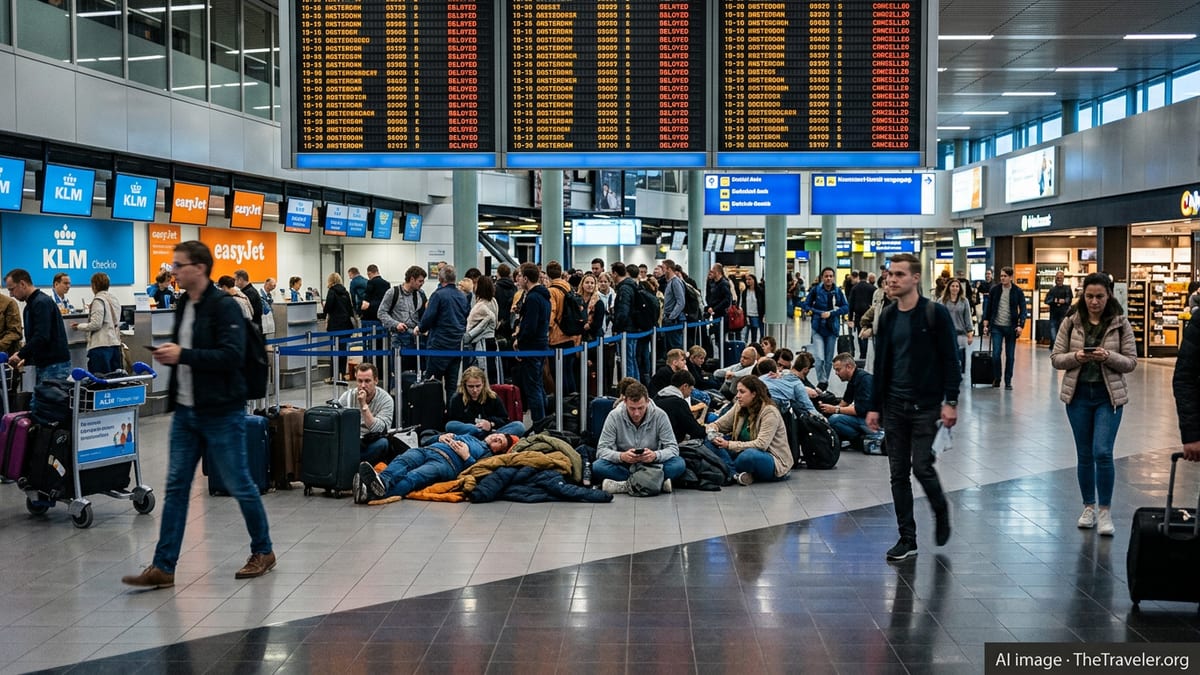
Wave of Delays and Cancellations Across Key Hubs
Publicly available flight-tracking data and industry coverage point to a difficult operating day across several of Europe’s busiest airports, where congestion, knock-on scheduling issues and capacity constraints have translated into unusually high levels of disruption. London Heathrow and Rome Fiumicino are among the worst affected, with a combined tally contributing significantly to the 1,813 delays and 98 cancellations reported across the region.
In Italy, recent reports on performance at Rome Fiumicino highlight the airport’s sensitivity to wider network strain, with earlier analyses already flagging hundreds of delays in a single day when conditions deteriorate. Those patterns appear to be recurring, with a concentration of late departures and arrivals on short haul routes linking Fiumicino to major European cities including Amsterdam and London.
Heathrow, which routinely handles more than 230,000 flights per year according to European performance data, remains a critical pressure point. When departure and arrival slots begin slipping, the impact cascades across the continent, particularly on high-frequency routes to hubs such as Amsterdam Schiphol, Copenhagen, Frankfurt and Zurich. Today’s figures indicate that similar dynamics are again in play, amplifying the overall disruption count.
Although the precise mix of causes varies by airport and flight, a blend of air traffic control restrictions, weather-related spacing, crew and aircraft rotation issues and residual rerouting from earlier airspace constraints continues to weigh on schedules. As a result, routes that usually operate with multiple daily frequencies are experiencing compounding delays.
Airlines Most Affected, From Legacy Carriers to Low Cost Giants
The disruption is being felt across a broad range of airlines. Lufthansa, Ryanair and several other major European brands appear prominently in the delay and cancellation tallies, reflecting their dense networks and reliance on the affected hubs for both point-to-point and connecting traffic.
Ryanair’s extensive short haul network, which links secondary and primary airports throughout the UK, Italy, Spain, the Netherlands and Scandinavia, is particularly exposed when conditions tighten simultaneously at multiple hubs. Operational performance reports from previous months already highlighted how even modest schedule slippage can translate into hundreds of delayed rotations for large low cost operators on busy days.
For Lufthansa and its partners, the current disruption creates pressure on both intra-European feeders and long haul connections. Earlier coverage of Italian airport disruption showed how delays at Rome Fiumicino and Milan Malpensa quickly ripple into flights bound for major hubs in Germany and beyond, and a similar effect is now visible as today’s irregular operations move aircraft and crews out of their normal patterns.
Other full service carriers and regional operators are facing comparable challenges. According to recent European punctuality analyses, airlines operating through Heathrow, Fiumicino and Schiphol already run relatively tight turnarounds to maximize aircraft utilization. When a wave of delays such as the one reported today hits, it reduces flexibility to recover within the same operating day.
Netherlands, Denmark and UK Passengers Face Knock-on Disruption
The impact of the current disruption is most visible in countries that depend heavily on the affected hubs for both domestic and international links. In the Netherlands, Amsterdam Schiphol is once again seeing an elevated number of late departures and arrivals, particularly on flights to and from the British Isles, Scandinavia and Southern Europe. Past data on Italy’s disruption showed how flights between Fiumicino and Schiphol were among those frequently affected when schedules came under pressure.
In Denmark, Copenhagen Airport is experiencing its own share of delays and scattered cancellations, reflecting its role as both a Nordic gateway and a key spoke in the wider European network. Recent travel coverage documented how cancellations and delays in Denmark and Norway can quickly trap passengers trying to connect through major hubs, with some travelers resorting to long-distance trains and buses to bypass bottlenecks.
Within the United Kingdom, the disruption at Heathrow is rippling outward to other airports that share overlapping traffic flows, such as Manchester, London Gatwick and regional bases used by low cost carriers. Earlier this week, published reports detailed more than a thousand delays in a single day across Italy, the UK, Spain, Denmark and Norway, underscoring how fragile the European network can become when several hubs struggle simultaneously.
For passengers, the practical effect is longer queues at check in and security, congested gate areas and a rise in missed connections. Even where flights are not cancelled outright, three hour or longer delays are becoming increasingly common on some intra-European sectors when schedules fall significantly out of sync.
What the Numbers Reveal About Europe’s Network Strain
The headline figures of 1,813 delays and 98 cancellations sit against a broader backdrop of growing concern about the resilience of Europe’s air transport system. Punctuality reports compiled over recent years show that major hubs such as Heathrow and Fiumicino routinely record tens of thousands of delayed flights annually, with average delay per disrupted flight approaching or exceeding 20 minutes.
When a single day produces more than 1,800 delayed services, it signals that the system is operating at or beyond its available buffer. Many of today’s problems are not isolated events but reflect accumulated pressures, including limited runway capacity, staffing challenges in air traffic control and ground handling, and continuing adjustments to airspace routings linked to geopolitical constraints.
Comparisons with earlier disruption events this year reveal a pattern of recurring, medium scale interruptions rather than one off shocks. In February, separate coverage highlighted another day in which more than 270 flights were delayed and 14 cancelled across a smaller set of airports, while March saw more than 1,900 delays and 75 cancellations during another bout of congestion. The current figures extend that trend, affecting a broader geographical area and additional carriers.
Industry observers note that while airlines are investing in improved operational planning and digital tools to keep passengers informed, structural constraints at hubs limit how much resilience can be built into tightly banked schedules. This context helps explain why simultaneous disruption across Heathrow, Fiumicino, Schiphol, Copenhagen and other airports can so quickly result in four digit delay totals.
Guidance for Affected Travelers in Amsterdam, Copenhagen and Beyond
With flight operations strained across multiple hubs, travelers in the Netherlands, Denmark, the UK and other affected countries are being urged by airlines and airports to check their flight status frequently and to allow additional time at the airport. Recent updates from major European carriers emphasize the importance of using mobile apps and online tools, which typically receive schedule changes and gate updates before departure boards.
Passengers experiencing long delays or cancellations on routes within or departing from Europe may have rights to rebooking, care and, in some cases, financial compensation under European and UK passenger protection rules, depending on the specific circumstances. Consumer advice shared in previous disruption episodes stresses the value of documenting delay times, keeping receipts for essential expenses and submitting claims directly through airline channels.
For those connecting through Heathrow, Fiumicino, Schiphol or Copenhagen, the current conditions suggest considering longer minimum connection times, particularly when itineraries involve separate tickets or self-transfer between carriers. Travel forums and recent case reports show that missed connections can be difficult to resolve when airports are already dealing with hundreds of disrupted flights.
As airlines work through the backlog of delayed operations, recovery is expected to take time, particularly for aircraft positioned overnight away from their home bases. Travelers over the next several days may continue to feel the knock-on effects, even if headline delay and cancellation numbers moderate, making proactive planning and close monitoring of itineraries essential.