

More news on this day
Air passengers across Europe are facing another bruising weekend of disruption as a fresh wave of delays and cancellations ripples through airports in Italy, Sweden, Turkey and beyond, with at least 217 flights delayed and 145 scrapped, hitting major hubs from Zurich and Paris to Warsaw.
Middle East Tensions Ripple Across European Skies
The latest bout of travel chaos is unfolding against a backdrop of heightened tensions in the Middle East, which has triggered widespread airspace restrictions and last-minute operational changes. Airlines that rely heavily on eastbound corridors and connections through Turkey and the eastern Mediterranean are being forced to reroute or suspend selected services, squeezing already congested European airspace and schedules.
Turkish Airlines has cancelled or suspended a raft of flights to destinations including Lebanon, Syria, Iraq, Iran and Jordan, while also pausing or trimming frequencies to key Gulf states. KLM, Air France and several other European carriers have adjusted or halted routes to Tel Aviv and neighbouring hubs, leaving aircraft and crews out of position and contributing to rolling knock-on delays across the continent.
As carriers scramble to reconfigure networks at short notice, airport control centres report growing strain on runway slots and turnaround times. Even flights that do not touch the Middle East are feeling the impact, as aircraft rotations, crew duty limits and ground handling capacity buckle under the pressure.
Industry analysts say the disruption underlines how sensitive Europe’s aviation system has become to geopolitical shocks far from its own borders, with a single flashpoint capable of throwing off finely tuned schedules from Scandinavia to the Alps.
Italy, Sweden and Turkey Among Worst Affected
Friday and Saturday have been particularly difficult for travellers in Italy, Sweden and Turkey, where airports are reporting clusters of cancellations and extensive delays across short- and medium-haul networks. In Italy, services operated by easyJet, ITA Airways and a range of European partners have been hit, especially on routes linking Milan, Rome and northern Italian gateways with major hubs in France, Germany and the UK.
In Sweden, Stockholm Arlanda has recorded a sharp rise in delayed departures as airlines juggle altered routings and slot constraints farther south. Nordic carriers and European low-cost operators have struggled to keep aircraft running on time, with late-inbound flights from central Europe cascading into missed connections and evening bank delays for passengers heading on to domestic and regional destinations.
Turkey, a pivotal bridge between Europe and the Middle East, has emerged as one of the flashpoints of the current crisis. Istanbul’s two main airports, along with Antalya and other coastal gateways, are all contending with a mix of delayed and cancelled flights affecting both domestic and international services. Turkish Airlines, Pegasus and foreign carriers including easyJet and KLM are all contending with rotated aircraft, crew reassignments and shifting security assessments.
While many flights are still operating, schedules have become markedly less predictable. Travellers are being warned that even services listed as on time may be subject to rapid changes as airlines adjust to evolving airspace restrictions and operational guidance.
Major Hubs From Zurich to Paris and Warsaw See Knock-On Disruption
The problems are not confined to the countries closest to the Middle East or to Scandinavia. Hub airports in Switzerland, France and Poland are experiencing their own share of disruption as delays and cancellations elsewhere in Europe echo through the network. Zurich has reported dozens of delayed arrivals and departures, with airlines such as Swiss, Emirates and easyJet forced to hold, reroute or retime services as disrupted aircraft and crews make their way back into position.
In Paris, both Charles de Gaulle and Orly are handling a busy mix of late-running intra-European flights and altered long-haul operations. Air France and partner carriers are contending with a higher-than-normal volume of missed connections, particularly among passengers traveling to and from North America and Africa who typically rely on tight transfer windows through the French capital.
Farther east, Warsaw Chopin Airport is seeing mounting delays on flights linking Poland to Turkey, Italy, Germany and the Nordic region. LOT Polish Airlines and a roster of European partners have had to pad turnaround times and in some cases cancel rotations entirely, cutting frequencies on certain popular weekend routes. Passengers arriving from delay-prone airports are frequently missing onward services, forcing rebookings onto later flights already close to capacity.
Air traffic managers warn that the tightly interwoven nature of European aviation means even modest concentrations of delays at a few key hubs can quickly translate into widespread disruption, particularly at the end of the month when schedules are often running near full utilisation.
easyJet, KLM, Turkish Airlines and Others Face Operational Strain
Low-cost and network carriers alike are under pressure. easyJet is among the hardest hit, with the airline’s dense European point-to-point network proving especially vulnerable to rolling knock-on delays. A late aircraft in Milan or Geneva can rapidly generate a chain reaction that touches Stockholm, Paris or Warsaw by the end of the day, particularly during peak travel periods.
KLM is grappling with congestion at Amsterdam and disruption on eastern routes, which has forced it to thin or cancel selected flights and bring forward the suspension of some Middle East services. The airline’s reliance on tightly timed connections through its Schiphol hub leaves limited room for recovery when major weather, airspace or geopolitical events strike.
Turkish Airlines, one of the key connectors between Europe, the Middle East and Asia, is simultaneously contending with security-driven route suspensions and heavy demand from passengers seeking alternative routings. Its reduced ability to operate eastbound services is constraining westbound schedules as well, feeding into the broader pattern of disruption seen across Italy, Sweden and other European markets.
Smaller regional players and leisure airlines are also being swept up in the turmoil. With spare aircraft and crew resources already thin in late winter, many operators lack the flexibility to mount recovery flights or add capacity on short notice, leaving stranded passengers with limited immediate options.
Passengers Face Long Queues, Missed Connections and Limited Guidance
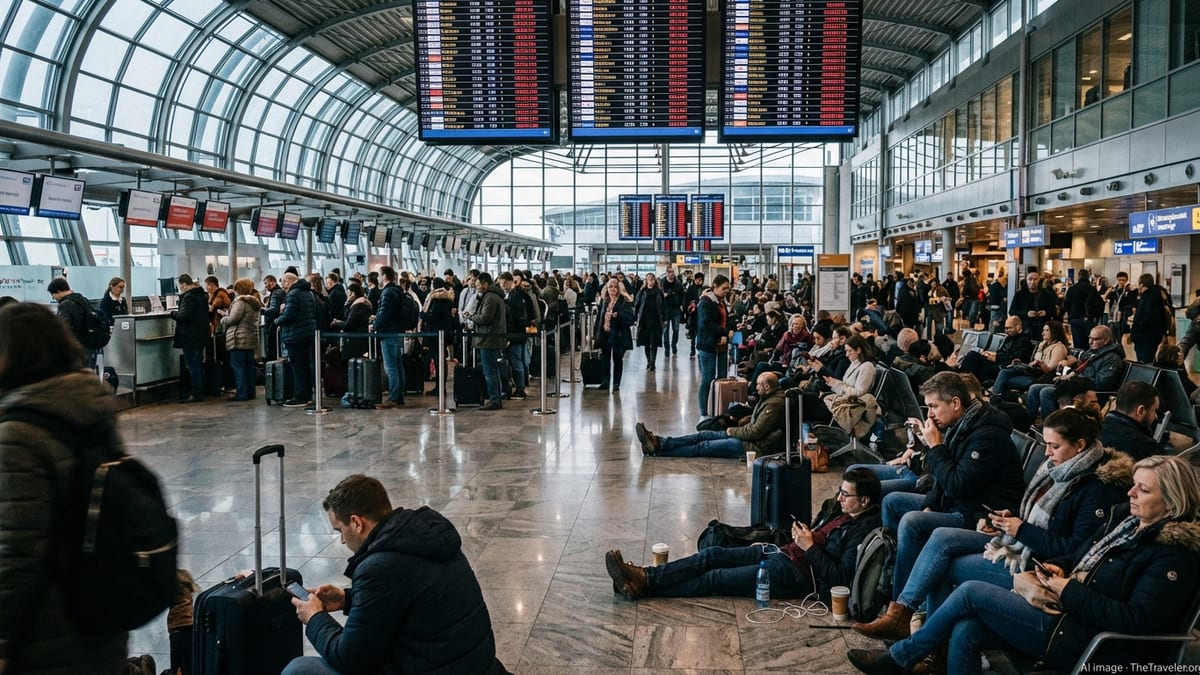
For travellers on the ground, the operational complexities translate into long queues at check in, security and rebooking desks, along with crowded departure halls and full airport hotels. At several major hubs, passengers arriving into Zurich, Paris and Warsaw report waiting hours in line to secure new itineraries, often only to find that alternative flights are also heavily delayed or fully booked.
Consumer advocates say the latest wave of disruption exposes familiar weaknesses in how airlines communicate during fast-moving crises. Many affected passengers report learning about cancellations only after arriving at the airport, or receiving fragmented updates through apps and text messages that do not clearly explain their rights or the likely duration of the disruption.
Under European air passenger regulations, travellers whose flights are cancelled or severely delayed may be entitled to care, assistance and in some cases financial compensation, depending on the root cause of the problem and the notice period given. With cancellations in this case largely driven by security and airspace restrictions, eligibility may vary widely from one route or airline to another.
With schedules still in flux, travel experts are urging passengers to monitor flight status closely, allow additional time at the airport, travel with essential items in carry on baggage and be prepared for last-minute changes. While airlines are working to stabilise operations, it may take several days before the full impact of the latest Middle East crisis washes through Europe’s crowded skies.