

More news on this day
Passengers across Europe faced a fresh wave of travel turmoil this weekend as Air France, SWISS and Brussels Airlines collectively cancelled 59 flights and delayed at least 15 more across France, Switzerland, England and Belgium, snarling operations at major hubs including Paris, London, Geneva and Brussels and leaving thousands of travellers scrambling for alternatives.
Storms, Strikes and Staffing Woes Converge on Key European Hubs
The latest disruption, affecting services across Paris Charles de Gaulle, London Heathrow and Gatwick, Geneva and Brussels, comes as a mix of winter weather, strike action and lingering staffing constraints once again exposes the fragility of Europe’s aviation recovery. Operations teams at legacy and flag carriers reported rapidly changing conditions, with flight plans reworked repeatedly as ground crews, air traffic controllers and airport operators struggled to maintain normal capacity.
In Paris and Geneva, freezing temperatures and intermittent snow forced extended de icing windows and occasional runway flow restrictions, leading airlines to pre emptively trim parts of their schedules. In London, strong crosswinds and low cloud at peak times slowed approaches and departures, adding further pressure to already tight rotations. Brussels, meanwhile, has been contending with rolling labour unrest and warnings of wider strikes, prompting carriers to consolidate services and reposition aircraft.
For passengers, the combined effect was felt in last minute cancellations, rolling delays and missed connections that rippled outward from these hubs to secondary cities around the continent. Although the tally of 59 cancellations and 15 delays tied directly to Air France, SWISS and Brussels Airlines represents a fraction of daily European traffic, the disruptions were heavily concentrated on popular business and leisure corridors, amplifying the impact for travellers.
Air France Cancellations Hit France–UK and Regional Links
Air France saw its operations disrupted primarily on short and medium haul routes linking France with the United Kingdom and neighbouring European markets. Flights between Paris Charles de Gaulle and London, as well as services connecting the French capital with regional airports and nearby hubs, were among those most affected as the carrier balanced safety requirements with tight aircraft and crew availability.
According to operational briefings, Air France’s cancellations were heavily weighted toward flights scheduled during early morning and late evening peaks, when de icing queues and air traffic flow restrictions are most acute. By trimming rotations at those times, the airline sought to preserve a more reliable core schedule through the middle of the day, minimising the risk of cascading delays across its network.
Passengers flying point to point between France and England often found themselves offered later same day departures or reroutings via alternative hubs, including Amsterdam and Frankfurt on partner airlines. However, those with onward long haul connections from Paris faced more complex rebooking challenges, as full cabins and limited spare capacity in premium cabins left fewer available seats for disrupted travellers.
SWISS Disruptions Add Pressure in Geneva and London
SWISS, already operating with a leaner schedule after previous capacity cuts linked to pilot shortages, faced renewed disruption on high frequency routes from Geneva to London and other European business centres. The airline cancelled a series of departures and arrivals in order to absorb weather related delays and avoid aircraft and crews ending up out of position overnight.
Travel industry analysts noted that SWISS’s compact Geneva based network gives it less flexibility when irregular operations strike. When a handful of rotations are cancelled or delayed, there are fewer back up aircraft available to step in, and crew duty time limits are reached more quickly. As a result, what begins as a modest weather or staffing disruption can swiftly escalate into a broader schedule shake up.
Passengers booked on SWISS services between Switzerland and England reported crowded customer service desks and long call centre waits as they attempted to secure new itineraries. Some were shifted onto codeshare flights operated by partner carriers, while others were offered rail alternatives for shorter cross border journeys. Those travelling with checked baggage often experienced the longest delays, as bags needed to be located and re tagged amid shifting departure times and gate changes.
Brussels Airlines and Belgian Travellers Face Mounting Uncertainty
In Belgium, Brussels Airlines passengers encountered cancellations and schedule changes that came against a backdrop of nationwide labour tensions and the looming prospect of broader strike action. The carrier cut a portion of its short haul services from Brussels to cities in France, Switzerland and the United Kingdom, citing both operational constraints and the need to pre position aircraft ahead of potential future disruption.
Brussels Airport authorities have warned in recent days that upcoming industrial action across multiple sectors could severely limit airport operations, heightening anxiety among travellers who rely on the Belgian capital as either an origin or connecting point. For Brussels Airlines, which uses the airport as its principal hub, any further restrictions on departures or ground handling capacity could force an additional round of cancellations and consolidations.
On Sunday, passengers described long queues at rebooking counters and self service kiosks in the departures hall, with airport staff directing affected travellers to dedicated disruption desks. While those flying within the European Union were generally offered same day alternatives or hotel accommodation when overnight stays became unavoidable, travellers heading onward to Africa and North America faced tighter availability, with some rebooked one or two days later than initially planned.
How the 59 Cancellations and 15 Delays Break Down
While precise tallies continue to shift as airlines adjust their schedules in real time, the disruption linked to Air France, SWISS and Brussels Airlines across France, Switzerland, England and Belgium is broadly clustered on core intra European routes. The 59 recorded cancellations over a roughly 24 hour period have been concentrated on flights of under three hours, where carriers have the most flexibility to trim capacity without jeopardising longer haul segments.
Industry data indicate that a majority of cancelled services involved city pairs such as Paris–London, Geneva–London, Paris–Geneva and Brussels–London, along with a handful of regional connections feeding into those hubs. The 15 delayed flights, many running between 60 and 180 minutes behind schedule, typically involved peak bank departures where air traffic congestion and weather related flow control combined to slow departures and arrivals.
This pattern reflects a strategy increasingly adopted by European carriers during periods of operational stress: protecting long haul and high yield flights wherever possible, while using short haul frequencies as a buffer to absorb unexpected shocks. Though effective in stabilising overall operations, it leaves short haul passengers disproportionately exposed to last minute changes and can quickly overcrowd rebooked flights on the remaining services.
Passenger Reactions: Long Queues, Missed Plans and Fraying Patience
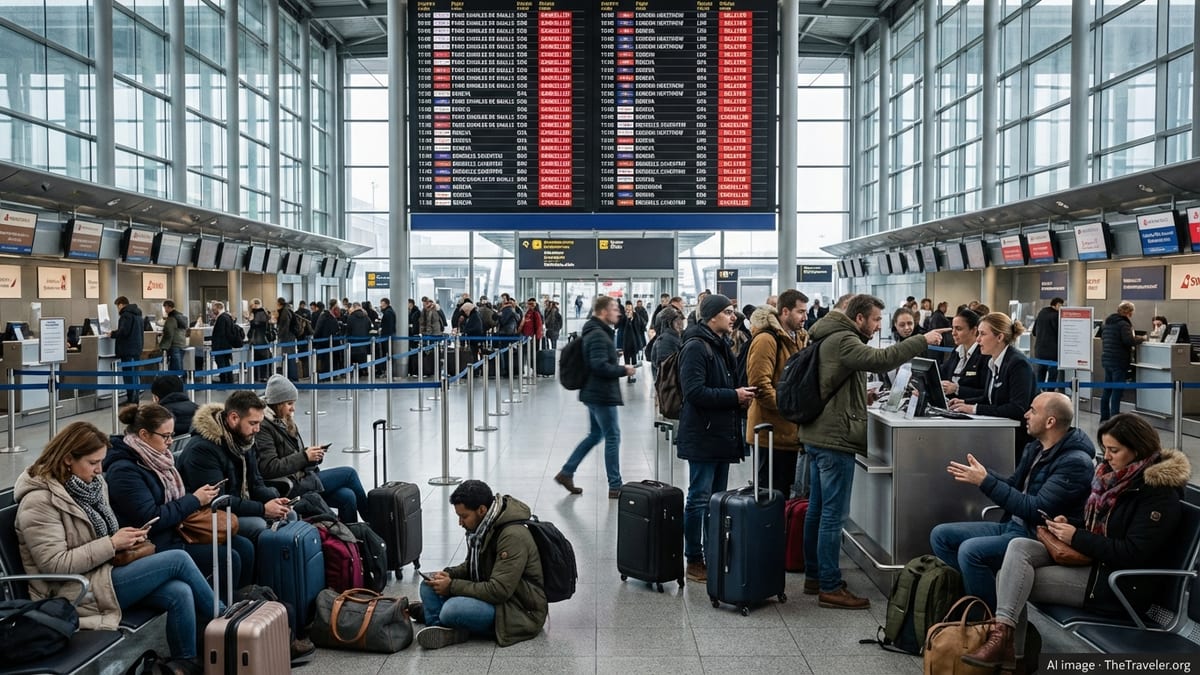
Across the four affected countries, passengers caught in the disruption described a familiar scene: snaking queues at service counters, departure boards flickering with red cancellation notices, and improvised workspaces set up around scarce charging points. Families returning from school holidays, business travellers heading to Monday meetings and weekend city breakers all found their plans abruptly derailed.
At Paris Charles de Gaulle, travellers reported waiting more than an hour in some terminals to speak with airline staff, with many instead turning to airline apps and chatbots to secure alternative flights. In London, the combination of weather related delays and knock on effects from mainland Europe meant that some passengers saw their aircraft wait on remote stands for crews to become available, even after boarding.
In Geneva and Brussels, where the local airports play an outsized role in regional connectivity, even a modest tally of cancellations had outsized consequences. Rail and coach operators reported higher than normal demand on cross border routes as stranded travellers searched for last minute alternatives, particularly on links between Belgium, France, Luxembourg and western Germany. Hotels near airports in all four countries also saw a spike in same day bookings as disrupted passengers resigned themselves to unexpected overnight stays.
Your Rights Under European Passenger Protection Rules
For travellers caught up in the wave of cancellations and delays, Europe’s air passenger protection rules provide an important backstop. Under Regulation EC 261/2004, passengers departing from or arriving in the European Union on an EU carrier may be entitled to care, assistance and, in some cases, financial compensation when flights are cancelled or significantly delayed.
In practical terms, that means airlines must provide meals, refreshments and access to communication when delays exceed certain thresholds, as well as hotel accommodation and ground transfers when an overnight stay becomes necessary. Where flights are cancelled, passengers can typically choose between a full refund of the unused ticket or re routing at the earliest opportunity, subject to seat availability.
Cash compensation, which can range from 250 to 600 euros depending on flight distance, may be owed when cancellations or long delays are not caused by extraordinary circumstances such as severe weather or major air traffic control system failures. With the current disruption rooted in a mix of weather, staffing constraints and industrial tensions, eligibility for compensation will likely vary case by case, making it essential for affected travellers to document the cause of disruption as communicated by the airline.
What Travellers Should Do Now if They Are Affected
Industry experts advise passengers whose flights are operated by Air France, SWISS or Brussels Airlines and touch France, Switzerland, England or Belgium in the coming days to monitor their bookings closely. Airlines are increasingly using mobile apps and text alerts as the first line of communication, often notifying customers of changes or options for voluntary rebooking before they reach the airport.
For those who learn of cancellations or long delays while still at home or in their hotel, the most efficient route is usually to rebook online or through an airline’s dedicated disruption page rather than joining airport queues. Travellers with time sensitive commitments, such as onward cruises, tours or important meetings, may wish to proactively look at alternative routings on partner carriers or via less affected hubs, even if it means longer connections.
At the airport, passengers should retain all receipts for meals, transportation and accommodation linked to the disruption, as these may be reimbursable later under airline policies or EU regulations. Keeping screenshots of delay notifications, boarding passes and any written communication about the causes of cancellation can also help support future claims.
Outlook: A Fragile System Heading Into Late Winter
As airlines and airports across Europe move through the final stretch of the winter travel season, the latest turmoil across Paris, London, Geneva and Brussels underscores how vulnerable the aviation ecosystem remains to overlapping stresses. Weather events that would once have been absorbed with relative ease now contribute to more visible and widespread disruption when layered onto staffing shortages, congested airspace and heightened labour tensions.
Executives at major European carriers have repeatedly stressed that investments in technology, staffing and infrastructure are underway, but many of those improvements will take time to translate into day to day resilience. In the meantime, travellers flying within and between France, Switzerland, England and Belgium should prepare for the possibility of short notice changes, particularly when travelling through major hubs or during early morning and late evening banks.
For now, the 59 cancellations and 15 delays logged across Air France, SWISS and Brussels Airlines serve as a stark reminder that even a relatively contained disruption can cause outsized headaches when it hits the busiest corridors of Europe’s skies. As late winter weather systems and labour negotiations continue to evolve, airlines and passengers alike face an uncertain few weeks before the calmer conditions of spring hopefully bring more stable schedules.