

More news on this day
Thousands of passengers across Europe faced another bruising travel day on March 7 as fresh disruption led to at least 181 flight cancellations and more than 800 delays at major hubs including London, Paris, Amsterdam, Frankfurt and Istanbul, hitting services operated by Ryanair, British Airways, KLM, Air France, Pegasus and several other carriers.
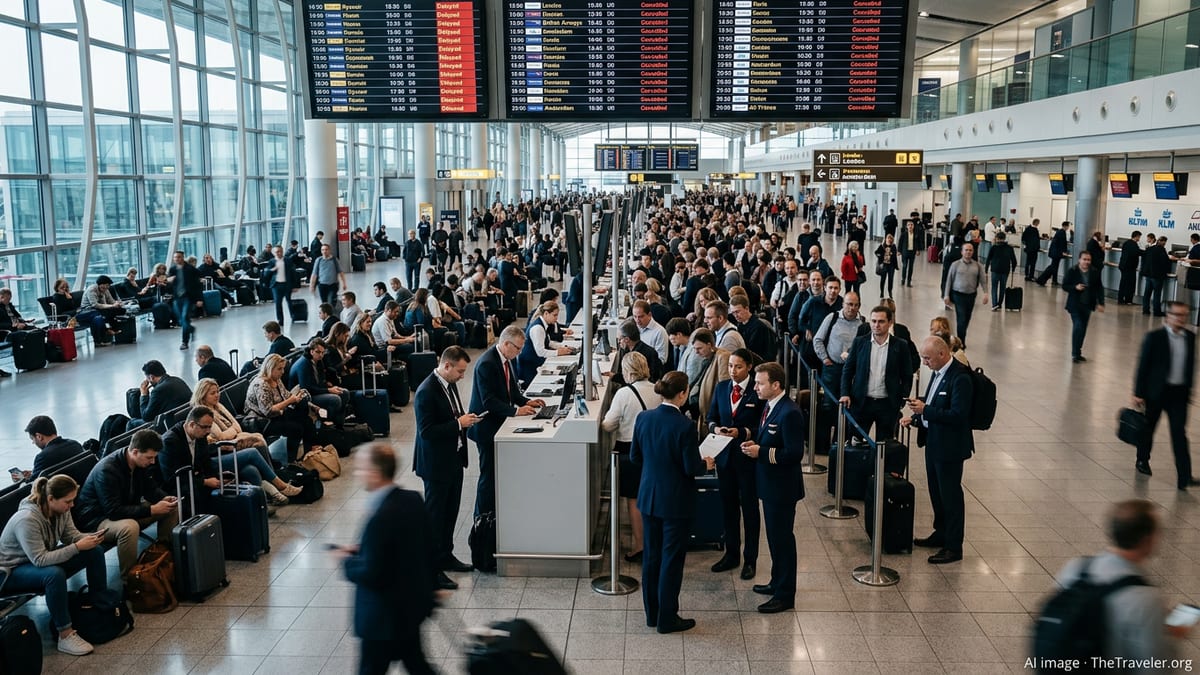
Fresh Wave of Disruption Hits Europe’s Busiest Airports
The latest wave of disruption follows several days of heightened operational stress across the European network, with aviation data showing more than 1,000 flights cancelled or delayed on March 5 alone and continued knock-on effects into the weekend. Weather systems moving across the North Sea, intermittent air traffic control flow restrictions in French airspace and staffing bottlenecks at ground-handling providers have combined to create a cascading series of schedule upsets affecting both short-haul and long-haul routes.
In the United Kingdom, London Heathrow again emerged as one of the hardest-hit hubs, with dozens of cancellations and more than a hundred delays reported in a single day earlier in the week. Similar patterns were visible at Paris Charles de Gaulle, where departure boards on March 5 and 6 showed well over a hundred delayed services and several dozen cancellations as Air France, British Airways and Gulf carriers struggled to recover their rotations.
Further north, Amsterdam Schiphol continued to feel the aftershocks of a turbulent winter season in which recurring storms and strong crosswinds had already forced mass cancellations. While not all of Saturday’s disruption could be attributed to weather, operational constraints at Schiphol and regional airports in the Netherlands added to a broader sense among travelers that flying across Europe has become markedly less predictable.
Germany’s key gateway at Frankfurt, as well as Istanbul’s main international airports, also reported elevated levels of delayed and cancelled flights tied to a mix of late-arriving inbound aircraft, staffing shortages and re-routed services avoiding conflict zones in the Middle East. The result was a patchwork of localized problems that, taken together, translated into widespread chaos for passengers attempting to connect through Europe’s main hubs.
Major Airlines Struggle to Maintain Schedules
The disruption has been particularly visible at large network and low-cost carriers that rely on tight rotation times and high aircraft utilization. Ryanair and other budget airlines saw multiple flights scrubbed or heavily delayed as a single late inbound aircraft often left entire sequences of point-to-point services running behind schedule. For travelers, that meant last-minute gate changes, missed connections on separate tickets and long queues at customer service desks.
British Airways, KLM and Air France grappled with a different but equally complex challenge: maintaining long-haul connectivity while adapting to route suspensions and diversions tied to regional tensions and restricted airspace over parts of the Middle East. In some cases, flights were extended by detours that added significant flight time and fuel burn; in others, services were cancelled outright, leaving passengers in London, Paris and Amsterdam scrambling for rebooking options on heavily loaded alternative flights.
Turkish carriers including Pegasus were affected both by the wider European knock-on effects and by their exposure to routes into conflict-adjacent regions. Schedule data in recent days has shown multiple cancellations to destinations in the eastern Mediterranean and the wider Middle East, curbing one of the key flows that normally pass through Istanbul and further constraining seat availability for travelers seeking last-minute alternatives.
Industry analysts note that while the raw number of cancellations remains well below the worst peaks seen during past strike waves or major storms, the combination of moderately higher cancellation volumes with very high load factors and already-stretched staffing has made each disruption more painful for travelers. Even relatively small schedule changes can now strand significant numbers of passengers because flights on adjacent days are already close to full.
Knock-On Effects Ripple Across Business and Leisure Travel
For business travelers, the latest round of disruption has led to missed meetings, reconfigured itineraries and in some cases the need to fall back on video conferencing when same-day or next-morning alternative flights were unavailable. Travel managers reported particular concern around services connecting London, Paris, Frankfurt and Amsterdam, routes that underpin much of Europe’s corporate mobility and are typically marketed as high-frequency and resilient.
Leisure travelers, many of whom had timed trips to coincide with late-winter city breaks or ski holidays, also found themselves caught in long lines at customer service counters and struggling to secure hotel rooms when missed connections forced overnight stays. Social media feeds on Saturday were filled with images of crowded departure halls at Paris Charles de Gaulle and Frankfurt, with passengers perched on suitcases amid improvised charging stations and overflowing seating areas.
The disruption has not been evenly distributed across Europe’s map. Airports in Spain, Denmark and Italy have reported elevated but more localized issues, often driven by weather patterns or air traffic control restrictions that then propagate outwards via connecting itineraries. Nonetheless, the cumulative picture is one of a network operating with very little slack, where unexpected constraints in one country are immediately felt several borders away.
Travel agents say that the growing unpredictability is beginning to influence booking behavior. Some corporate clients are shifting to earlier flights in the day to create buffer time for same-day rebooking, while leisure passengers with flexibility are increasingly choosing direct routes over cheaper, multi-stop itineraries that traverse several of the most disruption-prone hubs.
Passenger Rights, Refunds and Practical Advice
The renewed wave of flight problems has brought fresh attention to Europe’s passenger-protection framework, which gives travelers on most flights departing from or arriving in the European Union specific rights in the event of long delays, cancellations or denied boarding. Depending on distance and circumstances, passengers on affected flights may be entitled to meals, hotel accommodation, re-routing at the earliest opportunity, refunds, and in some cases fixed-sum compensation when disruptions are deemed to be within an airline’s control.
Consumer-rights advocates stress that passengers should keep all receipts for incidental expenses such as meals and ground transport when a delay or cancellation forces an unplanned overnight stay. They also recommend documenting the disruption with photos of departure boards and screenshots of airline notifications, which can prove helpful when submitting compensation claims or challenging an initial rejection.
Airlines, for their part, are urging travelers to use official apps and SMS alerts rather than relying solely on third-party trackers or older confirmation emails. Carriers such as KLM, Air France and British Airways emphasize that their digital channels will show the most up-to-date rebooking options, including self-service alternatives that allow customers to move to earlier or later flights without waiting in line at the airport.
Travel experts advise passengers departing in the coming days to build extra time into connections, avoid checking bags when possible to enable quicker re-routing, and consider travel insurance policies that specifically cover missed connections and additional accommodation costs. While there is cautious optimism that operations will stabilize if weather and air traffic conditions improve, the past week’s events underline how quickly Europe’s tightly wound aviation network can unravel when multiple stress factors collide.