

More news on this day
Hundreds of travellers were left stranded across Europe on March 2 as aviation data showed nearly 950 flights delayed and at least 265 cancelled across the continent, with UK, German, Spanish and Nordic airports among the worst affected and services operated by Finnair, British Airways, Ryanair and other major carriers heavily disrupted.
Ripple Effects From Middle East Airspace Closures Hit Europe
The latest wave of disruption follows sweeping airspace closures across the Middle East after US and Israeli strikes on Iran and subsequent retaliatory attacks, which have forced airlines to reroute or suspend services on key long-haul corridors linking Europe with Asia, Africa and Oceania. With major hubs such as Dubai, Abu Dhabi and Doha operating at sharply reduced capacity or temporarily closed, knock-on delays are fanning out through European schedules.
Carriers have been forced to extend flight times, replan crew rotations and reposition aircraft, creating bottlenecks at already busy European hubs. Aviation analytics firms report that the cumulative impact has translated into hundreds of delayed departures and arrivals each day in Europe, with services to and from the UK, Germany, Spain and Scandinavia particularly exposed because of their dense traffic to the affected region.
Although many of the disruptions originate outside Europe, passengers are feeling the impact most acutely at departure gates from London to Frankfurt and from Oslo to Madrid, where rolling delays, aircraft swaps and last-minute cancellations have become a familiar sight since the weekend.
Major Hubs in the UK, Germany, Spain and Scandinavia Snarl Up
In the UK, London’s major airports reported mounting disruption on Monday as schedules connected to the Middle East and onward Asian routes came under strain. Flights bound for the Gulf and beyond were among the first to be scrapped, but the operational shock soon spilled into short-haul European networks, leaving travellers to and from cities such as Frankfurt, Oslo and Helsinki facing extended waits and missed connections.
Germany’s key transit gateway, Frankfurt, has seen growing congestion on both inbound and outbound services. With long-haul aircraft arriving late or not at all, airport operations teams have been juggling stand capacity and departure slots, often resulting in late pushes from gate and creeping delays that cascade across the day. Munich, still recovering from a separate bout of weather-related disruption late last week, has had limited spare resilience to absorb further shocks.
In Spain, the pressure has been most visible at Madrid-Barajas and Barcelona-El Prat, where recent days have already seen hundreds of delayed and dozens of cancelled flights as schedules fray. Airlines serving Mediterranean holiday routes as well as key long-haul links to the Americas and the Middle East reported aircraft and crew out of position, forcing timetable cuts and extensive rebooking efforts for passengers.
Scandinavian gateways have not been spared. At Stockholm-Arlanda, official operational reports for March 1 and 2 highlighted a cluster of cancellations and dozens of delays for services operated by Scandinavian Airlines and international partners, with knock-on effects on traffic to London, Frankfurt and other European hubs. Oslo and Helsinki have also reported additional congestion as aircraft diverted from the Middle East seek alternative routings through northern Europe.
Finnair, British Airways, Ryanair and Others Grapple With Disruption
Among European carriers, both network and low-cost airlines are wrestling with the operational fallout. Finnair, heavily reliant on long-haul connectivity between northern Europe and Asia, has been forced to route services around closed or restricted airspace, extending flight times and complicating crew scheduling. These changes are feeding back into its short-haul timetables across Helsinki and other Nordic airports, where passengers have encountered rolling delays and sporadic cancellations.
British Airways has faced a dual challenge: direct service suspensions or diversions on routes into the Gulf and beyond, and congestion across its London hub operations as delayed long-haul arrivals compress into already busy peak periods. Passengers connecting from regional UK cities and key European markets, including Germany and Spain, have reported missed onward flights and long queues at transfer and customer service desks.
Ryanair and other low-cost carriers, while less exposed to long-haul disruptions, are contending with airspace restrictions and crowded skies over alternative corridors, which can increase flight times and fuel costs. Combined with tight aircraft utilisation patterns, even minor delays early in the day have been rippling through their point-to-point networks, affecting services into and out of London, Frankfurt, Oslo and other major cities.
Legacy carriers such as Lufthansa, Iberia and SAS are also reporting schedule adjustments, with some proactively trimming frequencies on select routes to restore reliability. Yet with demand for travel still strong and school holidays looming in several European countries, spare capacity to re-accommodate stranded passengers remains limited.
Passengers Face Long Queues, Rebookings and Limited Options
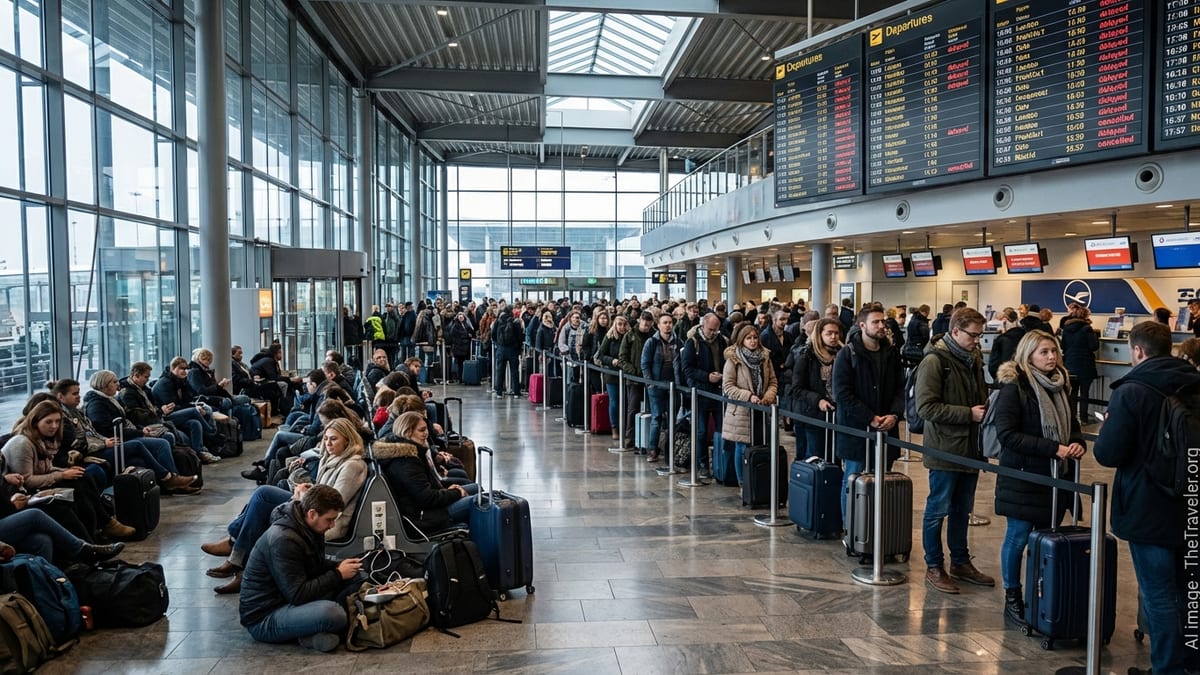
For travellers on the ground, the statistics translate into hours spent in terminals and uncertain onward journeys. At London, Frankfurt, Oslo and other key airports, departure halls filled on Monday morning with passengers clutching rebooking slips and watching departure boards flicker between new times, gate changes and cancellations. Many reported difficulties reaching airline call centres, with high call volumes and long hold times.
Hotel availability near major hubs has tightened as airlines provide accommodation under European passenger rights rules in cases of extended delays and cancellations. However, where disruptions are linked to security situations or war-related airspace closures outside the European Union, compensation entitlements may be more limited, further frustrating passengers who have missed holidays, business meetings or family events.
Travel agents report a surge in requests from customers seeking alternative routings that avoid the Middle East entirely, even at the cost of longer journeys. Some are opting to postpone trips, particularly complex itineraries requiring multiple connections, until schedules stabilise and more clarity emerges around the duration of regional airspace restrictions.
Airports have been urging passengers to arrive early, stay in close contact with their airlines and monitor departure boards frequently, as gate assignments and timings remain fluid. Staff on the ground, from check-in to security and customer service desks, are bearing the brunt of traveller frustration while working with constantly shifting operational plans.
Outlook for the Coming Days Remains Uncertain
While airlines and air traffic control authorities across Europe are working to smooth schedules and open additional routings where safe, industry analysts caution that disruption could persist for days or even weeks if tensions in the Middle East continue to affect airspace. The complex web of long-haul connections that underpin European hubs means that any sudden closure or reopening of key corridors can require wholesale timetable changes.
Carriers are expected to continue issuing rolling schedule updates rather than committing to firm restoration dates, allowing them to react to geopolitical developments and changing safety assessments. This approach, while operationally prudent, leaves passengers facing a high degree of uncertainty, particularly for journeys planned several days in advance.
For now, travellers booked on Finnair, British Airways, Ryanair and other affected airlines are being advised to keep contact details up to date in their bookings and to check flight status repeatedly in the 24 hours before departure. With aircraft and crews still out of position and airports from London and Frankfurt to Oslo operating under strain, Europe’s skies are likely to remain turbulent well beyond today’s tally of nearly 950 delays and 265 cancellations.