

More news on this day
Thousands of passengers across Europe are facing severe disruption as 102 flights are cancelled and 1,901 delayed, with services in Germany, the United Kingdom, France, Norway and Switzerland among the hardest hit, impacting major carriers such as British Airways, SAS, Lufthansa and easyJet and key hubs from London and Manchester to Copenhagen and Zurich.
Get the latest news straight to your inbox!
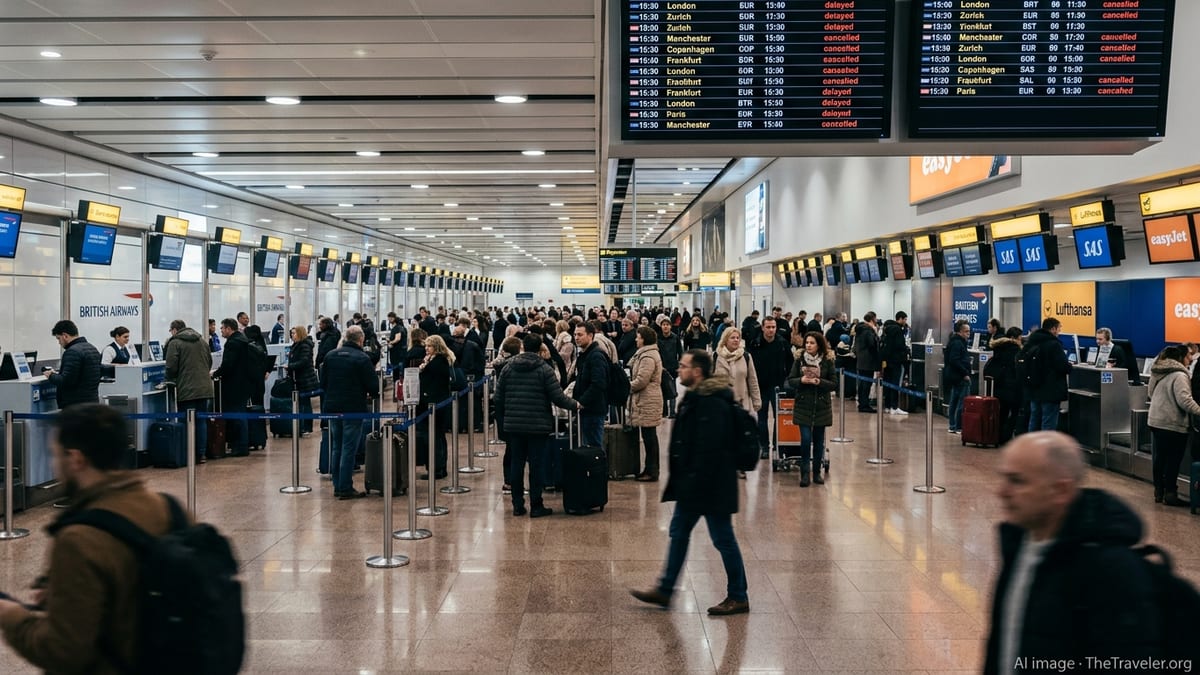
Wave of Cancellations and Delays Across Europe
Publicly available flight-tracking data shows that a fresh wave of operational disruption has swept across European skies, with more than 2,000 flights affected in a single day. A total of 102 cancellations and 1,901 delays have been recorded across the continent, concentrating heavily in aviation powerhouses Germany, the United Kingdom, France, Norway and Switzerland.
The disruption spans both legacy and low-cost carriers, including British Airways, SAS, Lufthansa, easyJet and several regional operators. Flights to and from major hubs such as London Heathrow, London Gatwick, Manchester, Frankfurt, Munich, Paris, Copenhagen, Oslo, Zurich and Geneva have been delayed, rerouted or cut entirely, stranding passengers and creating knock-on effects throughout the day’s schedules.
Operational performance reports for recent quarters already highlighted mounting pressure on European airlines and airports, with punctuality eroding and cancellation rates rising during peak periods. The latest figures underscore how quickly congestion, staffing constraints, technical issues and weather-related challenges can combine to tip an already stretched network into widespread disruption.
While overall numbers remain below the levels seen during past continent-wide crises, the current pattern of scattered but significant interruptions has left many travelers facing missed connections, curtailed holidays and complex rebooking processes at already crowded terminals.
Airline Networks Under Strain
The cancellations and delays are reverberating through the route maps of several of Europe’s best-known carriers. British Airways, with its extensive schedule at London Heathrow and Gatwick, has seen tight turnarounds and high aircraft utilization magnify the impact of individual technical faults and air traffic flow restrictions across the region.
Lufthansa and group partners have reported persistent punctuality pressures in recent seasons, with statistics from aviation performance dashboards indicating that even modest increases in disruption can significantly affect on-time performance. When aircraft and crews are heavily optimized, a delay early in the day can ripple through multiple rotations, particularly on dense intra-European routes linking Germany, Switzerland and Scandinavia.
SAS and easyJet, both major players in northern and western Europe, are likewise exposed to bottlenecks at crowded hubs and weather-sensitive airports. In Scandinavia, localized conditions can force spacing restrictions and de-icing delays, while in central Europe a shortage of air traffic control capacity has repeatedly been cited in industry analysis as a contributory factor in delays during busy travel periods.
Low-cost airlines built around rapid turnarounds are particularly vulnerable when even one sector loses its slot. Once the day’s operation starts to slip, subsequent flights may miss key runway slots at slot-controlled airports such as London Gatwick, Amsterdam, Frankfurt and Zurich, triggering further delays or, in some cases, cancellations when crew duty-time limits are reached.
Key Hubs from London to Zurich See Knock-On Chaos
London’s major airports remain among the most affected nodes in the current disruption. Heathrow and Gatwick both handle extensive networks for British Airways and easyJet, alongside a mix of European and long-haul operators that depend on precise connection windows. When arrivals fall out of sequence due to upstream problems in Germany, France or Scandinavia, ground operations and departure banks quickly become congested.
Manchester has also reported elevated levels of late-running services, particularly on short-haul European routes feeding leisure destinations and business centers. Operational performance summaries for recent months have shown that secondary hubs can experience disproportionate impact when they lack the spare capacity and stand availability of larger gateways.
In northern Europe, Copenhagen has seen delays accumulate on SAS and partner flights, with winter and early spring schedules especially sensitive to shifting weather patterns and infrastructure constraints. Meanwhile, Zurich and Geneva are experiencing pressure on arrival and departure punctuality, reflecting both the complexity of transalpine flight paths and the tight banking of services used by Swiss and Lufthansa Group airlines.
Because many of these airports serve as transfer points, issues at one hub can cascade across carriers and countries. A delayed feeder flight into London, Frankfurt or Copenhagen may cause passengers to miss onward connections, forcing airlines to rebook travelers on later services and further loading already stretched flights.
Passenger Impact and Rights Under European Rules
The immediate impact for many travelers has been long queues at check-in desks, transfer counters and customer service points, as passengers seek new itineraries, hotel accommodation and meal vouchers. Reports from recent disruption events across Europe show that, in some cases, passengers have spent hours in terminal lines while waiting for rebooking options to be processed.
European and aligned regulations provide a degree of protection for those affected by cancellations and long delays. Under established air passenger rights rules covering the European Union, as well as associated agreements with countries such as Norway and Switzerland, travelers on eligible flights may be entitled to care, rerouting and, in many circumstances, financial compensation depending on the length of delay, flight distance and cause of the disruption.
Guidance published by consumer bodies and national regulators states that airlines operating from European airports are generally required to provide assistance when delays exceed specified thresholds, including meals, refreshments and hotel accommodation where necessary. Monetary compensation may be due if the delay or cancellation is within the airline’s control and not caused by extraordinary factors such as severe weather or mandated airspace closures.
Passengers are advised in such events to retain boarding passes, booking confirmations and receipts for any additional expenses, as these documents are typically needed when submitting claims directly to airlines or, if necessary, escalating cases to designated enforcement bodies or alternative dispute resolution schemes.
What Travelers Can Expect in the Coming Days
With schedules already tight and aircraft utilization high, analysts caution that the effects of the current disruption may linger beyond the initial day of cancellations and delays. Aircraft and crew that end up out of position can continue to affect on-time performance for several days, particularly on complex multi-leg rotations linking smaller regional airports with major hubs.
Industry performance reports for recent seasons indicate that recovery from a significant day of irregular operations often requires a sustained period of relatively smooth running. Any further weather events, technical issues or air traffic control restrictions could complicate efforts by airlines to restore normal punctuality, especially on popular routes connecting the United Kingdom, Germany, France, Norway and Switzerland.
Travelers scheduled to fly in the short term are encouraged by public advisories to monitor their flight status frequently, make use of airline apps where available, and plan extra time for airport procedures in case of congestion at security, check-in or border control. Those with tightly timed connections, particularly at large hubs such as London Heathrow, Frankfurt, Copenhagen and Zurich, may wish to explore more flexible options where possible.
While European air travel remains robust overall, the latest disruptions highlight how vulnerable the network can be when multiple pressures arise at once. For passengers, understanding their rights and preparing for potential delays has become an increasingly important part of planning any journey across the continent’s busy skies.