

More news on this day
Passengers across Europe faced another day of severe travel disruption as fresh data showed 102 flights canceled and 1,901 delayed, affecting major hubs in Germany, the United Kingdom, France, Norway and Switzerland and disrupting operations at leading carriers including British Airways, SAS, Lufthansa and easyJet.
Get the latest news straight to your inbox!
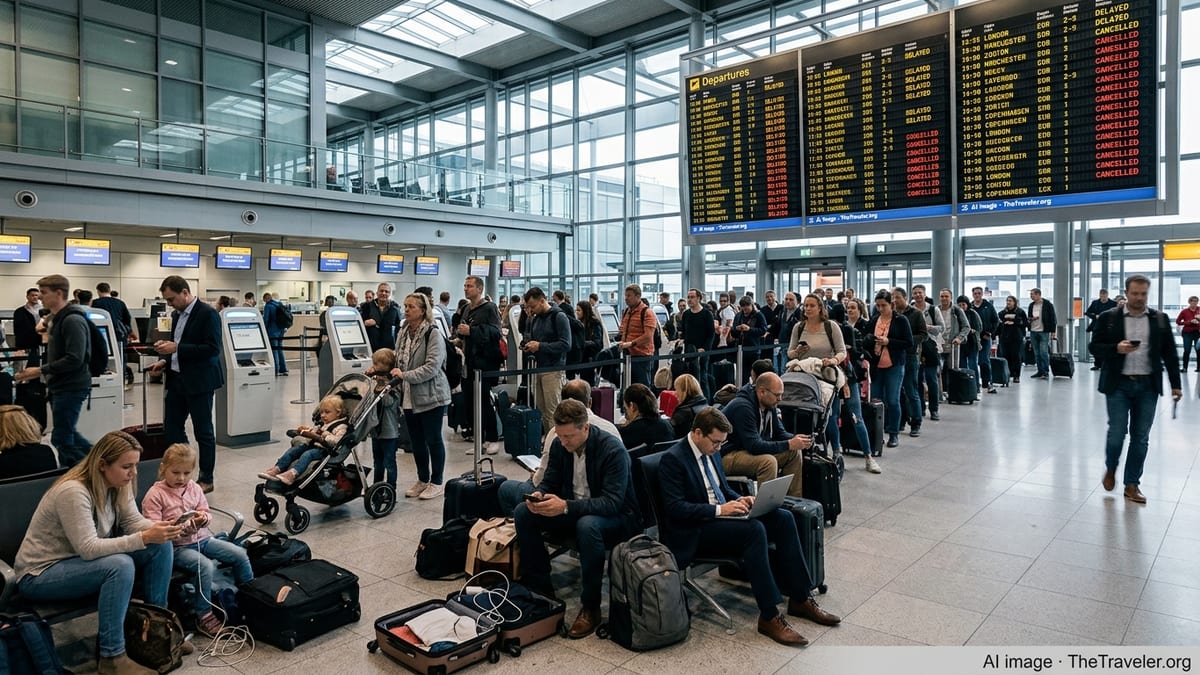
Widespread Operational Turbulence Across Key European Hubs
Publicly available flight tracking data for Monday indicates that Europe’s aviation network is again under heavy strain, with more than 2,000 flights either canceled or running late. The latest figures point to 102 cancellations and 1,901 delays across the continent, with a notable concentration of disruption around major hubs in Germany, the United Kingdom, France, Norway and Switzerland.
London, Zurich, Manchester and Copenhagen have featured prominently among the affected airports, according to multiple aviation analytics dashboards monitored on Monday. The pattern mirrors a broader trend seen over the past winter, when a combination of staffing constraints, industrial actions and recurrent storms repeatedly put pressure on schedules across Western and Northern Europe.
Flight disruption has not been uniform, with some airports reporting relatively normal operations while others struggled with knock-on effects from earlier delays and weather-related capacity restrictions. European network managers have previously highlighted how even localised issues, such as high winds or snow in one country, can ripple quickly through the tightly interconnected hub-and-spoke system that dominates regional air travel.
The latest flare-up follows a season in which several named windstorms brought gale-force conditions to the United Kingdom, France and Scandinavia, prompting widespread air traffic management restrictions and runway closures at times. Recent assessments of the 2025–26 European windstorm season describe repeated episodes where strong winds and heavy precipitation forced airlines and air traffic control to reduce movements for safety reasons, triggering rolling delays and cancellations far beyond the immediate storm zone.
Major Airlines Including British Airways, SAS, Lufthansa and easyJet Hit
The new wave of disruption has touched a wide range of carriers, with British Airways, SAS, Lufthansa and easyJet among those seeing schedules curtailed or pushed back. Data from previous operational performance reports at major European airports shows that these airlines already face a delicate balancing act, running dense schedules in congested airspace that can quickly unravel when weather or staffing issues arise.
In the United Kingdom, British Airways has been particularly sensitive to operational shocks at its primary London hub, where a high proportion of flights connect to onward long-haul services. Historic performance reports from large UK airports show that reactionary delays, where one late aircraft cascades into subsequent legs, regularly account for a significant share of total disruption for the flag carrier and its competitors.
Scandinavian travelers have also been affected. SAS, which relies heavily on Copenhagen as a connecting gateway between Scandinavia and the rest of Europe, has faced a series of scheduling challenges since early 2026, including industrial disputes and weather-related constraints reported in public forums. When Copenhagen experiences ground handling or air traffic flow restrictions, passengers on routes linking Denmark, Norway and Sweden with major European cities such as London and Zurich often feel the impact in the form of missed connections and extended layovers.
Germany’s Lufthansa and low-cost carriers such as easyJet continue to operate in some of the continent’s most crowded air corridors. Earlier analyses from European aviation bodies have highlighted how strikes by air traffic controllers and ground staff in France and Germany have repeatedly driven up average delays for these airlines, particularly on short-haul European sectors where turnaround times are tight and buffers limited.
London, Zurich, Manchester and Copenhagen Bear the Brunt
Monday’s figures show particularly acute disruption at several key airports that serve as both national gateways and major connecting platforms. London’s main international hubs, already operating near capacity during peak periods, have again seen a build-up of late departures and arrivals as incoming aircraft land behind schedule and must wait for slots, gates and crews.
Zurich, a key base for Swiss and other Lufthansa Group carriers, has experienced repeated periods of stress over the last two winter seasons. Punctuality rankings published over the past year have placed Swiss and Lufthansa among Europe’s poorer performers for on-time operations, a trend aviation analysts often link to structural congestion in Central European airspace and recurrent staffing and air traffic management constraints.
In Manchester, operational performance reports released in recent months for the wider airport group illustrate how even regional hubs are not immune. Weather delays, ground servicing bottlenecks and reactionary issues from earlier flights are commonly cited categories in these reports, aligning with the pattern of disruption seen on Monday.
Copenhagen’s role as a transfer hub for SAS and other airlines, meanwhile, means that any delay on long-haul arrivals can quickly translate into missed or tight connections for passengers heading onward across Europe. Posts shared by travelers in online aviation and travel communities in recent weeks describe a mix of rebookings, overnight stays and long waits as they attempt to navigate rescheduled itineraries through the Danish capital and other Northern European hubs.
Knock-on Effects and Passenger Experiences Across the Network
While Monday’s tally of 102 cancellations may appear modest compared with previous large-scale shutdowns, aviation experts note that the true impact is magnified by the 1,901 delays that can cascade through networks for days. When aircraft and crews end the day out of position, subsequent rotations must be adjusted, often forcing airlines to consolidate lightly booked flights, reroute aircraft or lean on partner carriers through codeshares and alliances.
Travelers have taken to social media and online forums to describe a familiar mix of queueing at service desks, long waits on customer service lines and uncertainty over rebooking options. In multiple recent cases documented online, passengers reported that flights initially appeared on time in airline apps before being pushed back repeatedly or disappearing altogether after what some described as “system cancellations.” Others detailed being rebooked via different hubs, or shifted between carriers, as airlines attempted to stitch together viable alternatives.
Consumer discussions in these forums frequently reference the complex web of rules governing compensation and assistance in Europe and the United Kingdom, especially where journeys involve multiple airlines or long-haul segments connecting through European hubs. With delays often attributed to weather, air traffic control flow restrictions or knock-on operational issues, many travelers are left weighing whether their situation falls under the category of extraordinary circumstances or qualifies for standard compensation.
For airports, the operational strain is equally visible. Handling late-arriving waves of passengers and baggage, managing ground transport queues and reallocating scarce stands and gates can disrupt terminal operations well into the night. Airport performance summaries published in recent months underline how spikes in late-evening arrivals complicate staffing patterns for security, immigration and ground services, raising the risk of further delays for departures the following morning.
What Stranded Passengers Can Do Next
Travel rights advocates point out that European Union Regulation 261/2004 and its UK equivalent set out common rules on assistance and, in some cases, compensation when flights are significantly delayed or canceled. These frameworks apply to most flights departing from EU or UK airports, and to arrivals operated by EU or UK carriers, although the exact entitlements depend on distance, length of delay and the cause of the disruption.
Under these regulations, passengers on severely delayed or canceled flights may be entitled to meals, refreshments, hotel accommodation and communication assistance while they wait for rerouting, regardless of whether compensation is payable. Public guidance also encourages travelers to keep receipts for reasonable expenses incurred during disruption and to submit claims directly to airlines, rather than relying solely on third-party intermediaries.
Specialist websites, consumer organizations and national enforcement bodies in Europe publish detailed explanations and example scenarios to help passengers understand how the rules apply to complex itineraries and codeshare flights. Recent online discussions highlight recurring questions about missed connections, downgrades to lower cabins when alternative flights are full and the treatment of journeys that start or end outside the EU or UK but include an intermediate stop in Europe.
With operational pressures expected to continue during the late winter and early spring travel period, industry analysts suggest that passengers traveling through London, Zurich, Manchester, Copenhagen and other major European hubs should build in extra buffer time for connections, monitor airline communications closely and consider flexible booking options where possible. As Monday’s figures again demonstrate, even a relatively limited number of cancellations combined with widespread delays can quickly transform a routine travel day into a challenging ordeal for thousands of passengers.