

More news on this day
Hundreds of travellers across Europe faced long queues, missed connections and unexpected overnight stays as widespread disruption hit major hubs including London, Paris, Amsterdam, Munich and airports in Spain, with publicly available data indicating around 1,872 flights delayed and at least 42 cancelled, heavily affecting operations for Lufthansa, KLM, Wizz Air, SAS and other carriers.
Get the latest news straight to your inbox!
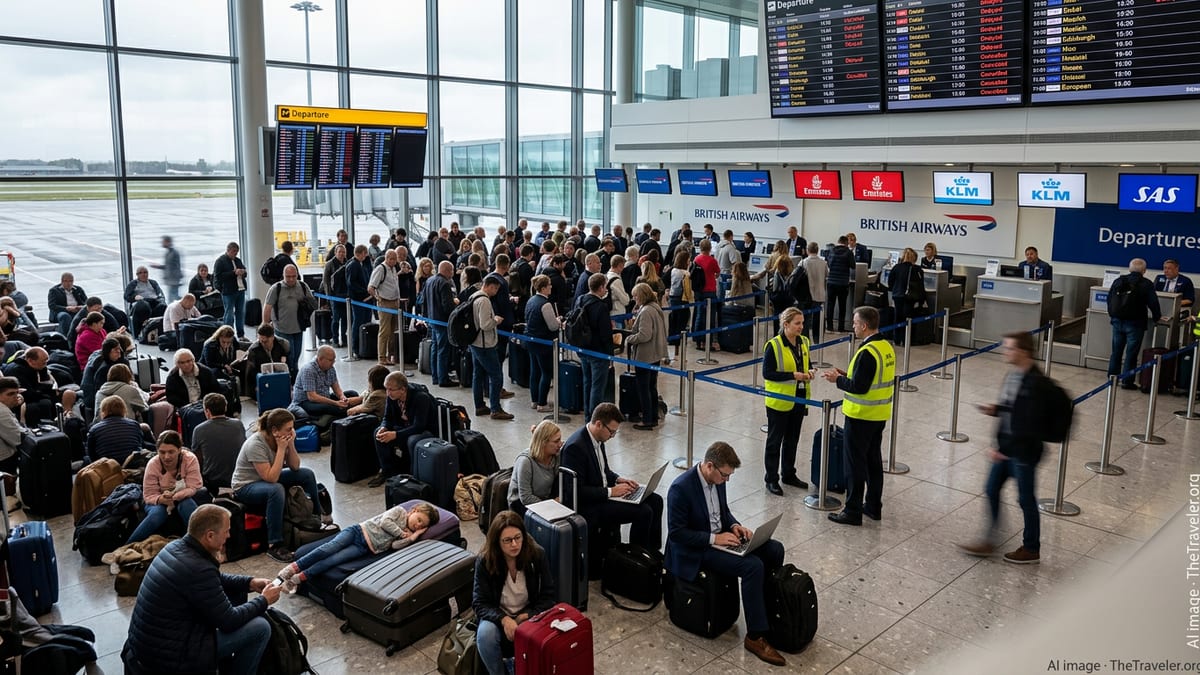
Image by Latest International / Global Travel News, Breaking World Travel News
Major Hubs Across Europe Grapple With Knock-On Delays
Flight-tracking and aviation analytics platforms on Monday indicated heavy disruption across European skies, with rolling delays building through the day at some of the region’s busiest hubs. London, Paris, Amsterdam, Munich and several Spanish airports reported some of the highest concentrations of late departures and arrivals, contributing to an estimated 1,872 delayed flights and 42 outright cancellations across the United Kingdom, Denmark, France, Germany, Spain and other countries.
The disruption is being described in industry coverage as a complex mix of local weather issues, airspace bottlenecks and operational strains after a difficult winter season. Recent storms over parts of northern and western Europe, alongside lingering staffing and aircraft-rotation challenges from earlier in the year, have left schedules vulnerable to even relatively minor interruptions that quickly cascade through the network.
Passengers at key airports reported long security and check-in queues, congested departure halls and late gate changes as delayed incoming aircraft knocked subsequent flights off schedule. With major hubs operating near capacity, small timing gaps left by a handful of delayed arrivals rapidly widened, pushing knock-on delays into the evening wave of flights.
While the overall number of cancelled services remains modest compared with the worst days of past disruptions, the scale of delays has been enough to strand travellers overnight and force many onto alternative routes across the continent.
Lufthansa, KLM, Wizz Air and SAS Among Most Affected Carriers
Publicly available data and recent performance reports indicate that some of Europe’s largest network and low-cost carriers are bearing the brunt of the latest disruption. Lufthansa, KLM, Wizz Air and SAS all feature prominently in delay statistics for the region, reflecting both their extensive intra-European networks and their reliance on tightly timed aircraft and crew rotations through major hubs.
Lufthansa’s operations in Munich and Frankfurt have been particularly sensitive this year, following a winter of weather-related issues and industrial action that left schedules stretched. Earlier in March, strikes affecting parts of the group’s operation triggered cancellations and backlogs, and industry observers note that today’s problems appear to be exacerbating an already fragile recovery in punctuality.
KLM, which relies heavily on Amsterdam Schiphol as a connecting hub, has also faced a challenging winter marked by de-icing bottlenecks and runway-capacity constraints. Aviation-focused analyses published in recent weeks highlighted how even short-lived ground holds at Schiphol can ripple through KLM’s short- and medium-haul network, a pattern that is now visible again as late arrivals from across Europe disrupt onward connections.
Low-cost operator Wizz Air, known for running dense schedules with tight turnaround times, appears vulnerable in similar ways. When ground operations slow at congested airports in Germany, Spain or Scandinavia, the carrier has limited slack to absorb delays, leading to a higher risk of late departures and missed connection opportunities on separate tickets. Scandinavian airline SAS, still restructuring its network, has also seen delay levels rise at Copenhagen and other Nordic gateways as it adjusts capacity and crew planning.
Weather, Airspace Constraints and Earlier Crises Feed Into Today’s Chaos
The latest wave of delays comes against a broader backdrop of strain on global aviation. In recent weeks, severe storms across parts of Europe and North America have disrupted flight patterns, while military tensions in the Middle East have forced large-scale rerouting of long-haul services between Europe and Asia. Published analyses describe how closures or restrictions in key Middle Eastern airspace have shifted traffic onto narrower corridors, increasing congestion on some European routes and complicating planning for airlines already dealing with winter-weather backlogs.
Reports on European windstorms earlier in the season detailed how major weather systems brought heavy snow, strong crosswinds and runway closures to airports such as Amsterdam, Paris and Munich, prompting hundreds of cancellations and delays. Those events not only stranded passengers at the time but also depleted airlines’ margins for error, leaving little room for further operational shocks as March progressed.
Aviation law resources also emphasise that, under European passenger-protection rules, airlines must provide care and, in some cases, compensation for significant delays and cancellations. That regulatory framework encourages carriers to operate as much of the schedule as possible, even when conditions are difficult, which can sometimes mean running heavily delayed flights rather than cancelling pre-emptively. The result, on days like today, is a sky full of late aircraft and terminals packed with frustrated travellers waiting for aircraft and crews to arrive from elsewhere.
Industry observers note that the interplay between weather, airspace constraints and high passenger demand means that disruptions originating far from Europe’s busiest hubs can still have a noticeable impact on same-day operations in London, Paris, Amsterdam, Munich and other cities.
Stranded Travellers Face Long Queues, Rebookings and Limited Options
For passengers caught up in the current wave of disruption, the experience is playing out in familiar ways. Travellers at European airports have described spending hours in customer-service queues to secure rebooked flights, hotel vouchers or meal support, while those on multi-leg itineraries scramble to piece together new routes through whichever hubs remain relatively stable.
With popular routes between the United Kingdom, France, Germany, Denmark and Spain already heavily booked for late March travel, options for same-day rebooking are limited. Many passengers are being offered flights one or more days later, or itineraries involving additional connections through smaller European airports that still have capacity. This is particularly challenging for those with time-sensitive plans or onward long-haul connections, who may find that missing a single short-haul leg leads to days of delay.
Travel insurers and consumer-rights organisations have recently reiterated guidance on documenting expenses and keeping all boarding passes and booking confirmations, in case passengers later seek compensation under European and United Kingdom regulations. Public information campaigns over recent years have increased awareness of the rights available under EU Regulation 261/2004 and its UK equivalent, though understanding the fine print around weather, airspace closures and extraordinary circumstances remains complex for many travellers.
Despite the difficulties, publicly available information shows that most European airports continue to process large numbers of flights, and aviation agencies stress that safety remains the overriding priority. However, with schedules as tight as they are at the tail end of the winter season, even moderate, short-lived disruptions are proving enough to leave hundreds of travellers sleeping in terminals or searching for last-minute accommodation nearby.
What Travellers Should Watch in the Coming Days
Analysts following the sector suggest that conditions could remain volatile in the short term. Weather systems expected to move across parts of northern and western Europe, combined with ongoing complexities in global airspace linked to tensions in the Middle East, mean that airlines and passengers alike may face further last-minute schedule changes. Historically, March has often been a transitional month in which lingering winter weather collides with busy leisure and business travel demand, exposing weaknesses in staffing, de-icing capacity and airport infrastructure.
Travellers are being encouraged by airlines, airports and travel advisories to monitor flight-status updates closely on the day of departure and to allow extra time at the airport, particularly when connecting through major hubs such as London Heathrow, Paris Charles de Gaulle, Amsterdam Schiphol and Munich. Where possible, experts recommend avoiding very tight connections and considering earlier flights in the day, when schedules have had less time to accumulate delays.
In the medium term, the latest disruption is likely to renew debate within Europe about airport capacity, staffing resilience and investment in air-traffic management technology. Eurocontrol data and other regional reports in recent months have highlighted continuing structural constraints in some parts of the network, even as passenger volumes recover or surpass pre-pandemic levels. For now, however, the immediate concern for hundreds of stranded travellers across Europe is simply getting a confirmed seat out of the terminal and back into the air.