

More news on this day
Hundreds of air passengers across Europe faced severe disruption today as airports in Denmark, the Netherlands, the United Kingdom and several other countries reported 2,497 delayed and 152 cancelled flights, snarling operations for carriers including easyJet, KLM and Lufthansa and leaving travellers stranded in London, Paris and other major hubs.
Get the latest news straight to your inbox!
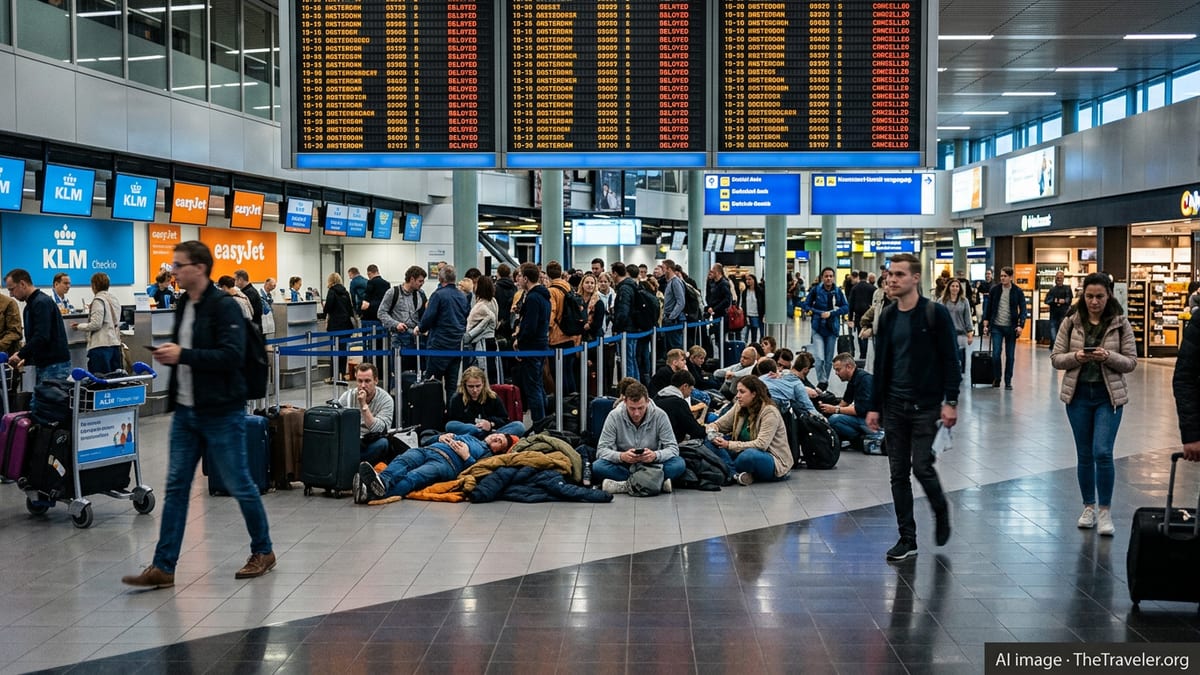
Widespread Disruption From Copenhagen To London
Publicly available operational data and industry reports indicate that flight delays have reached acute levels at several northern European hubs, with Denmark, the Netherlands and the UK among the hardest hit. Across the region, a combined 2,497 delayed services and 152 cancellations have triggered long queues, missed connections and terminal overcrowding.
In Denmark, Copenhagen Airport has emerged as one of the epicentres of the disruption, recording several hundred delayed departures and dozens of cancellations in a single trading day as airlines attempt to recover from earlier schedule shocks. Travellers transiting through the Danish capital have reported extended waits at gates and customer service desks as carriers reassign aircraft and crews.
UK airports are experiencing similar strain. London Heathrow, Gatwick, Stansted, Manchester, Birmingham and Liverpool have all logged triple digit delay totals in recent days, with dozens of outright cancellations. The fallout is being felt particularly strongly by passengers on intra European routes, many of whom rely on tight connections through London to reach onward destinations.
These operational difficulties are being amplified by the dense interlinking of European air routes. A late arriving aircraft in Copenhagen or Amsterdam can quickly cascade into further disruptions in London, Paris, Frankfurt and beyond, creating a knock on effect that ripples across the continent over the course of the day.
Major Carriers EasyJet, KLM And Lufthansa Under Pressure
Low cost and network carriers alike are being heavily impacted, with easyJet, KLM and Lufthansa all facing significant schedule changes. Data compiled from airline movements shows that KLM is dealing with particularly high numbers of delayed services, reflecting the strain at its primary hub in the Netherlands and on feeder routes into Amsterdam.
easyJet, which operates dense point to point networks out of London and other European bases, has recorded well over one hundred delayed flights and a notable number of cancellations. The airline’s sizeable presence at London Gatwick means that operational issues there have an outsized effect on its network, leaving many short haul leisure travellers facing extended waits or rebookings.
Lufthansa, meanwhile, is managing disruption across its German and wider European operations, with delayed departures from hubs such as Frankfurt and Munich affecting services to and from London, Paris and other capitals. These delays are complicating long haul connections for passengers trying to link intercontinental flights with shorter European sectors.
Other carriers, including British Airways, Air France, SAS and various regional operators, are also navigating schedule changes as they adjust to constrained airport capacity, weather related bottlenecks and lingering staffing challenges. The combined impact is a patchwork of rolling delays across multiple airlines and routes.
London, Paris And Key Hubs Struggle To Clear Backlogs
Major hubs in the UK and continental Europe are now working through sizable backlogs. London airports have reported hundreds of delayed flights in a single day, with Heathrow and Gatwick handling the largest volumes. These delays affect not only origin and destination passengers but also those relying on connections between domestic, European and long haul services.
In France, Paris Charles de Gaulle and Orly are facing their own pressures, tied both to regional weather systems and recent labour related issues affecting some operators. Delay and cancellation figures running into the hundreds across France, Germany, Italy and the Nordic countries illustrate how broadly the disruption is spread.
Smaller but strategically important hubs such as Oslo, Helsinki, Dublin, Keflavik and Stockholm are also seeing elevated levels of operational irregularities. When combined with issues at London and Paris, this has created a complex recovery picture for airlines attempting to restore normal rotations of aircraft and crew.
Rail links that feed into these airports are also under strain. Reports of Eurostar delays and reduced services between London, Paris, Brussels and Amsterdam add another layer of uncertainty for travellers whose journeys combine high speed rail with onward flights.
Underlying Causes Range From Weather To Staffing And Strikes
The latest wave of disruption comes against a backdrop of persistent structural stress in Europe’s aviation system. Recent severe weather episodes, including strong winds and heavy precipitation, have periodically reduced runway capacity at key airports, forcing sudden schedule cuts and diversions.
At the same time, several European carriers and airport operators continue to contend with staffing constraints, particularly in ground handling, security and air traffic management. When conditions tighten or unexpected events occur, these fragile staffing levels can quickly translate into longer turnaround times and missed slot windows, triggering wider knock on delays.
Industrial action has added further volatility. In France, for example, strike notices affecting easyJet cabin crew at major bases including Paris and Nice have introduced additional uncertainty into schedules, with targeted cancellations and timetable adjustments rippling into neighbouring markets such as the UK and the Netherlands.
These factors intersect with already busy spring travel demand and a European airspace that has grown more complex in recent years. The result is a system in which even moderate shocks can lead to large scale disruption, as evidenced by the latest figures on delays and cancellations affecting thousands of passengers in a single day.
What Stranded Travellers Can Expect Under EU Rules
For travellers caught up in these disruptions, European air passenger protections provide some important safeguards. Under the EU’s regulation on air passenger rights, many passengers on flights departing from or arriving in EU and certain associated countries are entitled to assistance in the event of long delays or cancellations.
Depending on factors such as flight distance, length of delay and the precise cause of the disruption, affected travellers may be eligible for care in the form of meals, refreshments, hotel accommodation and ground transport, as well as reimbursement or re routing at the earliest opportunity. In some circumstances, fixed sum financial compensation may also be payable.
However, these rights are not automatic in every case. Airlines can be exempt from compensation obligations when disruptions are caused by extraordinary circumstances that could not have been avoided even if all reasonable measures had been taken, such as certain severe weather or airspace closures. Passengers are therefore encouraged to keep detailed records of delay times, boarding passes and any written notices from airlines.
Consumer advocates note that claims can often be submitted retrospectively once travel is complete, either directly to carriers or through specialised claim services. With disruption levels currently elevated in Denmark, the Netherlands, the UK and several neighbouring markets, awareness of these protections is becoming increasingly important for Europe bound and Europe based travellers alike.