

More news on this day
Hundreds of travellers were left stranded across Europe as a fresh wave of disruption on Monday triggered 1,872 delayed flights and 42 cancellations, snarling operations at key hubs in the United Kingdom, Denmark, France, Germany and Spain and weighing heavily on carriers including Lufthansa, KLM, Wizz Air and SAS.
Get the latest news straight to your inbox!
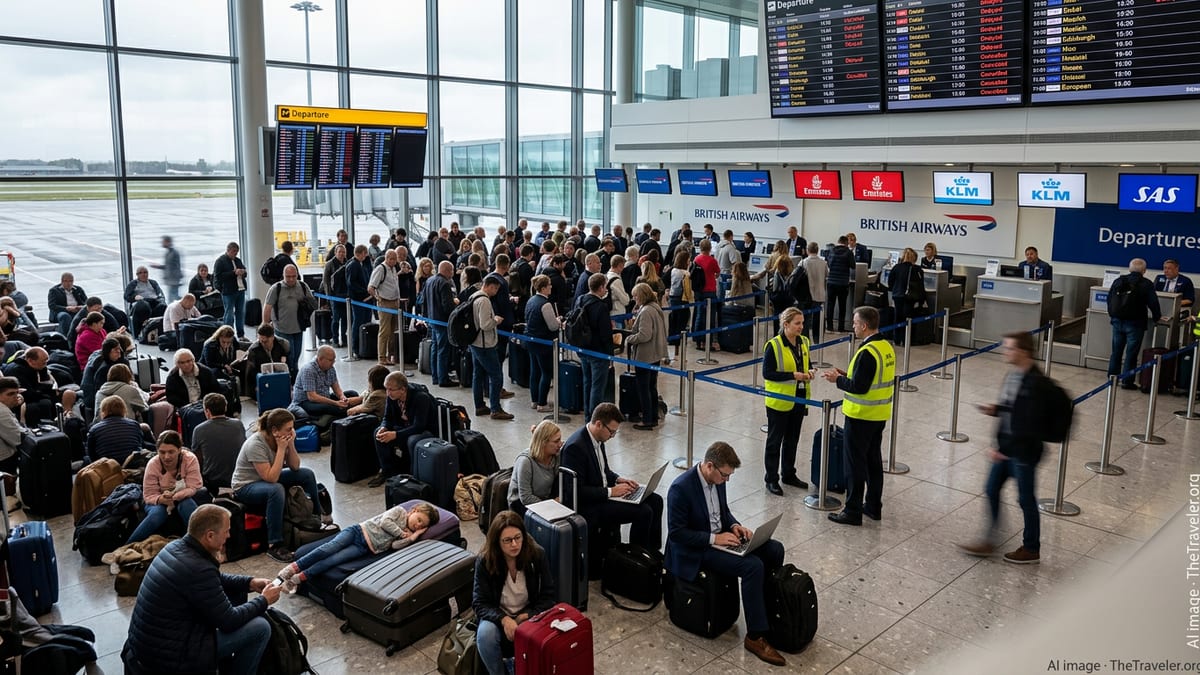
Image by Global Travel Alerts, Advisories, International Travel Alerts
Major Hubs Across Europe Struggle To Keep Schedules Moving
Publicly available airport and flight-tracking data for Monday indicate that disruption was concentrated at some of Europe’s busiest hubs, including London, Paris, Amsterdam, Munich and airports across Spain. The cumulative impact translated into nearly two thousand delayed departures and arrivals, with dozens of outright cancellations forcing passengers to queue for rebooking and overnight accommodation.
Network reports for early 2026 already show that European airlines have been operating under elevated strain, with long arrival delays rising compared with the previous year and legacy groups such as Lufthansa and the Air France–KLM alliance among the most exposed. The latest spike in operational issues adds to that pressure, especially at slot-constrained airports where recovery from one bad operations day can take several schedules to unwind.
Airports in Germany and the Netherlands have been frequent flashpoints during recent bouts of severe weather and staffing bottlenecks. Earlier this year, strong winds and heavy snow led to hundreds of cancellations and more than six hundred delays in a single day at Amsterdam Schiphol, with KLM and easyJet among the worst hit, underscoring how quickly schedules can unravel when conditions deteriorate. Similar patterns are now being reported again, though on a more geographically dispersed scale across western and northern Europe.
In France and Spain, winter and early spring storms have periodically disrupted aviation activity, and industry analyses point to an increase in average delay minutes per flight when disruption events hit multiple hubs simultaneously. The current wave of delays and cancellations appears to follow that familiar pattern of congested airspace, tight turnarounds and limited slack in the system to absorb shocks.
Airlines From Lufthansa To Wizz Air Face Network-Level Knock-On Effects
The impact on airlines such as Lufthansa, KLM, Wizz Air and SAS extends beyond the immediate list of delayed and cancelled flights. Hub-and-spoke networks depend on carefully timed connections, and even modest delays early in the day can cascade into missed onward connections, aircraft and crew out of position, and additional schedule trimming later in the evening.
Industry traffic reports for February and March 2026 show these carriers already operating dense schedules from their main bases in Frankfurt, Munich, Amsterdam, Copenhagen and a range of secondary European cities. When disruption hits several of these bases at once, aircraft rotations are reshuffled, spare capacity is consumed quickly and options for same-day rebooking narrow sharply, which is what many travellers experienced in recent days as they were pushed to overnight stays or re-routed via distant hubs.
Low cost and hybrid operators such as Wizz Air tend to run particularly tight utilisation of both aircraft and crews, a model that keeps costs down in normal times but leaves little room to recover from extended delays. Recent schedule updates for Wizz Air, including the planned closure of its Vienna base in March 2026, already reflect efforts to rationalise its network amid a demanding operating environment, so additional unplanned disruption further complicates fleet planning.
For SAS and other Nordic carriers linking Denmark and wider Scandinavia with the rest of Europe, irregular operations can be especially challenging in late winter and early spring, when weather conditions remain volatile and demand patterns are shifting toward the summer season. Prolonged delays at Copenhagen or other regional hubs quickly reverberate across feeder routes to major airports like London Heathrow, Paris Charles de Gaulle and Amsterdam Schiphol.
Weather, Overstretched Infrastructure And Wider Geopolitical Tensions
The surge in disruption comes against a backdrop of multiple stress factors on Europe’s aviation system. The 2025–26 European windstorm season has already produced several strong systems whose knock-on effect has included large clusters of cancellations and delays at airports such as Amsterdam, Paris and other coastal hubs, with some single-day events wiping out hundreds of flights. More recently, network operations reports highlight that long arrival delays have increased, driven in part by weather and air traffic management constraints.
Beyond meteorological conditions, labour and infrastructure challenges continue to weigh on reliability. Various national and sector-wide industrial actions over the past year have periodically affected air traffic control, ground handling and airport security staffing across parts of western Europe. Analyses of earlier French strikes, for example, show that industrial action can generate both air traffic flow management delays and outright cancellations across the wider network when flights must be rerouted or capacity reduced.
Geopolitical tensions and airspace restrictions have also added complexity to long-haul operations connecting Europe with the Middle East and Asia. Conflict-related airspace closures earlier in March forced airlines to reroute or suspend flights, with travel-industry assessments noting thousands of cancellations per day at the peak of the crisis on routes crossing affected regions. European carriers have had to absorb longer routings, higher fuel costs and more intricate contingency planning, making their schedules more vulnerable when additional local disruptions arise closer to home.
These compounded pressures mean that even a day featuring fewer than fifty outright cancellations, such as the current event, can still produce outsized passenger disruption if delays are heavily clustered around core connecting banks at major hubs. Travellers joining complex itineraries through European gateways have therefore faced a heightened risk of missed connections and unexpected layovers.
Passenger Rights And What Stranded Travellers Can Expect
As queues formed at customer service desks and digital channels became congested, many stranded passengers turned to Europe’s air passenger rights framework to understand what assistance they could request. European Union rules on passenger rights, mirrored in similar UK legislation, entitle travellers to care and, in some circumstances, financial compensation when flights are cancelled or subject to long delays, depending on distance, cause and length of disruption.
Under the EU’s common rules, travellers on flights departing from an EU or EEA airport, as well as those travelling into the region on an EU carrier, may be eligible for compensation amounts typically ranging from a few hundred euros upward if they arrive at their final destination several hours late and the delay is not caused by extraordinary circumstances such as severe weather or certain security risks. Regardless of compensation, airlines are generally expected to provide meals, refreshments, and accommodation where necessary while passengers wait for rerouting.
Consumer advocacy groups and online travel forums have repeatedly advised passengers to keep records of boarding passes, booking confirmations and receipts for reasonable expenses incurred during disruptions, as these documents are frequently required when submitting claims. Recent guidance shared with travellers dealing with cancellations in Europe also points to escalation mechanisms, such as alternative dispute resolution bodies and national enforcement agencies, for cases where compensation claims are rejected or delayed.
The current wave of disruption is likely to generate a fresh round of such claims, testing customer service capacity at several major carriers. Past episodes of widespread delays have shown that processing times can stretch over weeks or months when tens of thousands of passengers file compensation or reimbursement requests simultaneously.
Summer Schedules Loom As Airlines Race To Restore Confidence
The timing of the latest disruptions is particularly sensitive for Europe’s travel industry, which is in the midst of final preparations for the busy summer season. Aviation outlook reports for 2026 describe an environment of robust leisure demand but intense cost pressure, making operational reliability a key differentiator as travellers choose between competing carriers and routing options.
Airlines have been working to adjust schedules, rebalance capacity and reduce structural congestion risks at pressure points across the network. Some have trimmed marginal routes, shifted flying to less congested time bands or invested in improved crew and fleet planning tools intended to reduce knock-on delays. Industry analysis shows that even modest improvements in on-time performance can unlock significant cost savings and help restore passenger confidence after prominent disruption events.
Tourism-facing economies in southern Europe, including Spain, Greece and Cyprus, are closely watching aviation reliability indicators after recent reports of booking cancellations tied to wider regional tensions. A sustained pattern of operational instability at key European hubs could weigh on late bookings and encourage travellers to favour more predictable short-haul options or alternative transport modes for intra-European trips.
For now, carriers and airports are focused on clearing backlogs and returning operations to a more stable footing over the coming days. With summer timetables beginning to ramp up in early April, the latest episode of widespread delays and cancellations serves as a reminder of how finely balanced Europe’s aviation system remains and how quickly conditions can deteriorate when multiple risk factors converge.