

More news on this day
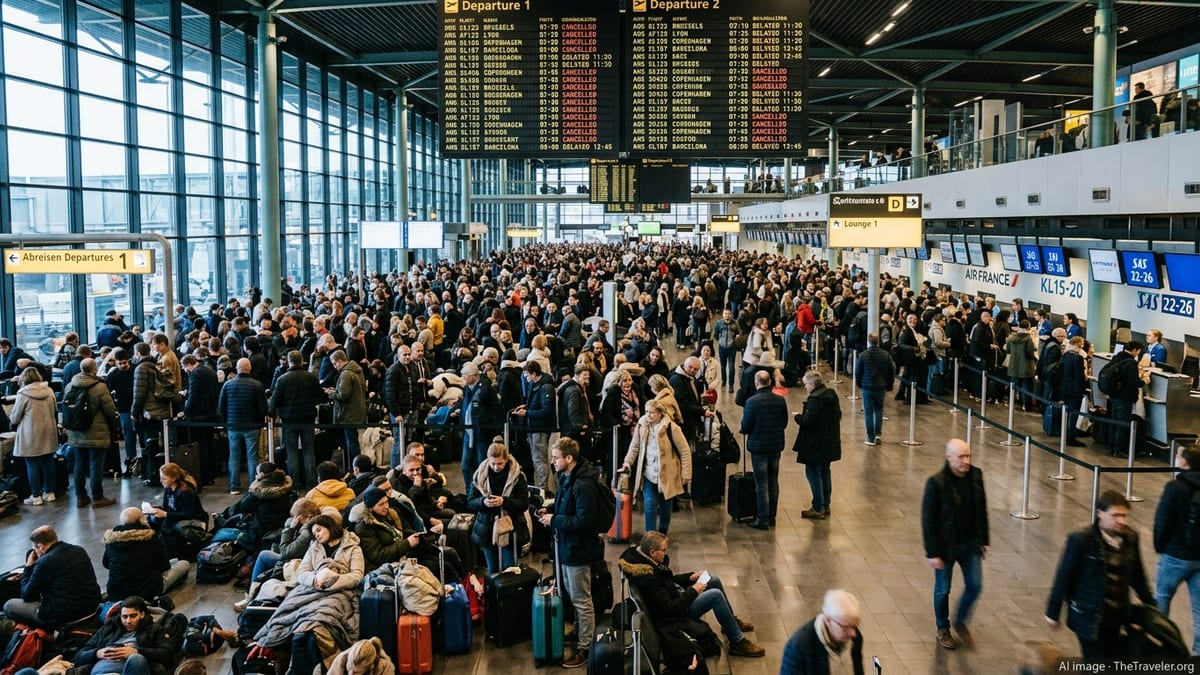
Thousands of passengers across Europe faced hours-long queues, missed connections and overnight stays as a fresh wave of disruptions hit major hubs in the Netherlands, France, Belgium and Spain, with publicly available data indicating at least 85 flight cancellations and 1,933 delays affecting carriers including Pegasus, SAS, Air France and Icelandair at airports such as Amsterdam, Lyon, Brussels and Barcelona.
Get the latest news straight to your inbox!
Major Hubs Buckle Under Winter and Capacity Pressures
Operational data from flight-tracking and airport performance platforms show that Amsterdam Schiphol again emerged as one of the hardest-hit airports, with a combination of winter weather, de-icing constraints and air-traffic capacity issues triggering widespread cancellations and long knock-on delays. The latest disruption adds to a difficult winter in which Schiphol has repeatedly struggled to maintain schedules when snow and freezing conditions arrive.
Similar patterns were reported at Brussels, Lyon and Barcelona, where congested airspace and tight turnaround times left little margin when early-morning rotations slipped behind schedule. Delays built throughout the day as aircraft and crews fell out of position, leaving some departures grounded for several hours while airlines tried to re-sequence operations.
Low-cost and network airlines alike were affected, with Pegasus, SAS, Air France and Icelandair among the carriers showing clusters of late or cancelled services in monitoring dashboards. The disruption extended across both intra-European routes and longer-haul connections via the affected hubs, magnifying the impact for travelers trying to make multi-leg journeys.
While the total number of cancellations remained relatively modest compared with some previous crises, the scale of delays meant that thousands of passengers were still stranded or heavily inconvenienced, particularly at transfer-heavy airports where missed connections quickly ripple through the system.
Knock-on Effects Across Airline Networks
Once the initial wave of delays took hold, the rigid nature of many airline schedules left limited room to recover during the same operating day. Aircraft stuck on the ground in Amsterdam or Brussels could not reach onward destinations on time, forcing further adjustments and compounding disruption across Europe.
Regional services operated by SAS and Air France into northern Europe and Scandinavia were particularly vulnerable, as smaller aircraft serving secondary cities rely on tight rotations through hub airports. When a single flight is delayed or cancelled, subsequent legs can be thrown off by several hours, creating a domino effect for passengers and crews.
Icelandair and Pegasus, which depend on specific connecting waves at their own bases, also faced challenges when partner or feeder flights into major European hubs were delayed. Late arrivals reduced available connection windows, resulting in missed transfers and the need for rebooking on later services or alternative routings.
Publicly available flight-status information indicated that some airlines attempted to consolidate lightly booked services or swap aircraft to larger-capacity jets where possible, in a bid to move as many passengers as they could in a constrained operating environment. However, these efforts were often outpaced by the volume of travelers needing assistance.
Traveler Experience: Long Queues and Limited Options
Reports from passengers and airport observers described crowded terminals, long customer-service lines and confusion over rebooking options as the disruptions intensified. At busy transfer points such as Amsterdam and Barcelona, travelers arriving late from one leg often found their onward flights already departed, with limited same-day alternatives remaining.
Hotel capacity near major airports quickly tightened as evening cancellations were added to already strong winter and business demand. Some travelers reported being rebooked for departures a full day or more later, particularly on popular city-pair routes where remaining seats had already been sold in advance.
The situation was particularly difficult for families, elderly passengers and those with fixed event dates, such as cruises or tours, who faced the prospect of missing non-refundable arrangements. With many flights fully booked for the coming days, even confirmed rebooking did not always guarantee a smooth onward journey.
Travel forums and social channels showed an uptick in advice-sharing among passengers, with experienced flyers recommending that stranded travelers explore rail connections between cities like Amsterdam, Brussels, Paris and Lyon, or consider nearby alternate airports where operations appeared less affected.
Regulatory Protections and Passenger Rights in Focus
The disruption again highlighted the importance of understanding passenger rights under European and UK regulations. Under the EU’s air passenger rules, many travelers departing from EU airports or flying on EU-based carriers may be entitled to care, rerouting and, in some cases, financial compensation when flights are cancelled or significantly delayed, except where airlines can demonstrate extraordinary circumstances.
Consumer advocates frequently point out that compensation eligibility depends on the specific cause of a delay or cancellation, as well as flight distance and the total length of the disruption. While severe weather and certain air-traffic-control restrictions can limit compensation obligations, duty-of-care provisions such as meals, refreshments and, where necessary, accommodation still generally apply.
Published guidance from consumer agencies encourages travelers to keep receipts, document communications with airlines and verify whether the reason given for a cancellation matches official airport and air-traffic information. Passengers are also urged to check whether they were offered the earliest possible rerouting option, including on partner or competing airlines, where regulations require it.
With several European hubs now experiencing repeated episodes of large-scale disruption each season, passenger-rights organizations continue to call for clearer communication from airlines during operational crises and for more proactive handling of vulnerable travelers who may be less able to navigate complex rebooking decisions on their own.
Planning Ahead: What Travelers Can Do Now
For travelers with upcoming itineraries through Amsterdam, Lyon, Brussels, Barcelona or other busy European hubs, current patterns suggest that flexibility and preparation are increasingly important. Booking longer connection times, avoiding the last flight of the day where possible and monitoring flight status closely in the 24 hours before departure can help reduce the risk of missed connections.
Travel experts also recommend building in backup surface options for shorter intra-European segments, such as rail journeys between major cities that sit on high-speed networks. Having a basic contingency plan can make it easier to react quickly if a flight is significantly delayed or cancelled at short notice.
Travel insurance that specifically covers delays and missed connections, combined with knowledge of statutory rights, can provide an additional layer of protection when schedules unravel. Policies differ widely, so travelers are encouraged to review coverage details well before departure and to retain all documentation in the event of a claim.
As airlines, airports and regulators continue to grapple with capacity constraints, weather extremes and technology vulnerabilities, episodes of large-scale disruption such as the latest wave of 85 cancellations and 1,933 delays are likely to remain a recurring feature of the European travel landscape, making informed planning an essential part of any trip.