

More news on this day
Thousands of travellers have been left stranded across Europe after widespread disruption led to 1,554 flight delays and 97 cancellations affecting services in the United Kingdom, Germany, France, Spain, Denmark and other countries, snarling operations for carriers such as British Airways, Lufthansa, SAS and Pegasus at major hubs from London and Paris to Frankfurt and Amsterdam.
Get the latest news straight to your inbox!
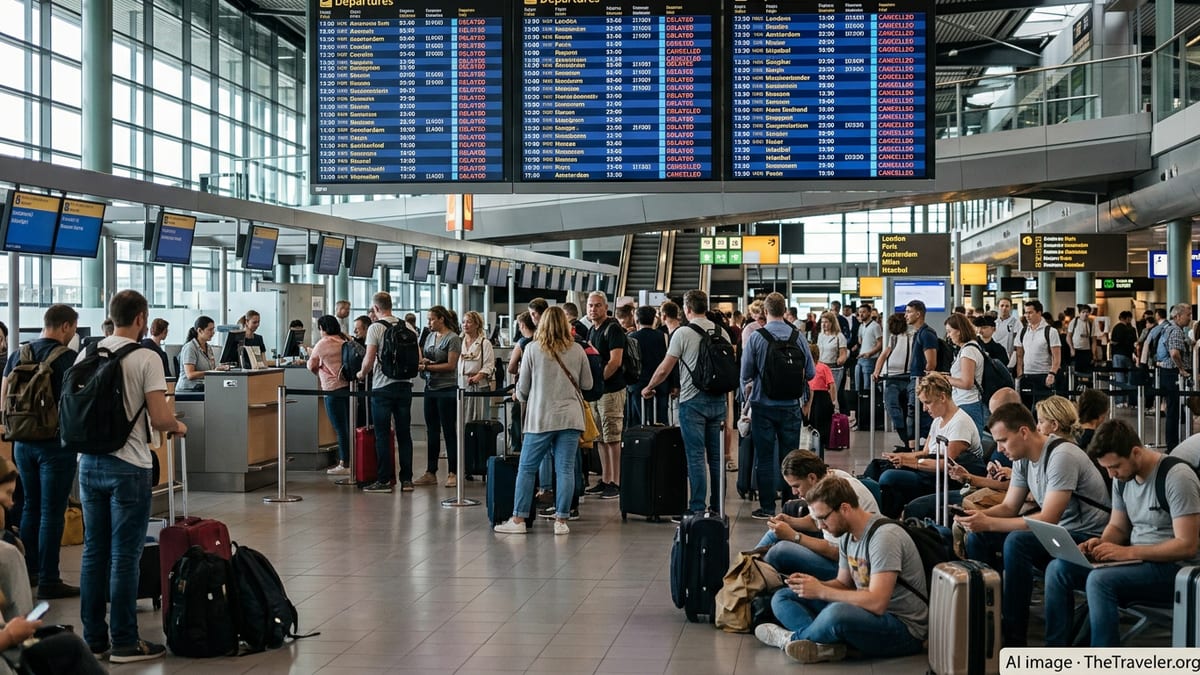
Major Hubs Buckle Under Network-Wide Disruption
Published operational data and airline updates indicate that Europe’s busiest hubs have borne the brunt of the latest disruption, with London, Paris, Frankfurt and Amsterdam reporting long queues, rolling delays and gate changes throughout the day. Knock-on effects have rippled into secondary airports serving major cities in Spain, Denmark and the wider Schengen area, catching many passengers mid-journey and limiting rebooking options.
At London Heathrow and Gatwick, British Airways has faced a wave of schedule changes as late-arriving aircraft and congested airspace forced crews to hold or re-rotate planes, leaving passengers stuck on board or waiting in crowded departure halls. In Paris, services operated by Air France, low-cost rivals and codeshare partners have also been affected, compounding delays for connecting travellers heading to Africa, Asia and North America.
Germany’s Frankfurt hub has seen a series of rolling delays across Lufthansa’s short and medium-haul network, with banked connections particularly vulnerable when one late inbound aircraft disrupts an entire wave of departures. Reports from Denmark and the Netherlands describe similar patterns, with Copenhagen and Amsterdam Schiphol handling both local disruptions and diverted traffic from elsewhere in the region.
With so many hubs simultaneously affected, the normal safety valve of rerouting via a nearby airport has been harder to use. Capacity constraints, crew duty time limits and aircraft positioning issues have all contributed to the unusually high number of delayed and cancelled services recorded across the European network.
British Airways, Lufthansa, SAS and Pegasus Among Hardest Hit
Publicly available airline schedules and flight-tracking data show that major European groups have experienced some of the most significant operational strains. British Airways has seen a series of late departures and a smaller number of outright cancellations across its short-haul network from London, while long-haul services have been affected by aircraft arriving late from disrupted European feeder flights.
Lufthansa’s operations from Frankfurt and Munich have similarly been affected, with passengers reporting cancellations on intra-European routes and missed onward connections to North America and Asia. The carrier has been using partner airlines within its wider alliance where possible, but high load factors and limited spare capacity have restricted the number of same-day alternatives available to stranded travellers.
Scandinavian Airlines (SAS) has faced additional challenges across its Nordic bases, where schedule adjustments linked to higher operating costs and fuel prices have intersected with wider network disruption. Published coverage in Scandinavian media has recently highlighted short-notice cancellations on some routes from Copenhagen and Oslo, and today’s network issues have further limited the airline’s ability to absorb irregular operations.
Turkish low-cost operator Pegasus, which runs an extensive network linking Turkey with European Union hubs, is also experiencing disruption as delays cascade through its rotation-heavy schedules. Any single late inbound aircraft can quickly affect several subsequent legs, a vulnerability that becomes particularly acute when air traffic control restrictions or adverse weather hit multiple regions at once.
Knock-On Effects Across Europe’s Crowded Skies
European aviation has been operating close to its pre-pandemic traffic volumes, and network reports from Eurocontrol show that capacity constraints, staffing limitations and seasonal weather all contribute to a fragile system that can tip into widespread disruption when several factors coincide. Recent analytical briefings have already pointed to France, Germany and Spain as key generators of air traffic flow management delays due to congested routes and limited controller availability.
In the current episode, delays have been amplified by the tightly interconnected nature of European scheduling. A late-morning disturbance in one country can quickly ripple into afternoon and evening waves elsewhere, particularly when it affects large carriers with dense hub-and-spoke networks. The 1,554 delayed flights recorded across the region today represent not only individual inconveniences but also missed connections, crew reassignments and overnight aircraft out of position for the following morning’s departures.
Weather has added another layer of complexity in recent months. A series of Atlantic storms and Mediterranean lows during the 2025–26 European windstorm season has already caused multiple days of cancellations and diversions, with several systems hitting the United Kingdom, France, Spain and surrounding states in quick succession. Each new episode builds on a network that is still working to recover from previous disruptions, making it harder for airlines to restore normal operations quickly.
According to recent European aviation overviews, staffing and capacity bottlenecks at air navigation service providers and some major airports remain a chronic challenge. Even on routine days, controllers and ground operations teams are working close to their limits; when irregular operations strike, there is limited margin to absorb spikes in demand, leading to longer delays and more frequent cancellations.
Passengers Face Long Queues, Rebookings and Limited Options
For travellers on the ground, the disruption has translated into hours-long waits at check-in counters, transfer desks and customer service points. With nearly a hundred flights cancelled outright and more than a thousand delayed, many passengers have been forced to queue for rerouting, hotel vouchers or compensation under European Union and United Kingdom passenger rights frameworks.
Under EU261 and the post-Brexit UK261 regulations, airlines operating from or within the European Union and the United Kingdom are generally required to offer rebooking or refunds when flights are cancelled, alongside care such as meals and accommodation when passengers are stranded overnight. Online travel forums and consumer advice outlets have recently reported that some travellers are turning to these rules to secure hotel stays and alternative flights when same-day rebooking is unavailable.
However, high load factors on remaining services mean that rebooking can often push travellers back by several days, particularly on long-haul routes or to smaller regional destinations served only a few times per week. Reports from affected airports today describe families sleeping on terminal floors, business travellers improvising remote workspaces near power outlets and long lines building around limited customer-service desks.
Digital tools such as airline apps and self-service kiosks have helped some passengers secure alternative flights or request refunds without waiting in person, but not all customers have access to these channels or are familiar with the rules. Consumer advocates continue to recommend that travellers keep boarding passes and receipts for reasonable expenses, as these documents can be critical when submitting claims once the immediate disruption subsides.
Outlook: A Strained System Heading Into Peak Seasons
Recent statistical overviews from European aviation bodies suggest that overall traffic has largely recovered from the pandemic downturn, with carriers such as SAS and Pegasus reporting strong growth in flight volumes over the past year and major groups like British Airways and Lufthansa operating near pre-crisis capacity. At the same time, infrastructure and staffing have not expanded at the same pace, leaving little slack in the system when weather, geopolitical events or technical issues arise.
Analysts tracking the region’s performance note that France, Germany and Spain alone account for a significant share of en-route air traffic flow management delays, while key airports in the United Kingdom, the Netherlands and Scandinavia continue to grapple with resource constraints. This structural imbalance means that days like today, when 1,554 flights are delayed and 97 are cancelled across multiple states, are likely to recur, particularly around busy holiday periods.
For airlines, the latest wave of disruption underscores the importance of operational resilience strategies, including better aircraft and crew contingency planning, closer coordination with air navigation service providers and more realistic scheduling that accounts for chronic congestion on some routes. For passengers, it is a reminder to build extra time into itineraries involving tight connections and to stay informed about their rights when flights are delayed or cancelled.
As Europe moves toward the spring and summer peak seasons, industry reports indicate that demand for air travel remains robust despite recent disruptions. Unless capacity and staffing issues are addressed more comprehensively across the network, however, travellers may need to brace for further days of widespread delays and cancellations at major hubs from London and Paris to Frankfurt, Amsterdam and beyond.