

More news on this day
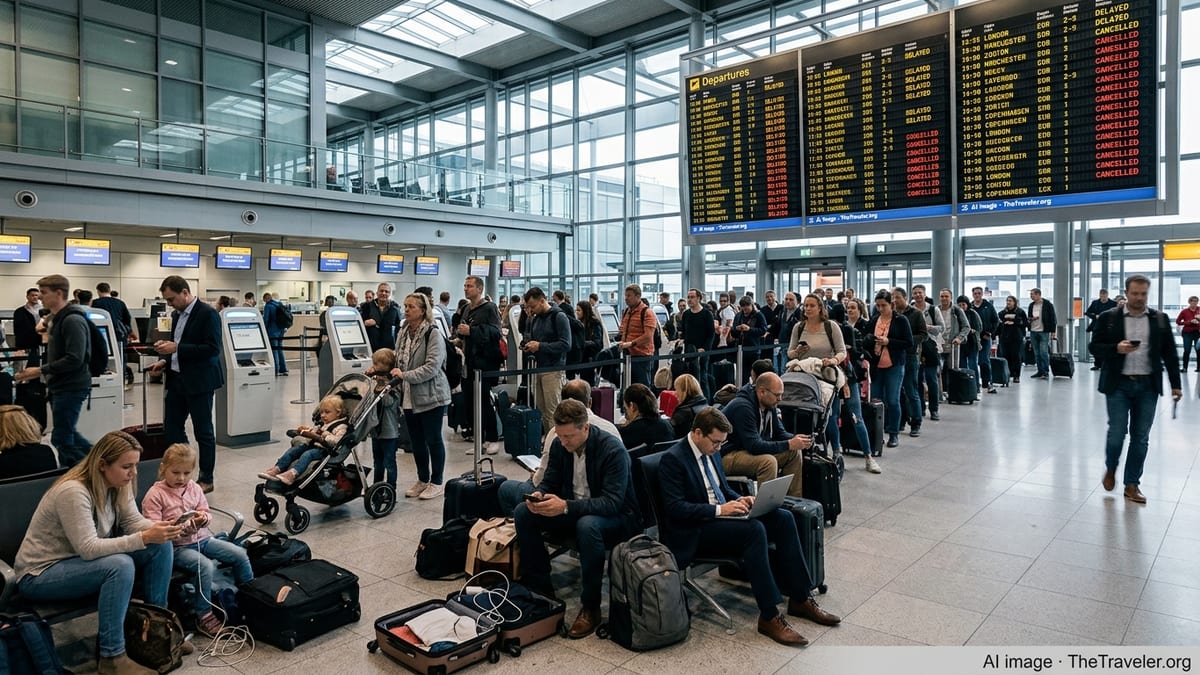
Thousands of air passengers across Europe faced major disruption today as operational constraints and adverse weather combined to delay 1,425 flights and cancel 80 more across France, Germany, Italy, the Netherlands, Spain and the United Kingdom, heavily affecting services operated by Lufthansa, KLM, British Airways, Air France and other carriers at leading hubs such as Paris, London, Madrid and Rome.
Get the latest news straight to your inbox!
Major Hubs From Paris to London Hit by Wave of Disruptions
Published traffic and airport monitoring data indicate that the worst disruption has been concentrated at Europe’s busiest hubs, with Paris, London, Madrid and Rome among the hardest hit. Knock-on effects are also reported at secondary airports in Germany, Italy, Spain and the Netherlands as aircraft and crew fall out of position.
Air France and its partners have faced rolling delays at Paris Charles de Gaulle and Orly, with congestion spreading through regional French airports as connections misalign. In London, British Airways schedules at Heathrow and Gatwick have seen extended ground holds and late arrivals, creating long queues at rebooking desks and customer service points.
In Spain and Italy, publicly available flight feeds show a pattern of late departures and missed connections at Madrid Barajas and Rome Fiumicino, affecting both intra-European services and long haul links. Passengers connecting onward to Latin America, Africa and Asia have been particularly exposed, with some itineraries disrupted by multiple separate delays in the same day.
At Amsterdam Schiphol and key German hubs such as Frankfurt and Munich, Lufthansa Group and KLM passengers have reported extensive re-timings and rebookings. Earlier heavy weather in northwestern Europe this season has already stretched schedules, and today’s additional constraints have compounded the challenge of restoring normal operations.
Weather, Airspace Constraints and Capacity Issues Behind Delays
Operational data from European aviation bodies and national meteorological services point to a mix of adverse weather, short-notice airspace restrictions and air traffic control capacity constraints behind the current disruption. Strong winds, heavy rain and low clouds over parts of France, Germany, the Netherlands and the UK reduced runway capacity at several airports, requiring longer spacing between arrivals and departures and forcing airlines to hold or divert flights.
Across the wider network, air traffic flow management regulations have been introduced to prevent sectors of European airspace from becoming overloaded. Recent reporting from Eurocontrol has highlighted that staffing and capacity issues in some air navigation service units, particularly in France and parts of Germany and Spain, continue to generate a significant share of delay minutes during busy periods.
When bad weather coincides with these structural constraints, punctuality deteriorates quickly. Today’s pattern of 1,425 delayed flights and 80 cancellations across multiple states reflects how vulnerable high-density hubs remain to relatively small reductions in available capacity, especially at times when schedules are already tight and contingency aircraft are limited.
Industry analyses published over recent months have also noted that European punctuality remains sensitive to seasonal weather events and the cumulative effect of airspace restrictions linked to wider geopolitical tensions, which can force traffic onto narrower corridors and increase congestion along southern and central European routes.
Lufthansa, KLM, British Airways and Air France Among Worst Affected
According to real-time schedule trackers and airline operational updates, large network carriers including Lufthansa, KLM, British Airways and Air France have borne the brunt of today’s disruption. Their extensive hub-and-spoke models mean that delays at a single hub rapidly cascade through connecting banks of flights and onward services.
Lufthansa has experienced rolling knock-on delays at Frankfurt and Munich as aircraft arriving late from other European cities compress turnaround times. Late inbound flights reduce the buffer for crews to complete safety checks, boarding and pushback, prompting several rounds of minor delays that can accumulate into missed connections for passengers on tight itineraries.
KLM operations at Amsterdam Schiphol have also come under strain, following a winter season in which the airline and airport have already dealt with episodes of heavy snow and strong winds. Publicly available flight boards show clusters of services departing more than an hour behind schedule, especially on regional European routes that depend on rapid turnarounds.
British Airways and Air France, meanwhile, are navigating disruption at some of Europe’s most constrained airports. With Heathrow and Charles de Gaulle already operating close to capacity on a typical day, any weather-related reduction in runway availability or temporary limitation in air traffic control flow produces a swift backlog of departing and arriving aircraft that can take many hours to clear.
Passengers Face Long Queues, Rebookings and Overnight Stays
Reports from airports across the affected countries describe long queues at airline service counters, self-service kiosks and baggage halls as travellers attempt to salvage disrupted journeys. Families returning from holidays, business travellers and students heading back to universities are among those facing missed events and extra nights away from home.
In several hubs, airport operators have activated contingency plans to manage crowding, including deploying additional staff for queue management, providing water and basic refreshments, and extending opening hours for information points. Ground transport links around major hubs have also become busier as some passengers opt to abandon delayed flights in favour of rail or coach alternatives on short and medium distance routes.
European consumer groups are reminding travellers that, on flights departing from the European Union, the United Kingdom and associated states, airlines remain subject to passenger rights rules governing assistance during long delays and cancellations. These frameworks typically require carriers to provide meals, refreshments and hotel accommodation where necessary, irrespective of whether the underlying cause is considered extraordinary.
However, the practical experience on the ground often depends on the scale of disruption and the resources available at each airport. During large-scale events, many airlines rely heavily on digital rebooking tools and messaging apps, and passengers without ready access to these services can find it more difficult to obtain timely information and support.
What Travellers Can Expect in the Coming Days
Network forecasts and recent performance reports suggest that it may take some time for European schedules to stabilise fully, especially if unsettled weather persists over key airspace sectors. Airlines will first focus on operating today’s remaining services as safely and punctually as conditions allow, while gradually repositioning aircraft and crews to restore regular patterns of flights.
In the short term, travellers with bookings over the coming 24 to 48 hours should prepare for the possibility of residual delays, particularly on early morning departures following late-arriving aircraft. Publicly available advice from airports and airlines emphasises the importance of checking flight status frequently, allowing extra time for security and boarding, and monitoring gate changes closely.
Analysts note that the broader trend in Europe points to a gradual improvement in structural delay levels compared with the most disrupted years earlier in the decade, even if individual days such as today still see significant disruption when multiple risk factors coincide. Investments in air traffic management, airport infrastructure and digital passenger communications are expected to play an important role in reducing the impact of future events.
For now, tens of thousands of passengers remain scattered across terminals from Paris and London to Madrid, Rome and beyond, waiting for updated departure times, replacement flights or alternative routes home as Europe’s aviation system works to absorb another day of concentrated strain.