

More news on this day
Thousands of air passengers across Europe are facing severe disruption as a fresh wave of cancellations and delays ripples through major hubs in France, England, the Netherlands, Norway, Spain and beyond, with recent snapshots indicating 58 flights cancelled and 1,379 delayed across carriers including SAS, KLM, British Airways and Lufthansa.
Get the latest news straight to your inbox!
Major Hubs From Paris to London and Oslo Under Pressure
Operational dashboards tracking air traffic across Europe on April 3 and 4 highlight widespread disruption concentrated around some of the continent’s busiest airports. Paris Charles de Gaulle, London Heathrow and Gatwick, Amsterdam Schiphol, Oslo Gardermoen and Madrid Barajas are among the hubs reporting elevated levels of late departures and missed arrival slots as airlines struggle to work through congested schedules.
While the headline figure of 58 cancellations appears modest compared with historic shocks, the scale of the 1,379 delays is driving the greatest impact for passengers. Travel data compiled from airport performance feeds and airline punctuality trackers shows that many of these delays stretch beyond one or two hours, a level that can easily cause missed connections and force overnight stays.
Reports indicate that traditional network carriers such as SAS, KLM, British Airways and Lufthansa are particularly exposed, due to their reliance on tightly timed hub‑and‑spoke operations at airports like Copenhagen, Amsterdam, London and Frankfurt. When an inbound flight arrives late, the knock‑on effect can cascade through several onward legs, amplifying the disruption felt by travelers far from the original problem airport.
Low cost and regional operators are also being caught in the ripple effects. Publicly available tracking data points to scattered delays among airlines feeding traffic into the major hubs, creating bottlenecks at security, boarding gates and baggage reclaim at peak times throughout the day.
Weather, Staffing and Knock‑On Delays Drive the Disruptions
Analysis of network reports and aviation briefings suggests there is no single cause behind the latest round of disruption. Instead, a combination of seasonal weather, residual staffing constraints and reactionary delays is straining resilience at several airports simultaneously. Eurocontrol summaries for late winter and early spring highlight periods of low cloud, strong winds and poor visibility across parts of western and northern Europe, conditions that typically reduce runway capacity and slow turnaround times.
At the same time, airlines and ground handling providers in France, the United Kingdom, the Netherlands and Spain continue to manage tight staffing levels following several years of fluctuating demand. Aviation performance reports frequently cite crew availability and ground handling bottlenecks as recurring issues, particularly at peak morning and evening banks when multiple long‑haul and short‑haul flights converge on the same terminals.
Reactionary delay, where one disruption triggers a chain of further delays, is a prominent feature in current datasets. Industry analyses note that once a carrier’s first wave of flights is significantly delayed, recovering the schedule can be difficult without cancelling rotations later in the day. This pattern appears in the latest figures, where relatively few outright cancellations are paired with a large volume of late departures, suggesting airlines are prioritizing keeping flights operating, even if behind schedule.
Observers also point to the lingering effects of recent air traffic control constraints and infrastructure outages in parts of Europe. Although not always directly visible to passengers, restrictions on airspace, reduced controller capacity or technical slowdowns can force aircraft into longer routings or holding patterns, tightening the squeeze on already busy airports.
National Impacts in France, England, the Netherlands, Norway and Spain
The disruption is being felt unevenly across the continent, with certain national networks bearing a heavier load. France continues to feature prominently in disruption statistics, reflecting both the central role of Paris as a long‑haul gateway and the sensitivity of French airspace to traffic flows between northern and southern Europe. Publicly available traffic data shows recurring delays for flights crossing French airspace on busy days, contributing to the wider knock‑on effects.
In England, London’s multi‑airport system is again under strain. Recent coverage of performance at Heathrow, Gatwick, London City and regional airports such as Manchester and Liverpool points to sustained congestion on some days, with dozens of delays and a cluster of cancellations recorded within a 24‑hour window. With British Airways operating a dense schedule of European and long‑haul services from Heathrow and Gatwick, even small schedule disruptions can quickly affect thousands of passengers.
The Netherlands and Norway are experiencing their own challenges, particularly at Amsterdam Schiphol and Oslo Gardermoen. Schiphol’s role as a central European hub for KLM and its partners means that delays there can spread across networks reaching into Scandinavia, the Baltics and southern Europe. Oslo, a key base for SAS and Norwegian, is highly exposed to winter weather and runway performance issues; when arrival rates are cut, flights can be held on the ground across the region, extending disruption to secondary cities.
Spain’s large domestic and international market is also reflected in the numbers. High‑volume leisure gateways such as Madrid and Barcelona, alongside coastal airports serving the Mediterranean and Canary Islands, feature regularly in disruption tallies. Passenger‑rights organizations note that the combination of strong leisure demand, busy transfer traffic and recurring air traffic control constraints over parts of western Europe makes Spain particularly vulnerable during peak travel periods.
Impact on Passengers and What Travelers Are Experiencing
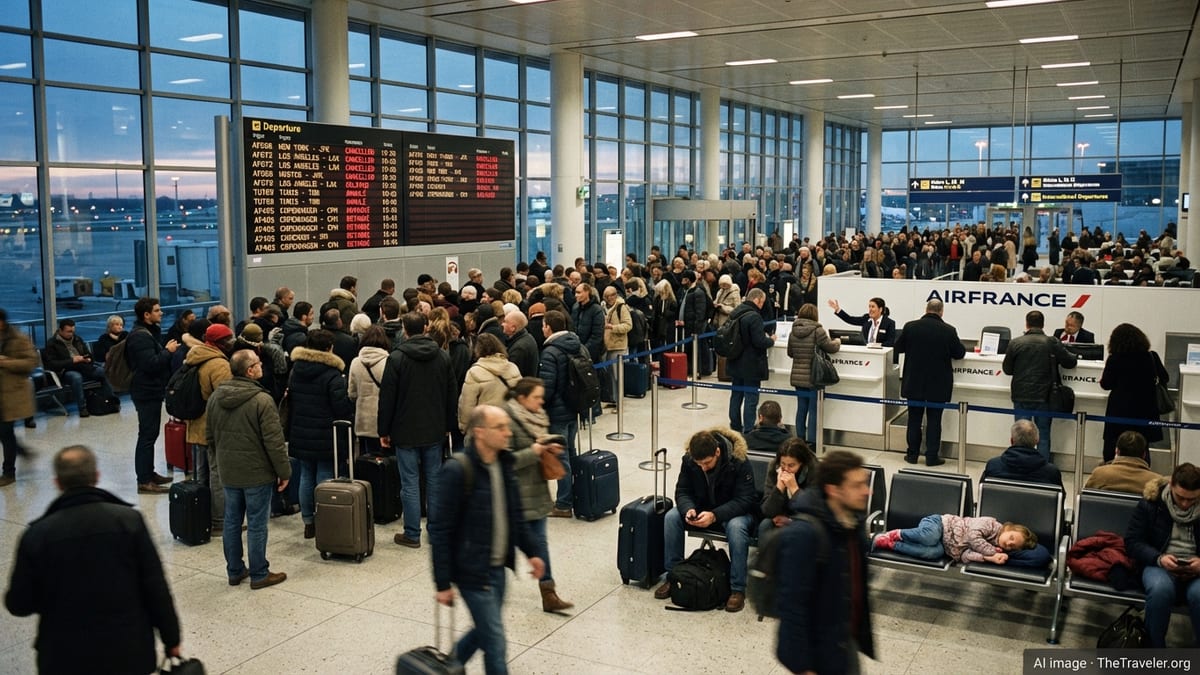
For travelers, the statistics translate into long queues at customer service desks, crowded terminal concourses and uncertain arrival times. Social media posts and passenger‑rights case studies from recent weeks describe families stranded overnight at hubs such as London and Amsterdam, travelers rerouted through multiple countries to reach their final destination, and business passengers forced to abandon onward connections altogether.
Published accounts from consumer advocates indicate that many passengers are receiving same‑day rebooking offers, but often on later flights or via less direct routings. In some cases, travelers report being split from their companions to fill remaining seats on heavily booked services. Hotel vouchers and meal coupons are being provided unevenly, depending on the airline, the cause of the delay and local regulations.
Baggage disruption is another recurring theme. When schedules slip and connections are re‑timed, luggage systems can struggle to keep pace, leading to bags missing tight transfers or becoming stuck at intermediate hubs. Recent reports from major airports suggest that some passengers are arriving at their destinations on time only to find their luggage delayed by a day or more.
Travel experts commenting in public forums emphasize that uncertainty is often the most stressful aspect for passengers. With departure times repeatedly adjusted and gate information changing at short notice, travelers are encouraged to monitor airline apps and airport departure boards closely and to build in more buffer time for connections than they might have considered before.
Passenger Rights and Practical Advice During Ongoing Disruptions
As delays and cancellations continue to affect European air travel, passenger‑rights frameworks such as EU Regulation 261/2004 and aligned United Kingdom rules are again in focus. Public guidance from regulators and advocacy groups explains that travelers departing from airports in the European Union, Norway and other associated countries, or flying into the region on European or UK carriers, may be entitled to assistance and in some cases financial compensation when flights are heavily delayed or cancelled.
Eligibility often depends on specific criteria, including the length of delay, the flight distance, the point of departure, and whether the disruption is linked to factors within the airline’s control, such as crew scheduling or technical faults, rather than extraordinary circumstances like severe weather or airspace closures. Passengers are advised by consumer organizations to retain boarding passes, booking confirmations and any written explanations provided by airlines, as these documents can be important when submitting claims.
Published advice also stresses the importance of acting quickly when disruption hits. Seats on alternative flights can disappear rapidly once a major delay becomes apparent, particularly on busy routes between cities such as London, Paris, Amsterdam, Oslo and Madrid. Many guidance materials recommend using airline apps, websites and customer service hotlines in parallel with queuing at airport desks, in order to secure the best available rebooking options.
With the latest figures showing hundreds of thousands of travelers affected by rolling disruption episodes across Europe in early 2026, travel analysts suggest that passengers should continue to plan for potential interruptions over the coming weeks. Choosing longer connection windows, traveling with carry‑on luggage where possible and keeping flexible accommodation and ground transport arrangements are among the practical steps being highlighted to help mitigate the impact if schedules shift again.