

More news on this day
Thousands of air travelers across Europe are facing missed connections and overnight waits as widespread flight disruptions sweep through France, England, the Netherlands, Norway, Spain and several other countries, with at least 58 flights cancelled and around 1,379 delayed across major carriers including SAS, KLM, British Airways and Lufthansa.
Get the latest news straight to your inbox!
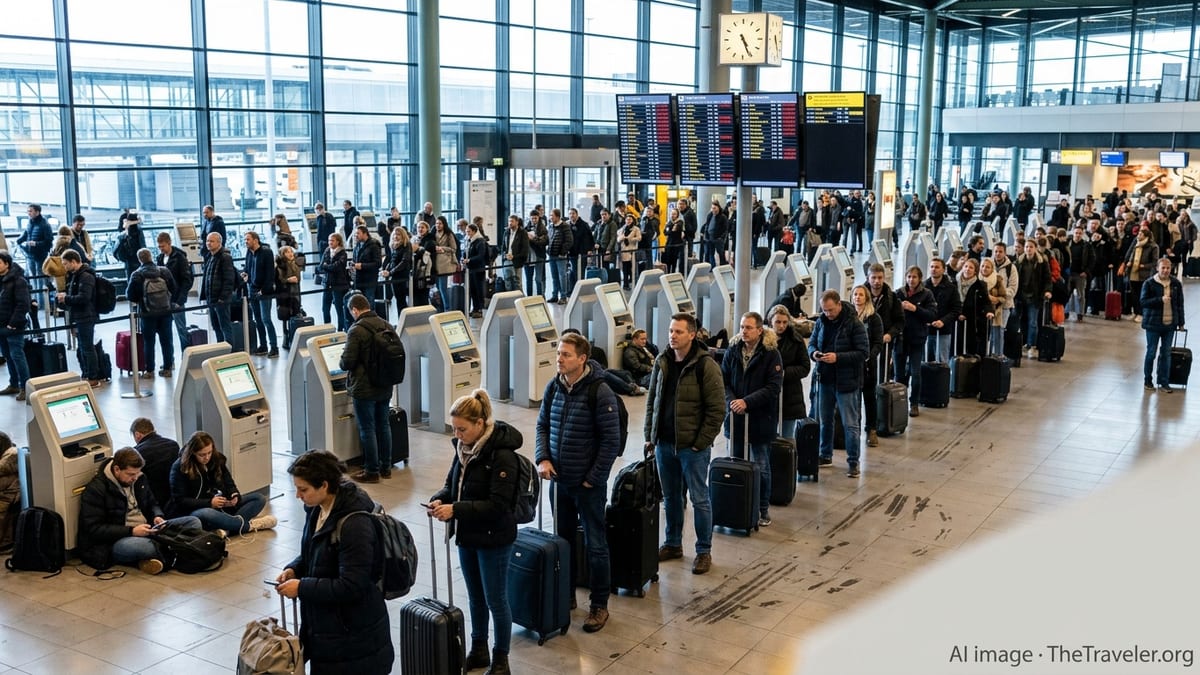
Major Hubs From Paris to Oslo Feel the Strain
Publicly available tracking data and industry coverage indicate that airports in Paris, London, Amsterdam, Oslo and Madrid are among the most heavily affected, with a mix of outright cancellations and rolling delays rippling through Sunday schedules. The disruption spans short European hops and longer intercontinental services, compounding pressure on already busy Easter-period operations.
In France and England, congestion at Paris Charles de Gaulle, Paris Orly, London Heathrow and London Gatwick has led to queues at check in and security as passengers attempt to rebook or reroute around cancelled departures. Similar patterns are reported at Amsterdam Schiphol in the Netherlands, where dense hub-and-spoke operations mean a single late inbound aircraft can trigger knock-on delays across the network.
Norway and Spain are also experiencing significant strain. Coverage from regional outlets and airport data show Oslo Airport suffering clusters of cancellations and late departures on routes linking to Ireland, the United Kingdom, Spain, Sweden and the Netherlands, while Madrid and Barcelona have logged waves of delayed departures affecting domestic and international links. These localized issues feed into a wider European picture as missed connections strand passengers far from their final destinations.
The overall tally of at least 58 cancellations and nearly 1,400 delays across the continent captures only part of the disruption, since many flights continue to depart but significantly behind schedule. For travelers with tight connections or cruise departures, even modest schedule changes are causing major itinerary upheaval.
Flag Carriers and Network Airlines Hit on Key Routes
The impact is particularly visible among Europe’s major network airlines, which rely on tightly timed banks of flights feeding through core hubs such as Paris, London, Amsterdam, Oslo and Madrid. Public reports highlight disruptions for SAS, KLM, British Airways and Lufthansa alongside a range of other European and transatlantic carriers that share codes or connect through these hubs.
Scandinavian operator SAS has been coping with both short term schedule adjustments and broader capacity cuts announced in recent weeks, and today’s disruption is adding further pressure on its operations across Norway, Denmark and Sweden. Flights touching Oslo and Copenhagen are among those affected, distorting connections to southern Europe and key business destinations.
KLM’s extensive use of Amsterdam as a single large hub makes it especially exposed to delays propagating through the day. Recent operational advisories show the airline steering passengers toward digital tools and flexible rebooking options as delays mount, with late arrivals into Schiphol frequently resulting in missed onward flights to cities in France, Spain, the UK and beyond.
British Airways and Lufthansa, meanwhile, are experiencing a mix of cancellations and shorter delays across their European networks. Published coverage notes that services linking London and major continental cities are contending with congestion and air traffic management restrictions, while Lufthansa’s operations through Frankfurt and Munich continue to be affected by reactionary delays when earlier flights arrive late or crews and aircraft are out of position.
Weather, Airspace Constraints and Knock-On Effects
Reports from European aviation and weather services suggest that a combination of seasonal storms, strong winds and lingering airspace restrictions is underlying much of the current disruption. Recent windstorm systems tracking from the North Atlantic into Western and Northern Europe have periodically reduced runway capacity at airports in France, the UK, the Netherlands, Norway and Spain, forcing airlines to trim schedules or accept longer turnaround times.
In parts of Scandinavia, airlines have warned in recent days of strong winds and unsettled conditions affecting approaches and departures, particularly in southern Norway and adjacent regions. Even when aircraft can operate safely, such conditions often require increased separation between flights, limiting hourly movements and building queues on the ground.
Air traffic control flow management across European airspace is also playing a part. When sectors over France or neighboring states become constrained, flights may be rerouted or held on the ground, reducing punctuality even for airlines that are otherwise operating a full schedule. Publicly available advisories show that carriers whose routes cross French airspace, including British Airways, Lufthansa and KLM, can experience delays even when their origin and destination airports appear unaffected.
These operational realities create a classic domino effect. A delayed early-morning rotation can leave an aircraft and crew out of position for subsequent legs, slowly eroding on-time performance throughout the day. By afternoon and evening peaks, relatively modest weather or airspace issues can translate into large numbers of passengers arriving hours behind schedule.
Passenger Experience: Missed Connections and Crowded Hubs
Across Europe’s major hubs, the immediate human impact of the disruption is visible in crowded departure halls, long queues at service desks and passengers sleeping in terminal seating. Travel industry reports describe families racing between gates in Paris and London in search of replacement flights, while others in Amsterdam and Madrid queue at transfer counters after missing onward departures by minutes.
Hub airports such as Paris Charles de Gaulle, London Heathrow and Amsterdam Schiphol are particularly challenging environments during widespread irregular operations. Their intricate web of connections means that delays on short feeder flights, for example between regional Spanish or Norwegian airports and a major hub, can cascade outward, affecting long haul services to North America, Africa and Asia.
At Oslo Airport, travel coverage notes that cancellations and delays to routes serving Ireland, Spain, the UK and other European destinations are leaving some passengers with no same day alternatives. With limited spare capacity on popular leisure routes, travelers are often forced to consider overnight stays, rail alternatives or rerouting via entirely different countries to reach their destinations.
For many passengers, digital tools such as airline mobile apps and airport departure boards have become essential. However, during fast-evolving disruption, published information can lag behind real-time operational decisions, making it difficult for travelers to know whether to remain airside, exit to landside hotels or attempt to rebook via online channels.
What Travelers Can Do and How Rules Apply
For those caught up in the current wave of disruptions, consumer advocates and travel specialists point to the importance of understanding Europe’s air passenger rights framework. Under EU Regulation 261/2004 and equivalent UK rules, travelers departing from European airports are generally entitled to care, assistance and, in certain circumstances, financial compensation when flights are cancelled or significantly delayed.
The level of support depends on factors such as the length of delay, total journey distance and whether the cause is considered within the airline’s control. When weather or air traffic control restrictions are judged to be extraordinary circumstances, compensation may not be payable, although passengers remain entitled to basic assistance such as meals, refreshments and, if required, hotel accommodation and transport to and from that accommodation.
Travel experts consistently recommend that affected passengers document their disruption, retain boarding passes and receipts, and use official airline channels to request refunds or compensation after travel. Many carriers, including KLM, British Airways and Lufthansa, highlight online claim forms and customer service channels dedicated to handling disruption-related requests.
With further unsettled conditions and heavy holiday traffic expected in the coming days, publicly available forecasts suggest that punctuality across Europe may remain fragile. Travelers planning journeys through key hubs such as Paris, London, Amsterdam, Oslo and Madrid are being advised in published guidance to monitor flight status closely, allow generous connection times, and consider flexible tickets that permit rebooking if schedules unravel.