

More news on this day
Thousands of passengers were left stranded across Europe on Monday as severe disruption at London Heathrow, Frankfurt and Copenhagen airports delayed 581 flights and cancelled 68 more, snarling connections on British Airways, Qatar Airways, KLM, Air France and other major carriers and halting routes to Abu Dhabi, Amsterdam, Dubai, Newark and beyond.
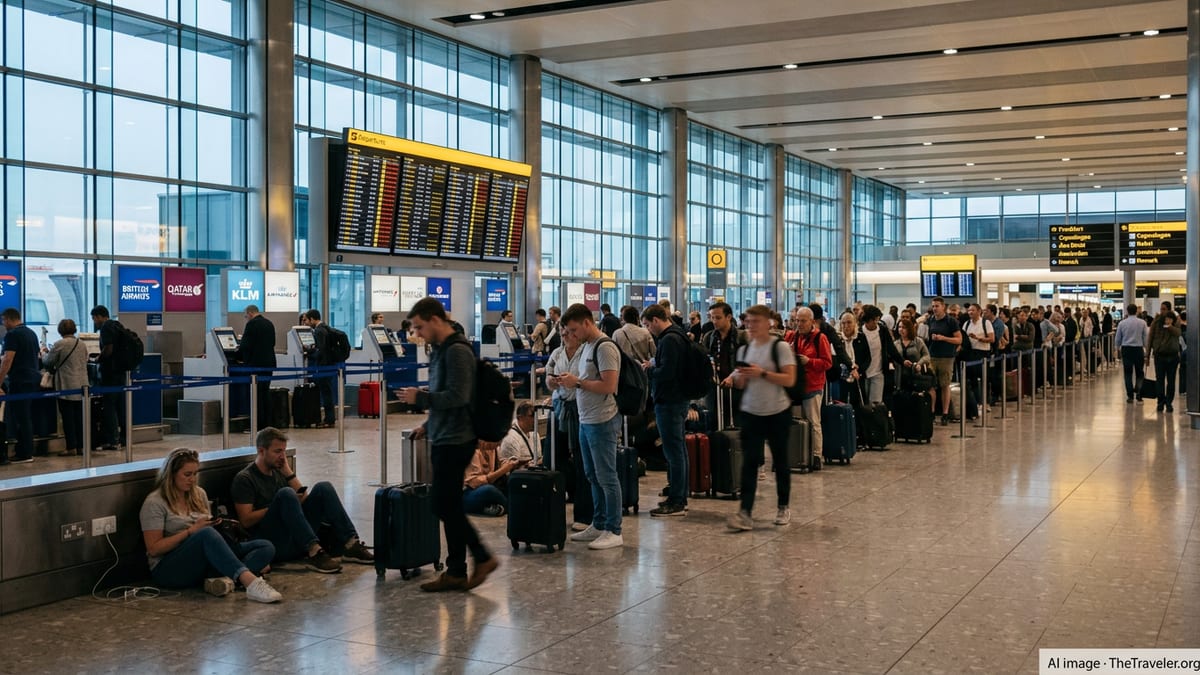
Major European Hubs Buckle Under Strain
Operational turbulence at three of Europe’s most important gateways turned routine travel days into marathon ordeals, with departure boards at Heathrow, Frankfurt and Copenhagen dominated by delays and cancellations. The disruption rippled across short and long haul networks, trapping travelers in terminals and forcing mass rebookings as airlines struggled to reposition crews and aircraft.
Data from European aviation trackers indicated that a combined 581 departures and arrivals at the three airports were operating behind schedule, while 68 services were scrubbed from the boards entirely. The affected flights included both intra-European hops and intercontinental legs, magnifying the knock-on effect for passengers bound for the Middle East, North America, Africa and Asia.
Heathrow, already operating near capacity in normal conditions, appeared particularly vulnerable to cascading delays, with late inbound aircraft and tight turnaround times limiting options for recovery. At Frankfurt and Copenhagen, a mix of operational constraints and wider regional disruption limited spare capacity to absorb missed connections and diversions.
Airport operators in all three countries urged passengers to arrive early, travel with hand luggage where possible and check their flight status repeatedly, warning that schedules would likely remain volatile throughout the day as airlines attempted to stabilize operations.
Global Carriers Forced to Reroute and Suspend Key Links
The disruption at European hubs is unfolding against a backdrop of severe upheaval in Middle Eastern airspace, which has already forced major airlines to cancel or reroute hundreds of flights in recent days. Carriers including Emirates, Etihad Airways and Qatar Airways have been operating heavily reduced schedules from Dubai, Abu Dhabi and Doha after regional airspace closures and security concerns upended normal routing.
Those constraints have fed directly into European operations. British Airways has adjusted services linking Heathrow with Abu Dhabi, Dubai and Doha, while Frankfurt’s role as a key transfer point for Lufthansa Group carriers connecting to the Gulf has left German operations exposed to delays and cancellations cascading back from the Middle East. KLM and Air France, meanwhile, have been avoiding certain airspace corridors and issuing flexible rebooking options as they fine tune long haul schedules from Amsterdam and Paris.
On Monday, passengers at Heathrow, Frankfurt and Copenhagen reported long lines at transfer desks serving British Airways, Qatar Airways, KLM and Air France as airline staff attempted to rebook customers whose onward flights to Abu Dhabi, Amsterdam, Dubai, Newark and other long haul destinations were no longer operating as planned. Some travelers were offered overnight hotel stays, while others were placed on indirect routings that added many hours, and in some cases an extra travel day, to their journeys.
Industry analysts noted that when Gulf hubs are constrained, European airports quickly feel the pressure, because a large share of Europe to Asia and Europe to Australia traffic relies on one or more connections through Dubai, Doha or Abu Dhabi. With those routings disrupted, demand for direct and one stop alternatives via Europe has surged faster than airlines can add replacement capacity.
Travelers Face Long Queues, Missed Connections and Limited Options
For passengers on the ground, the numbers translated into a day of uncertainty and frustration. At Heathrow’s Terminal 5, travelers described security lanes backing up as delayed flights disgorged late-arriving passengers into already crowded departures areas. In Frankfurt, long queues formed at customer service counters as travelers scrambled to secure new seats before remaining options disappeared.
At Copenhagen Airport, travelers connecting from Scandinavia onto long haul services via London, Amsterdam or Frankfurt found themselves particularly exposed. A delayed morning departure could mean missing a tightly timed onward flight to hubs such as Dubai or Newark, with rebooking options constrained by aircraft and crew availability across multiple airlines.
Families returning from school holidays, business travelers with time sensitive meetings and tourists on multi stop itineraries were among those forced into last minute changes. Some passengers opted to buy new tickets on competing carriers just to keep moving, hoping to claim reimbursement later through airline policies or travel insurance.
Airport staff and airline agents reported rising tension at customer service desks but emphasized that most travelers were ultimately able to secure onward travel, albeit often with substantial delays. Nevertheless, with aircraft and crew out of position across several regions, officials warned that recovery would be gradual rather than immediate.
Knock-On Effects Stretch From Europe to the Gulf and North America
The disruption at Heathrow, Frankfurt and Copenhagen reverberated far beyond Europe’s borders. With long haul departures delayed or cancelled, aircraft that would normally continue to destinations such as Abu Dhabi, Dubai and Newark remained stuck on the ground, creating gaps in downstream schedules.
In the Gulf, where airports are still working to rebuild operations after widespread suspensions, the sudden reduction in inbound capacity from Europe complicated efforts to repatriate stranded passengers and restore normal connectivity. Services that did operate often did so at full capacity, leaving little room to accommodate travelers from missed connections upstream.
Across the Atlantic, US airports including Newark reported arrival banks that did not match their usual profiles, as some transatlantic flights arrived hours late while others were cancelled outright. That created secondary disruption for domestic connections in the United States and Canada, as airlines reshuffled aircraft and crews to cover gaps.
Aviation experts warned that the global nature of modern airline networks means any prolonged disruption in key regions, whether due to weather, airspace closures or operational bottlenecks, can echo for days across multiple continents. Even after Monday’s immediate delays and cancellations are resolved, some travelers may face schedule changes or equipment swaps on flights later in the week as carriers work through the backlog.
What Airlines Are Advising Affected Passengers
Airlines operating through the three affected hubs have urged customers to use digital tools as a first resort. British Airways, KLM, Air France and Qatar Airways all recommend that passengers check their flight status and any rebooking options through official apps or websites before heading to the airport, noting that call centers and airport counters are experiencing very high demand.
Carriers are also reiterating that passengers whose flights are cancelled are generally entitled to a choice between rebooking at a later date or requesting a refund, subject to fare rules and local regulations. For those facing long delays, many airlines are providing meal vouchers, hotel accommodation and ground transport, particularly when passengers are stranded overnight away from home.
Consumer advocates advise travelers caught in the disruption to keep detailed records, including boarding passes, confirmation emails and receipts for meals, hotels and alternative transport. These documents can be vital when seeking reimbursement or compensation once operations normalize. Passengers are also encouraged to build extra buffer time into future itineraries that rely on tight connections through congested hubs.
With conditions at Heathrow, Frankfurt and Copenhagen still fragile and Middle Eastern airspace disruptions ongoing, both airlines and airports caution that further schedule changes are likely in the coming days. Travelers planning to pass through these hubs are being urged to monitor their bookings closely and remain prepared for last minute adjustments as the global aviation system continues to recalibrate.