

More news on this day
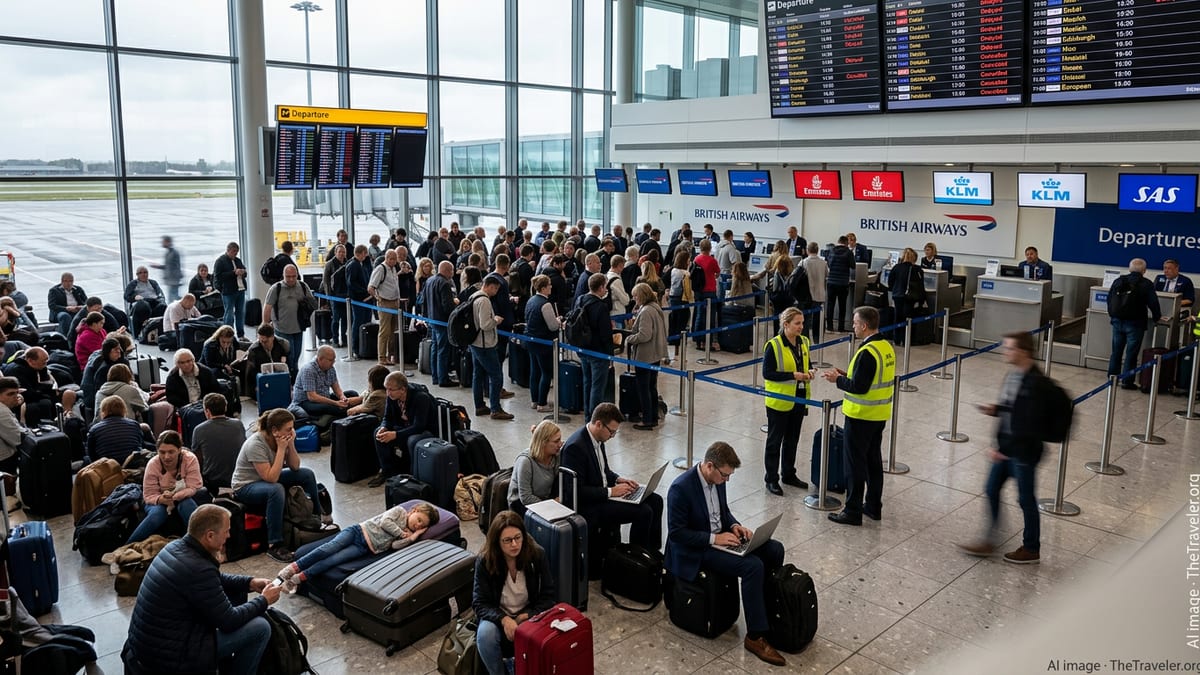
Thousands of travellers were left stranded across Europe on Tuesday as airports and airlines in the United Kingdom, Spain, the Netherlands and Germany delayed 781 flights and cancelled a further 180, with services operated by British Airways, Emirates, SAS and KLM among those hardest hit and long-haul links to hubs such as Dubai, Munich, Edinburgh, Nice and Helsinki thrown into disarray.
IT Failures and Congested Skies Trigger Fresh Wave of Disruption
A mix of IT system failures, airspace congestion and lingering staffing pressures combined to produce one of the most disruptive days for European aviation this year, according to operational data compiled by flight-tracking and passenger-rights services. The latest turmoil follows a series of recent cyber incidents and software outages that have repeatedly exposed the vulnerability of Europe’s highly interconnected air travel infrastructure.
Industry analysts said the disruption was concentrated at major hubs in the United Kingdom, Spain, the Netherlands and Germany, where already stretched ground and air traffic control systems struggled to cope once key digital tools failed or were taken offline for emergency fixes. At several airports, check-in and boarding reverted to manual processing, instantly slowing passenger flows to a crawl and pushing departure boards deep into red.
The pattern mirrored previous large-scale outages linked to aviation software suppliers, which in recent years have periodically knocked check-in platforms offline at airports from London and Amsterdam to Barcelona and Berlin. Each time, airlines and airports have insisted that lessons have been learned, but Tuesday’s figures suggest that the sector remains acutely exposed to technical shocks.
Travel demand across Europe has surged back to and in some cases beyond pre-pandemic levels, intensifying the impact when things go wrong. With schedules tightly packed and aircraft and crew operating at high utilisation, even a brief interruption in one country can ripple quickly across multiple networks, leaving passengers facing missed connections and overnight stays far from home.
Major Carriers Hit: British Airways, Emirates, SAS and KLM
The worst of Tuesday’s fallout was borne by full-service carriers linking Europe with global hubs. British Airways was forced to trim frequencies on intra-European routes while juggling long-haul rotations, after congestion and IT issues around London and other UK airports left aircraft and crews out of position. Passengers reported hours-long queues at check-in and security, with some told to expect rebooking several days ahead on already crowded services.
In the Netherlands and Germany, KLM and Lufthansa-group operations were heavily affected as knock-on delays spread through Amsterdam Schiphol, Frankfurt and Munich. These airports function as critical transfer points for travellers from North America, Asia and Africa, meaning a single delay can strand hundreds of passengers at a time while airlines scramble to arrange hotel rooms and alternative routings.
Middle Eastern carriers were not spared. Emirates, which relies on European feeder traffic into its Dubai hub, cancelled and retimed flights after rotations from London, Germany and Spain ran late or were held on the ground. Delays on Europe-bound sectors then cascaded back into its overnight bank of departures from Dubai, impacting connections further on to Asia-Pacific and Africa.
Scandinavian operator SAS also faced mounting disruption, particularly on services through Copenhagen and other Nordic gateways that feed into continental Europe. With aircraft arriving late from Germany and the Netherlands, the airline warned of rolling delays across its short-haul network and urged passengers to travel with hand luggage only where possible to speed airport processing.
Airports from Dubai to Edinburgh and Nice Feel the Shockwaves
Although the epicentre of Tuesday’s problems lay in European control centres and airport systems, the effects were felt much further afield. In Dubai, one of the world’s busiest international airports, departure boards showed wave after wave of late arrivals from Europe, tightening connection windows and forcing gate agents to rebook passengers who had missed onward flights to Asia, Australia and Southern Africa.
In Germany, Munich saw a build-up of delayed inbound flights from the United Kingdom and Spain, which in turn pushed back departures to Mediterranean destinations and key Nordic and Eastern European cities. Travellers described crowded terminals and snaking queues at rebooking desks, with some flights closing the doors while long lines of passengers were still being processed by overstretched staff.
Further north, services to and from Edinburgh and Helsinki were among those disrupted as aircraft scheduled to operate these routes became trapped in wider European congestion. At Edinburgh, which has previously suffered from IT-related stoppages, travellers shared images of packed departure halls and sparse information from airlines already juggling crew-hours limits and aircraft rotations.
On the French Riviera, Nice Cote d’Azur Airport reported delays and cancellations on links to London, Amsterdam and German cities, disrupting both business traffic and winter-sun holidaymakers. With aircraft out of place and turnaround times stretched, some carriers opted to consolidate flights, leaving passengers to compete for a shrinking pool of available seats.
Passengers Face Long Queues, Vague Updates and Limited Options
For travellers caught in Tuesday’s disruption, the most immediate experience was one of uncertainty. Many reported receiving contradictory messages from airline apps, airport screens and staff on the ground, reflecting the difficulty carriers faced in updating schedules in real time while key systems were degraded or operating at reduced capacity.
With 781 flights delayed and 180 cancelled across the United Kingdom, Spain, the Netherlands and Germany alone, hotel capacity near major airports quickly came under pressure. Some passengers described being handed basic amenity kits and meal vouchers but told to make their own accommodation arrangements and claim reimbursement later, a challenge in cities already running close to full occupancy due to trade fairs and school holidays.
Families travelling with children and elderly passengers were particularly vulnerable, often facing hours in line to reach help desks. Social media footage showed makeshift queues winding through corridors and around baggage halls at several European hubs, while airport staff tried to distribute water and basic refreshments to those waiting for news.
Passenger-rights advocates warned that many travellers were still unaware of their entitlements under European and UK compensation regimes, especially in complex cases where delays stem from a mix of technical failures, staffing limits and airspace constraints. They reiterated that, even when cash compensation is not due, airlines remain responsible for care and assistance, including meals, communications and overnight accommodation where necessary.
Airlines and Regulators Under Pressure to Bolster Resilience
The latest disruption is likely to intensify pressure on both airlines and regulators to improve the resilience of Europe’s aviation network. In recent years, a succession of IT outages, cyber incidents and chronic staffing shortages in air traffic control have prompted calls from consumer groups and industry bodies for greater investment in digital infrastructure and contingency planning.
Experts point out that many European carriers rely on a small number of third-party technology providers for core functions such as check-in, boarding and baggage handling. When a single supplier experiences a failure or cyberattack, dozens of airlines and airports can be affected simultaneously, creating a systemic risk that is difficult for any one operator to manage alone.
Regulators in Brussels, London and national capitals have already signalled that they are reviewing whether current rules adequately reflect these evolving threats. Options under discussion include stricter uptime and redundancy requirements for critical aviation IT systems, clearer reporting obligations when outages occur, and coordinated stress-testing of cross-border air traffic management platforms.
For passengers, however, such reforms will come too late to salvage disrupted trips this week. As airlines worked through the backlog of delayed aircraft and displaced crews on Tuesday evening, operational planners warned that residual delays and scattered cancellations were likely to persist for at least another 24 to 48 hours, prolonging the uncertainty for thousands of people hoping simply to get where they were going.