

More news on this day
Thousands of travelers across Europe are facing severe disruption today as a fresh wave of aviation turmoil forces airlines to cancel at least 556 flights and delay a further 1,928, snarling operations at major hubs including London, Bucharest, Madrid, Munich, Istanbul and Prague.
Conflict-Driven Airspace Closures Ripple Into European Hubs
The latest disruption comes as airlines across Europe continue to grapple with widespread airspace closures linked to the escalating conflict in the Middle East, which has triggered large-scale rerouting and capacity cuts. Over the weekend and into March 2, carriers have been forced to suspend or heavily delay services that typically transit Gulf-region corridors, pushing congestion and knock-on delays into already busy European terminals.
Data compiled from airport operation reports and aviation industry trackers shows that, between March 1 and March 2, more than 500 flights were cancelled and nearly 2,000 delayed across the UK, Germany, Turkey, France, Italy and other European states. The impact has been particularly acute at long-haul gateways such as London, Frankfurt and Istanbul, where routes to Dubai, Tel Aviv, Abu Dhabi and other Middle Eastern destinations form a critical part of the daily schedule.
German airports have reported some of the heaviest strain, with Frankfurt, Munich and Berlin together logging more than 70 cancellations and more than 250 delays as Gulf hubs temporarily halted operations and airlines scrambled to rework timetables. Airport authorities in Frankfurt have activated contingency plans to manage aircraft backlogs and escalating passenger queues as delayed arrivals and departures stack up across the day.
Across the wider region, flag carriers and low-cost operators alike have warned of further timetable changes as they continue to assess airspace availability and security conditions. Industry analysts say the cascading reroutes are likely to keep European operations unstable for several days, even if more direct Middle Eastern flight paths gradually reopen.
London, Istanbul and Other Key Hubs Under Intense Pressure
In the UK, London’s major airports remain among the worst affected, with dozens of cancellations and more than a hundred delays reported across the capital’s network over the weekend. Flights linking London with Middle Eastern hubs have borne the brunt, but short-haul connections into continental Europe have also suffered as aircraft and crew end up out of position.
In Turkey, Istanbul’s twin airports, along with Antalya and Ankara, have seen a combined tally of more than 80 cancellations and nearly 200 delays within a single day, as carriers operating eastbound routes adjust to changing overflight permissions. Passengers at Istanbul’s main international airport faced crowded terminals and long lines at service desks as airlines attempted to rebook customers onto limited remaining seats.
Southern and western European hubs are also under strain. In Spain, Madrid and Barcelona, together with Valencia and Malaga, reported more than 30 cancellations and over 270 delays on March 1 alone, forcing hundreds of passengers to sleep in terminal seating or nearby hotels as missed connections piled up. In Italy, Rome Fiumicino and Milan Malpensa experienced around 45 cancellations and more than 100 delays over the weekend, with ripple effects felt at secondary airports such as Venice, Naples and Florence.
While some airports have begun to see a modest stabilisation of schedules as airlines trim frequencies and consolidate services, airport managers warn that backlogs can take days to clear. With many long-haul aircraft operating on extended routings that add up to 40 minutes to block times, even small schedule gaps can quickly vanish, leaving carriers with little flexibility when new disruptions occur.
Ryanair, easyJet, Turkish Airlines and Others Forced to Cut and Reroute
The current wave of cancellations and delays is touching almost every major airline operating European routes, from legacy network carriers to budget operators. Ryanair and easyJet, two of Europe’s largest low-cost airlines, are among those reporting widespread delays across their intra-European networks, particularly where aircraft had been planned to operate around congested airspace or through already pressured hubs in the UK, Germany, Italy and Spain.
Turkish Airlines, which relies heavily on Istanbul as a bridge between Europe and Asia, has had to cancel dozens of flights and delay many more as it navigates a patchwork of airspace restrictions to the east. Additional disruption from other Middle Eastern carriers, including Emirates and Qatar Airways, has compounded congestion at European airports that serve as key arrival and departure points for long-haul traffic.
At secondary hubs such as Bucharest and Prague, passengers have also been left facing multiple-hour delays and short-notice cancellations as regional feeders to the larger hubs are adjusted or temporarily suspended. Aviation analysts note that while the headline numbers are concentrated at a handful of major airports, the operational shock is reverberating far deeper into the European airport network, affecting holidaymakers and business travelers in smaller cities as well.
Several airlines have begun offering more flexible rebooking policies, allowing passengers to shift travel to later dates without additional fees where seats are available. However, with load factors already high at the start of the spring travel season, spare capacity remains limited, particularly on long-haul routes, and many travelers are being told they may need to wait days for the next available itinerary.
Passengers Face Long Queues, Patchy Information and Overnight Stays
Across the continent, passengers caught up in the disruption have reported long queues at check-in and transfer desks, as well as patchy or last-minute information on departure boards and airline apps. In some cases, flights that initially showed as delayed were later cancelled outright, forcing families and solo travelers to scramble for alternative options after hours spent waiting in crowded terminals.
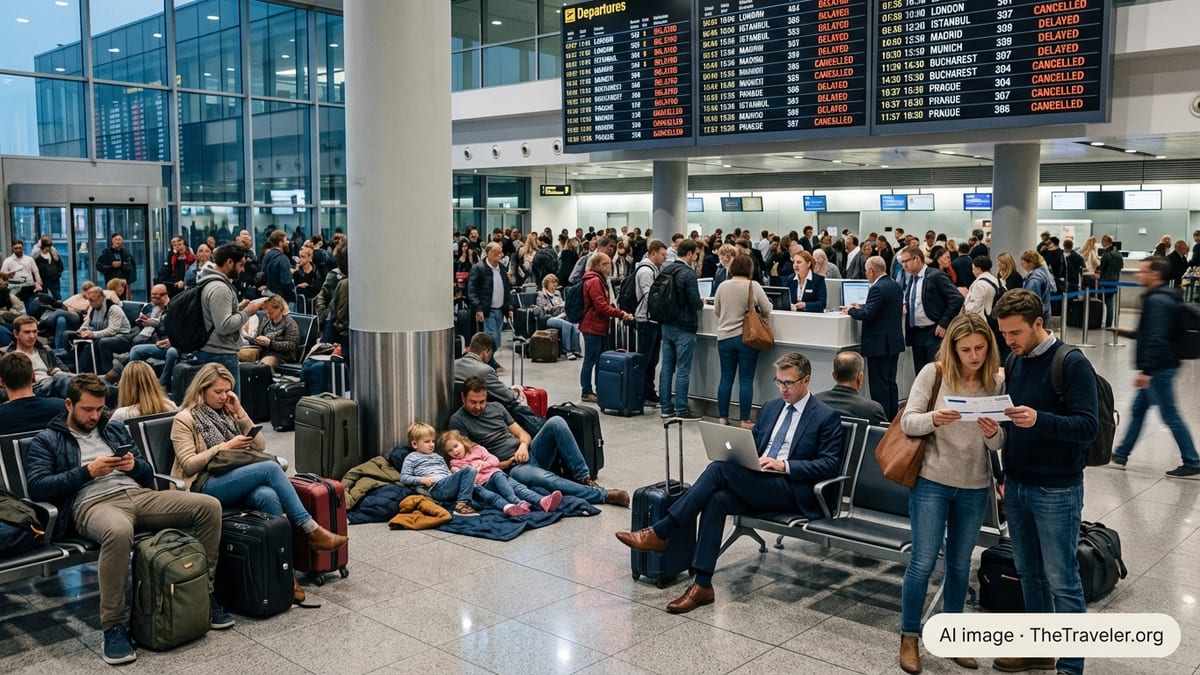
At London and Istanbul, terminal concourses were dotted with passengers lying on jackets or makeshift bedding, with many hotels near the airports quickly filling to capacity. Similar scenes were reported in Madrid, Munich and Prague, where taxi ranks and airport shuttle buses struggled to cope with demand as stranded travelers sought last-minute accommodation.
Consumer groups are urging passengers to document their disruption carefully, keeping records of boarding passes, messages from airlines and receipts for meals and accommodation. While the precise compensation and care obligations vary according to route, airline and the cause of the disruption, travelers on flights departing from EU and UK airports, or flying with EU or UK carriers, may be entitled to assistance such as meals, refreshments and hotel stays when cancellations or long delays occur.
Travel advisers are also recommending that passengers whose trips are not time-sensitive consider postponing or rebooking for later dates, as airlines work through the immediate backlog. Those who must travel are being told to build in significant buffer time for connections, monitor flight status closely and arrive at airports earlier than usual to navigate extended security and check-in lines.
Uncertain Outlook as Airlines Monitor Security and Airspace
Looking ahead, airline executives and aviation authorities are cautioning that the situation remains fluid. While some airspace corridors may reopen in the coming days, geopolitical tensions in the Middle East and the need to preserve strict safety buffers around conflict zones mean that further closures or restrictions cannot be ruled out.
Operational planners at major carriers continue to adjust schedules day by day, weighing safety considerations against commercial demand and crew availability. Even where airlines manage to restore a near-normal timetable on paper, the extra flying time required on detour routes, combined with aircraft and crews displaced by earlier cancellations, is likely to keep punctuality under pressure.
For Europe’s traveling public, the immediate priority remains simply getting home or reaching long-planned destinations. With more than 556 flights cancelled and close to 2,000 delayed across Europe over a short period, industry observers warn that the disruption will not disappear overnight. Instead, passengers should expect a period of elevated risk for delays and last-minute changes, particularly on routes touching the UK, Germany, Turkey, France, Italy, Spain and their key hub airports.
As airlines issue fresh travel advisories and governments update guidance for citizens abroad, one clear message is emerging for travelers across Europe: in the current environment, flexibility and preparedness are as essential as a valid ticket and passport.