

More news on this day
Thousands of air travellers across Europe were left stranded on Sunday as major international carriers including British Airways, Lufthansa, Swiss, Emirates, Qatar Airways and Turkish Airlines suspended 565 flights and delayed a further 1,493 services, disrupting operations at key hubs in the United Kingdom, Germany, Turkey, France and Italy.
Airspace Closures Ripple Into Europe’s Biggest Hubs
The latest wave of disruption followed rapid airspace closures across the Middle East after United States and Israeli strikes on Iran between February 28 and March 1, which prompted Iran, Iraq, Israel, Jordan, Kuwait, Qatar, Bahrain and the United Arab Emirates to restrict or shut their skies. Airlines that rely on Gulf hubs to connect Europe with Asia, Africa and Australasia have been forced to cancel, reroute or significantly delay services, pushing knock-on disruption into European schedules.
At London’s Heathrow and Gatwick airports, departure boards on Sunday showed clusters of cancellations and long delays to flights bound for Dubai, Doha and other Gulf destinations, as well as onward services to Asia and Australia that would ordinarily transit the region. Passengers reported being turned back at check-in for Emirates and Qatar Airways flights or being rebooked days later via alternative routings, with many unsure when they would finally be able to depart.
In Germany, Frankfurt Airport, the country’s primary intercontinental hub, struggled with the double impact of Middle East airspace restrictions and existing weather and congestion issues. Flight data collated by aviation analysts and industry outlets indicated hundreds of delays and dozens of cancellations over the weekend at Frankfurt, Munich and Hamburg, with Lufthansa and its partners Eurowings and Swiss forced to trim schedules and consolidate services.
Turkey’s Istanbul Airport, a key crossroads between Europe and Asia, also saw heavy disruption as Turkish Airlines adjusted routes to avoid closed airspace and coped with diverted traffic arriving from the Gulf. Long queues formed at transfer desks as travellers arriving from North America and Europe sought new connections eastward without overflying restricted zones.
Hundreds of Cancellations Leave Passengers Sleeping in Terminals
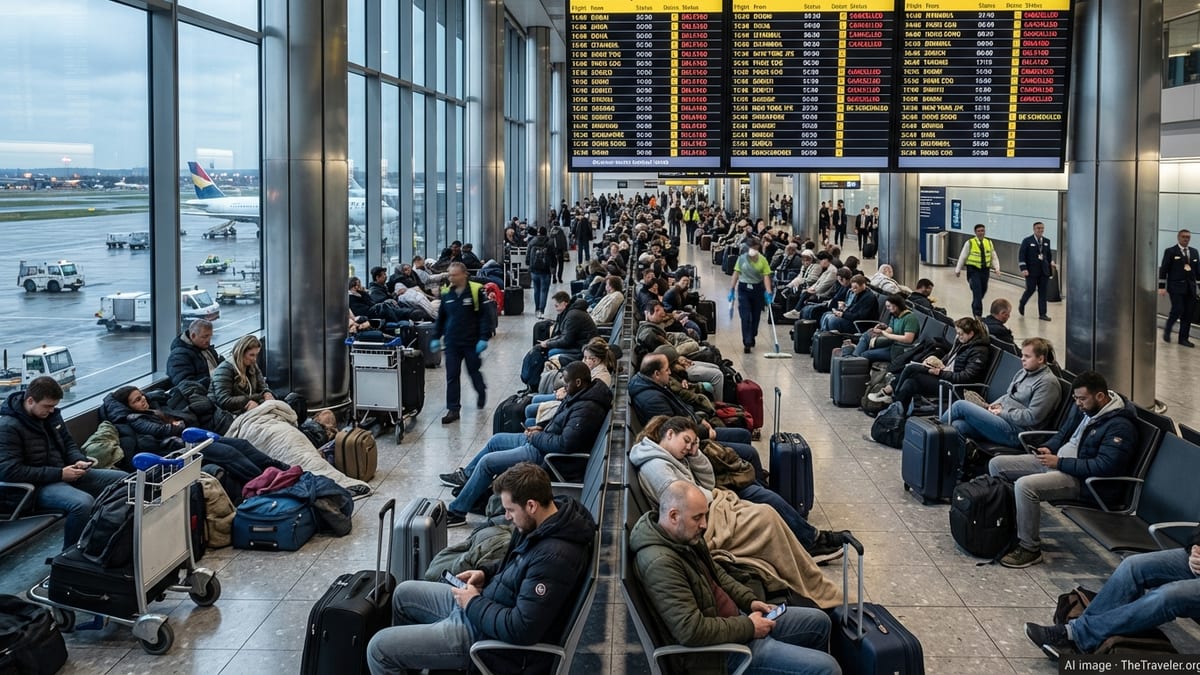
The scale and speed of the schedule changes left many passengers with little choice but to camp out in departure halls. In London, travellers on evening flights to the Middle East described scenes of confusion as staff delivered rolling announcements of cancellations for services that had appeared on time only hours earlier. Airport hotels quickly filled, pushing some families to spread out on terminal floors with blankets and carry-on bags as makeshift pillows.
At Frankfurt and Munich, German travellers attempting to reach destinations such as Dubai, Doha and beyond to Asia reported being held at gates for extended periods before flights were ultimately called off. Some were placed on standby for limited alternative routes via southern Europe that skirted closed airspace, while others were told they might be rebooked several days later due to a lack of available seats.
In Istanbul, where Turkish Airlines ordinarily operates one of the world’s largest networks, the airline deployed extra staff to manage long lines at service counters as connecting passengers sought rerouting. Travellers described waiting hours to speak with agents amid uncertainty over whether their tickets could be honoured on revised routings that complied with new overflight restrictions.
Paris Charles de Gaulle and Zurich Airport, key hubs for Air France and Swiss respectively, experienced similar patterns of disruption. While many intra-European flights continued to operate, long-haul services that would typically connect via the Gulf or traverse now-closed corridors were delayed, rerouted or cancelled outright, stranding transit passengers who had started journeys as far away as Asia-Pacific and southern Africa.
Network Carriers Scramble to Reroute and Consolidate Flights
With airspace in parts of the Middle East effectively sealed or heavily restricted, global network airlines have turned to longer, more northerly routings to keep at least some intercontinental services running. Carriers such as British Airways, Lufthansa and Air France shifted selected flights over central Asia, the Caucasus or the Mediterranean where possible, adding flight time and fuel burn that complicated crew rostering and aircraft rotations.
Emirates, Qatar Airways and Turkish Airlines, whose business models depend on funneling traffic through mega-hubs in Dubai, Doha and Istanbul, faced especially acute operational challenges. With hundreds of Gulf-bound flights cancelled or subject to major delays, airlines prioritized repatriation and strategic trunk routes while suspending less critical frequencies, leading to temporary gaps in connectivity between secondary European cities and long-haul destinations.
Low-cost carriers and regional operators were not immune. While many of their routes remain within Europe’s own airspace, knock-on effects from congested airports, displaced aircraft and limited ground-handling capacity translated into rolling delays. At London, Frankfurt and Paris, some short-haul departures left hours late as operations teams juggled aircraft that had been diverted or held on the ground earlier in the day.
Aviation analysts noted that the precise tally of 565 new cancellations and nearly 1,500 delays across European gateways on Sunday represented a snapshot of a rapidly moving situation. As airlines continue to adjust their schedules in response to changing overflight permissions and security assessments, those figures could rise or fall sharply over the coming days.
Travelers Face Uncertain Timetables and Patchy Communication
For passengers, the most common frustration has been uncertainty. Many travellers said they received little advance warning that their flights were in jeopardy, learning of cancellations only upon arriving at the airport or after lengthy waits at departure gates. Others reported that airline apps and airport displays lagged behind real conditions, showing flights as on time or merely delayed long after staff on the ground had acknowledged they would not depart.
Information bottlenecks were particularly acute for those with complex itineraries involving multiple carriers and codeshare agreements. Travellers who had booked through one airline but were due to fly with another sometimes found that each company referred them to the other for updates, leaving them without clear guidance on rebooking options or compensation rights.
At London and Frankfurt, some stranded passengers described confusion over entitlement to hotel rooms, meal vouchers and transport, as staff struggled to interpret consumer protection rules in the context of widespread airspace closures and security concerns. In several terminals, volunteer organisations and airport authorities stepped in to distribute water, snacks and basic supplies to those stuck overnight.
Despite the difficulties, a minority of passengers reported relatively smooth experiences, particularly where airlines proactively cancelled services early and offered clear alternatives. Those who were able to accept rerouting via alternative hubs in Europe or North Africa, or to delay travel by several days, often fared better than travellers insisting on original timings and routings.
Outlook: Gradual Stabilisation Hinges on Security Developments
Industry experts say that the timing of any recovery in European flight schedules will depend largely on how quickly Middle Eastern airspace can be safely reopened. If restrictions ease within days, airlines may be able to restore many suspended services relatively quickly, though displaced crews and aircraft could keep some delays and cancellations in place through the week.
Should the security situation deteriorate or airspace closures be extended, more profound schedule overhauls are likely. Airlines might reconfigure their networks by adding capacity on long, nonstop routes between Europe and Asia, bypassing Gulf hubs altogether, while trimming frequencies on marginal routes that rely on Middle East connections. Such changes could reshape global travel patterns well beyond the duration of the immediate crisis.
For now, airport operators at London, Frankfurt, Istanbul, Paris, Zurich and Italy’s major gateways including Milan’s Malpensa Airport near Ferno have urged passengers to arrive early, remain flexible and check flight status frequently. While some terminals reported gradually improving punctuality on Sunday afternoon, large crowds and scattered gate changes remained common.
Travel advisers recommend that passengers transiting Europe in the coming days build extra time into their journeys, keep essential items in carry-on bags in case of unexpected overnight stays and be prepared for last-minute changes. With airlines, regulators and air traffic controllers still recalibrating global flight paths, Europe’s skies are set to remain unsettled even as carriers work to bring stranded travellers home.