

More news on this day
Thousands of travelers were left stranded across Europe on Monday as severe disruption at London Heathrow, Frankfurt and Copenhagen airports delayed 581 flights and cancelled 68, snarling operations for major carriers including British Airways, Qatar Airways, KLM and Air France and halting key routes to Abu Dhabi, Amsterdam, Dubai, Newark and other global hubs.
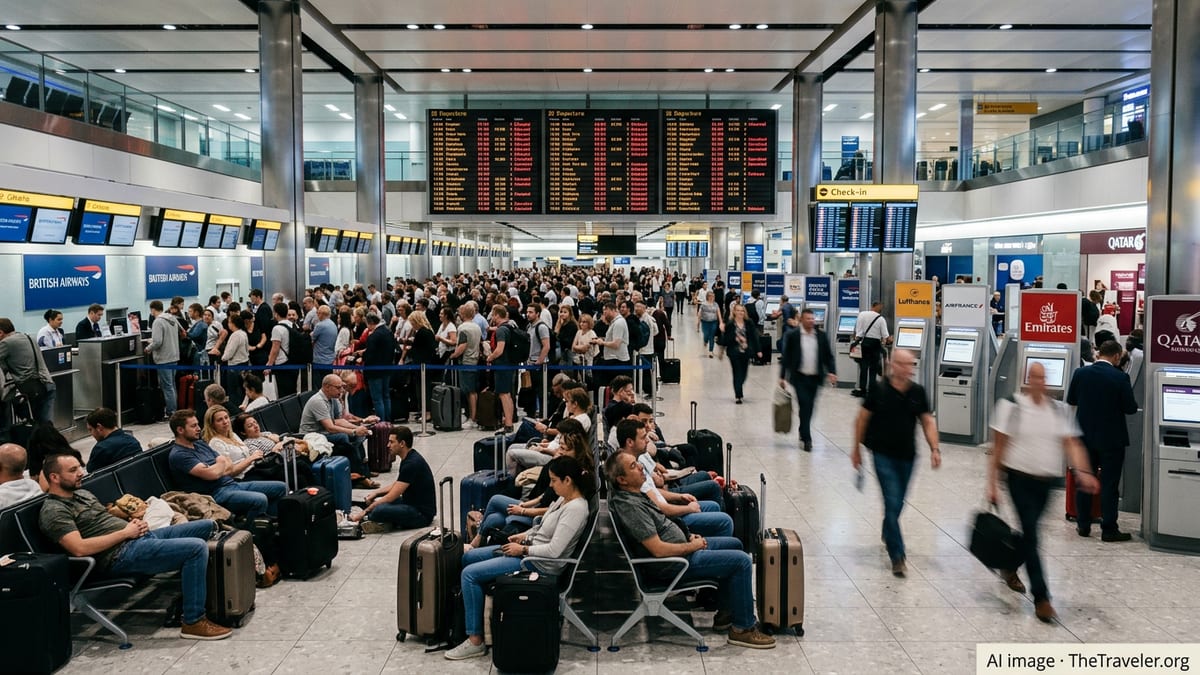
Major European Gateways Grind to a Near Standstill
The latest wave of disruption hit three of Europe’s most important transfer hubs simultaneously, creating a cascading operational backlog across the continent. At London Heathrow, one of the world’s busiest international airports, delays stacked up across both short haul and long haul services, with departure boards dominated by late and cancelled flights.
Frankfurt Airport, a critical node in the global network for transatlantic and Middle East connections, reported mounting hold-ups across morning and afternoon banks. The knock-on effect quickly spread to feeder services from secondary German cities and onward long haul departures to North America, Asia and the Gulf.
In Denmark, Copenhagen Airport saw its own schedules deteriorate through the day as arriving aircraft missed their slots and departing services pushed back late. With all three hubs fighting to recover, passengers found themselves stuck in terminal queues, sleeping on benches and scrambling to secure scarce rebooking options.
Airlines From Europe and the Gulf Forced to Cut and Reroute
The disruption has hit a wide range of carriers that rely on Heathrow, Frankfurt and Copenhagen as key spokes in their networks. British Airways passengers faced extensive delays across intra-European routes and long haul services to the United States and Middle East, with ripple effects stretching as far as Newark and other East Coast gateways.
Qatar Airways and other Gulf carriers, already contending with Middle East airspace restrictions, saw further schedule stress as European rotations ran late or were cancelled. Routes linking the Gulf to Europe, including services to Abu Dhabi and Dubai operated by various partners, were among those most affected, forcing complex rerouting via alternative hubs.
KLM and Air France, which depend heavily on coordinated schedules between their own hubs and partner airports, also reported disruption on services touching Amsterdam and Paris. Missed connections at Heathrow and Frankfurt left some passengers unable to reach onward flights to Amsterdam, while delays in Copenhagen and Germany unsettled aircraft and crew rotations feeding Paris Charles de Gaulle.
Global Routes to Abu Dhabi, Amsterdam, Dubai and Newark Hit Hard
The operational strain was felt most acutely on long haul corridors linking Europe with the Middle East, North America and Asia. Flights connecting through Heathrow and Frankfurt to Abu Dhabi and Dubai encountered extended ground waits, aircraft substitutions and, in some cases, outright cancellation as airlines struggled to keep crews within legal duty limits.
Transatlantic services also came under pressure, particularly routes to Newark and other major U.S. gateways that depend on tight connection windows in Europe. Delayed feeder flights from regional European cities meant many passengers missed their long haul departures entirely, with rebooking options limited by already full spring schedules.
Shorter regional sectors, including links to Amsterdam and other nearby hubs, were not spared. While some of these flights eventually departed, late arrivals eroded connection buffers and forced airlines to juggle aircraft across their networks, adding complexity and extending the disruption window well beyond the initial trigger events.
Passengers Face Long Queues, Confusion and Limited Options
Across terminals in London, Frankfurt and Copenhagen, travelers reported long lines at check-in and transfer desks as staff attempted to rebook thousands of disrupted itineraries. With hotel capacity around the airports tightening, some passengers resorted to makeshift beds on terminal floors, using jackets and hand luggage as pillows while waiting for updates.
Families returning from holidays, business travelers en route to meetings, and long haul passengers midway through multi-leg journeys all found themselves caught in the same web of delays. For many, the biggest challenge was the lack of clear, timely information as schedules shifted repeatedly and departure estimates slid from hour to hour.
Airlines urged passengers to use mobile apps and digital channels for real-time updates and rebooking rather than crowding service counters, but intermittent system overloads and limited inventory for same-day alternatives left many still queuing in person. Social media channels filled with images of packed departure halls and departure boards filled with red and amber status messages.
Knock-On Effects Expected to Linger for Days
Operational experts cautioned that the impact of the latest disruption would not be confined to a single day, given the central role Heathrow, Frankfurt and Copenhagen play in European and global connectivity. With 581 delayed flights and 68 cancellations concentrated at such critical hubs, aircraft and crews are now out of position across multiple continents.
Even as airlines work overnight to reset schedules, passengers traveling over the next several days can expect lingering delays, swapped aircraft types and occasional last-minute cancellations as networks are gradually rebalanced. Routes linking Europe with Abu Dhabi, Amsterdam, Dubai, Newark and other key long haul destinations are likely to remain under particular strain.
Travel advisers are encouraging passengers with upcoming itineraries through the affected airports to build in extra connection time, check their flight status repeatedly before leaving for the airport and consider re-routing through alternative hubs where possible. For those already stranded, documentation of expenses and close attention to airline communications will be essential as carriers begin processing claims and compensation once the immediate operational crisis eases.