

More news on this day
Thousands of airline passengers across Europe are facing significant disruption as 1,476 flight delays and 400 cancellations ripple through major hubs in the United Kingdom, Germany, Spain, France, Italy, and several neighboring countries, affecting services operated by Lufthansa, Air France, Ryanair, KLM and other leading carriers.
Get the latest news straight to your inbox!
Major Hubs From Berlin to Paris Buckle Under Strain
Publicly available flight-tracking data and operational updates show that Europe’s busiest airports are bearing the brunt of the latest disruption, with Berlin, Paris, Brussels, Vienna and Zurich among the hardest hit. The wave of delays and cancellations has built up through a combination of severe winter weather in parts of northern Europe and ongoing rerouting pressures linked to airspace restrictions over the Middle East, which continue to push additional traffic into already congested corridors.
In Germany, major hubs including Berlin and Frankfurt have seen cascading delays as tight runway capacity and crew rotation issues compound the impact of weather-related schedule adjustments. Industry reporting indicates that Lufthansa and its partner airlines are juggling aircraft and crews across their networks in an attempt to keep long-haul connections operating, which in turn is leading to tighter margins and longer ground times on short-haul routes.
French and Benelux airports are also under pressure. Paris and Brussels are handling large volumes of diverted and rerouted services, adding to standard winter operations that already run close to capacity. Airlines are extending minimum connection times and warning travelers that even small schedule changes can cause missed onward flights as queues build at security, passport control and rebooking desks.
Further south and east, airports such as Vienna and Zurich are reporting a similar pattern of knock-on disruption. Even when local conditions are relatively stable, aircraft arriving late from other parts of Europe are triggering rolling timetable changes throughout the day, leaving passengers facing gate changes, last-minute delays and overnight stays in transit cities.
Lufthansa, Air France, Ryanair and KLM Battle Network Chaos
Flag carriers Lufthansa and Air France, along with low-cost giant Ryanair and Dutch airline KLM, feature prominently in the latest disruption figures due to the sheer size of their European networks. These airlines operate dense webs of short- and medium-haul flights that act as feeders for long-haul services to North America, Africa, Asia and the Middle East, making them particularly vulnerable to any system-wide shock.
Operational updates and airline statements over recent weeks have highlighted how quickly disruption in one region now spreads across the continent. When flights are delayed or cancelled in northern Europe because of snow or strong winds, aircraft and crews are often left out of position for later departures from cities such as London, Paris or Rome. That effect has been magnified by ongoing diversions around closed or restricted airspace in the Middle East, which is increasing flight times and tightening crew duty limits on long-haul segments.
Ryanair and other low-cost operators are contending with additional complexity due to their heavy reliance on secondary airports and tight turnaround times. When arrival delays extend beyond runway slots or when ground handling is slowed by weather or congestion, the result can be a cascade of knock-on delays. Reports from several European airports indicate that some short-haul sectors are departing with gaps in the schedule, as airlines choose to cancel selected flights to protect key long-haul or high-demand routes.
KLM, which uses Amsterdam as a central hub, has already faced intense operational pressure this winter from snow and de-icing backlogs. Industry coverage shows that similar weather-related constraints at other northern airports are now being layered on top of the wider network challenges, narrowing the options for rerouting passengers and reassigning aircraft when things go wrong.
Passengers Stranded Overnight as Rebooking Options Shrink
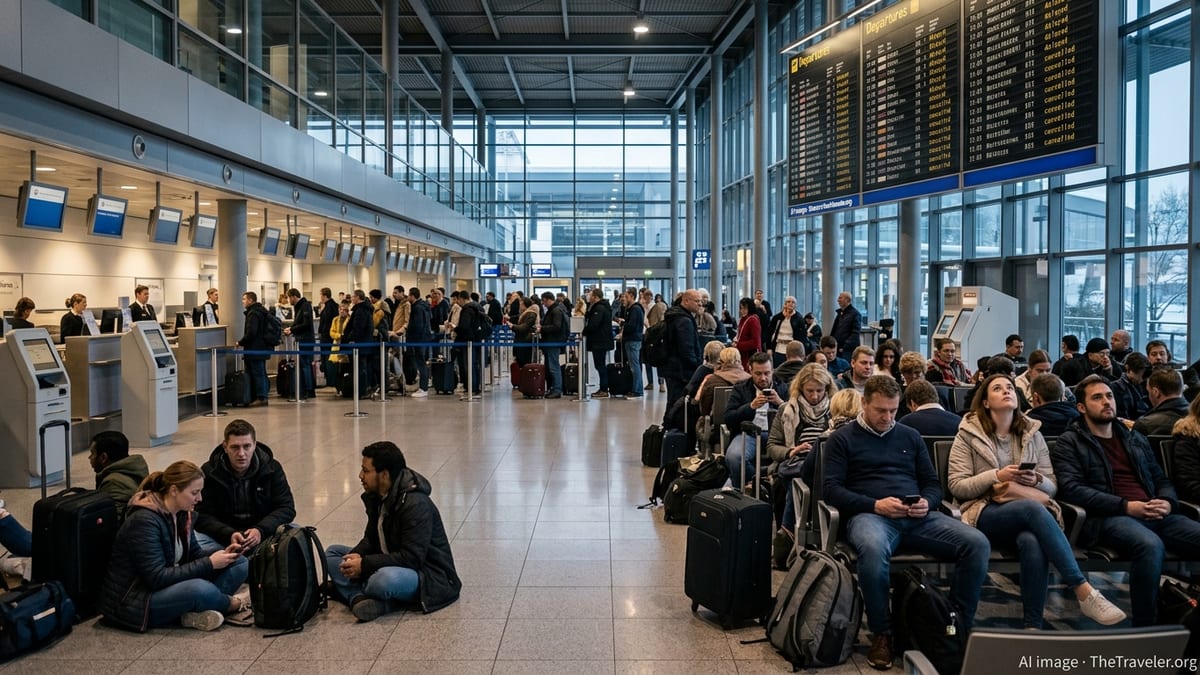
For travelers on the ground, the most visible impact of the 1,876 disrupted flights is a growing number of stranded passengers facing long waits for alternative options. Social media posts and local media coverage from airports across Europe show crowded departure halls, long queues at service desks and passengers stretched across terminal floors as they wait for new itineraries or hotel vouchers.
Because multiple major carriers are affected at once, spare seats on later flights are limited, particularly on popular city pairs such as London to Berlin, Paris to Rome, or Madrid to Vienna. In many cases, travelers are being rebooked on itineraries involving additional connections or significant detours through less congested hubs, sometimes adding a full day or more to their journeys.
Publicly available information indicates that some airports are opening additional customer service counters and advising travelers to use airline apps and websites where possible to avoid the longest lines. However, when disruption is widespread, call centers and digital channels can also quickly become overloaded, leaving some passengers with little choice but to wait in person for assistance from ground staff.
Families with small children, elderly passengers and those on tight schedules are among the worst affected. Travel industry commentators note that when weather, airspace restrictions and staffing constraints collide, airlines have limited flexibility to create extra capacity. As a result, many travelers are being forced to split groups, accept multi-stop routings or stay overnight in transit while waiting for the next available flight.
EU Passenger Rights and Practical Steps for Travelers
The disruption has renewed attention on European air passenger protections, particularly the EU’s core regulation governing compensation and assistance in cases of delays and cancellations. Under current rules, travelers departing from an airport in the European Union, or flying into the EU on an EU-based carrier, may be entitled to support such as meals, hotel accommodation and, in some circumstances, financial compensation, depending on the length of the delay, the distance of the flight and the cause of the disruption.
Legal analysis and consumer-rights guidance emphasize that the trigger for compensation is not only the disruption itself but also whether it stems from circumstances considered within the airline’s control. Severe weather and airspace closures related to security incidents are often treated as extraordinary circumstances, which can limit eligibility for cash payments, although assistance with care and re-routing may still be due.
Travel experts recommend that passengers keep boarding passes, booking confirmations and receipts for any additional expenses, such as meals, local transport and overnight accommodation. These documents can be important when submitting claims directly to airlines or through third-party claim services that specialize in EU aviation cases. Travelers are also advised to check whether they purchased travel insurance that covers missed connections, trip interruption or additional hotel stays.
Consumer organizations further suggest that travelers monitor airline apps, text alerts and airport departure boards closely, as same-day changes are common during major disruption events. In some situations, passengers may find it faster to accept rebooking via a different European hub, even if it adds a connection, rather than waiting for the next direct service from a heavily affected airport.
Ongoing Outlook for Europe’s Spring Travel Season
The current wave of delays and cancellations comes as airlines and airports prepare for an increasingly busy spring travel period, with demand expected to remain strong for both leisure and business trips across Europe. Aviation trend reports over the past year have repeatedly highlighted how tightly scheduled many European networks have become, leaving limited slack to absorb disruptions caused by weather, strikes or unexpected airspace issues.
Analysts note that while individual events such as winter storms or regional conflicts may not be new, the combination of high passenger volumes, lean staffing and complex routing patterns has raised the risk of large-scale knock-on disruption. When a single day sees more than a thousand delayed flights and hundreds of cancellations across multiple countries, the effects can reverberate for several days as airlines work to reposition aircraft and crews.
For travelers planning upcoming trips, industry guidance increasingly emphasizes flexibility. Recommendations include allowing more time for connections, avoiding the last flight of the day on critical segments where possible, and building in buffer days ahead of important events such as cruises, weddings or business conferences. Some travelers are also exploring alternatives such as high-speed rail on shorter intra-European routes, particularly where rail infrastructure offers reliable journey times between major cities.
As Europe’s aviation sector continues to navigate a volatile operating environment, the latest disruption underscores the importance of contingency planning for both airlines and passengers. With thousands of people still trying to reach their destinations after 1,476 delays and 400 cancellations in a single spell of irregular operations, the balance between efficiency and resilience in European air travel remains firmly in the spotlight.