

More news on this day
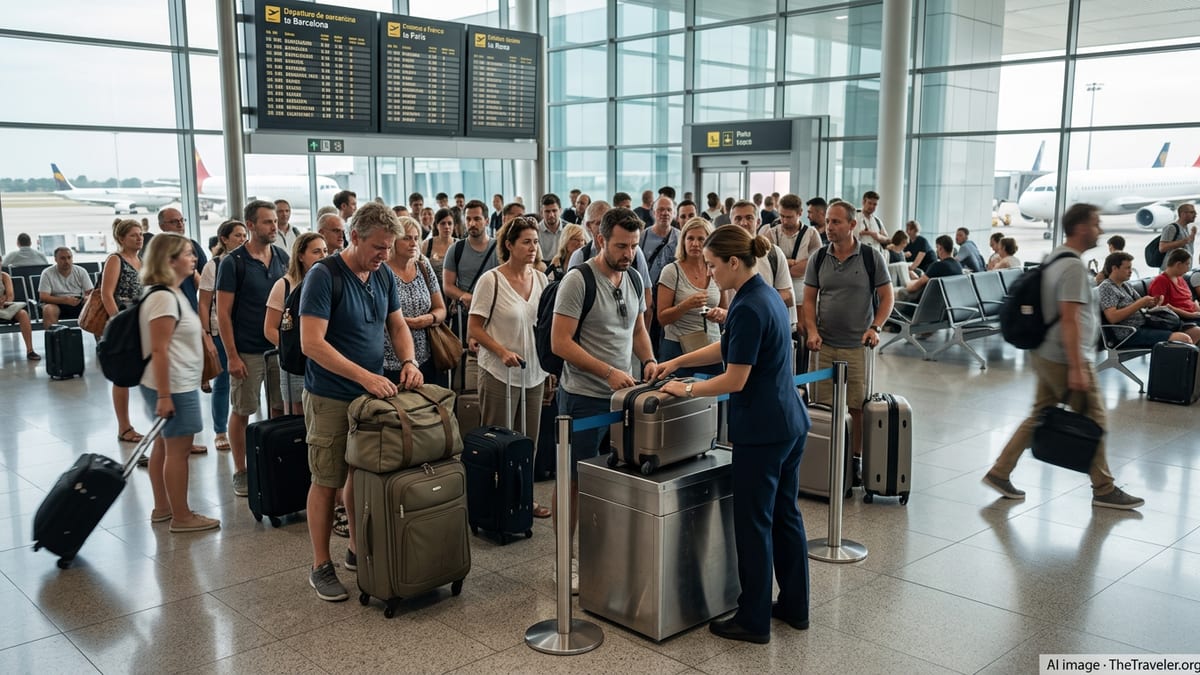
Global tourists heading to Europe’s busiest holiday corridors are being caught off guard by strict airline luggage enforcement in Spain, France and Italy, leading to unexpected airport fines and hefty add-on fees at the gate.
Get the latest news straight to your inbox!
Fines, Legal Battles and a Patchwork of Rules
Spain, France and Italy now sit at the centre of a Europe-wide tug of war over what passengers should pay to bring bags on board, and how transparently those charges are advertised. In Spain, consumer authorities have issued headline-grabbing penalties running into hundreds of millions of euros against low-cost carriers over what regulators characterised as abusive charges on standard cabin bags and compulsory seat reservations. At the same time, proceedings at EU level have challenged Madrid’s attempts to ban extra fees for reasonable-sized hand luggage, creating uncertainty for airlines and travellers alike.
Consumer organisations across the continent have seized on Spain’s actions to escalate their own campaigns. Coalitions representing passengers in more than a dozen EU countries have filed formal complaints in Brussels against several budget airlines, arguing that charging for typical small trolleys and second carry-on items violates a 2014 ruling by the Court of Justice of the European Union. That judgment stated that hand luggage meeting reasonable weight, size and safety requirements should not incur a surcharge, a principle advocacy groups say is now routinely ignored through complex fare structures and aggressive gate checks.
Airlines, for their part, maintain that unbundling services such as larger cabin bags and checked luggage keeps base fares low and offers choice to passengers who travel light. Industry groups point out that European law gives carriers wide freedom to set prices for optional services, and that allowing a free, larger cabin bag for every ticket would remove flexibility and increase costs for those who do not need it. The clash between these positions has turned airports in Spain, France and Italy into frontline arenas, where interpretation of rules often plays out in real time at boarding gates.
The result for tourists is a confusing, fast-evolving landscape. While legal challenges and regulatory reviews continue in Brussels, individual carriers have not waited for a definitive EU-wide standard. Instead, many have tightened their own policies and reinforced on-the-spot checks in southern Europe’s hubs, where high volumes of short-haul leisure traffic and packed overhead bins have made baggage enforcement a daily flashpoint.
Crackdowns at Spanish Gateways Shock Holidaymakers
Spain’s big coastal and island airports are seeing some of the most visible friction. Publicly available information and recent watchdog reports describe widespread complaints from passengers who believed they complied with free baggage limits, only to be told at boarding that a small suitcase or second personal item must be paid for or checked at substantial cost. On popular budget routes to Barcelona, Madrid, Málaga and the Balearic Islands, last-minute hand luggage fees can rival or exceed the original ticket price, particularly for peak summer departures.
The heightened scrutiny follows years of tension between Spain’s consumer ministry and several low-cost carriers over cabin bag policies. Fines announced since 2024 targeted practices such as surcharges for ordinary carry-on trolleys, charges for printing boarding passes and mandatory payment for adjacent seats for children or dependants. Airlines have appealed those sanctions, and the European Commission has since opened proceedings questioning whether Spain overstepped by effectively outlawing certain luggage fees, even as passenger advocates in Madrid argue that firm action is needed to protect travellers from opaque pricing.
The dispute has not stopped more rigorous policing of bag dimensions at the airport. Travellers report being asked to test even modest backpacks in metal sizers and being invoiced high counter or gate fees for bags that protrude only slightly. Confusion is amplified by differences between fares on the same airline, with “basic” tickets allowing only a slim under-seat bag, and anything larger treated as a paid extra. For tourists connecting from long-haul flights or arriving with luggage bought to older specifications, the Spanish rules can feel like an expensive trap at the end of a long journey.
Despite growing political pressure from both consumer groups and airlines, there is still no definitive EU-wide settlement on how far countries such as Spain can go in restricting charges. Until that changes, visitors arriving for beach holidays or city breaks face an environment in which gate staff have considerable discretion and domestic enforcement priorities are not always aligned with pan-European policy debates.
France Tightens Checks at Major Hubs
In France, reports from Paris Charles de Gaulle and Orly indicate a more methodical, if no less strict, approach. National and international media coverage, as well as passenger accounts, describe flag carriers and low-cost operators weighing not just roller bags but every item a traveller attempts to bring into the cabin, including handbags, duty-free purchases and laptop sleeves. When combined weight exceeds the allowance for a given fare, passengers can be directed to pay on-the-spot fees to check items, sometimes at premium airport prices.
The French market is shaped by a mix of traditional full-service airlines and a growing number of low-cost entrants on domestic and intra-European routes. Many mainstream carriers still include at least one cabin bag in the standard fare, but have reduced weight or introduced stricter enforcement in recent seasons. Budget operators, meanwhile, commonly sell a minimal “seat only” product around which all luggage must be purchased as an add-on. At busy hubs like Charles de Gaulle, where connecting times can be tight and signage complex, this contributes to a steady stream of last-minute disputes at boarding gates.
Publicly available airport documentation highlights rising pressure on ground handling and baggage systems, which may be encouraging closer control of cabin items to protect punctuality. Overstuffed overhead bins slow boarding and can trigger delays that ripple through already congested schedules. For airlines facing thin margins on short European legs, ancillary revenue from luggage and strict adherence to boarding times have become central to the business model, and that reality is increasingly visible to travellers who find themselves paying extra after misjudging a bag’s size or weight.
Tourists arriving in France from outside Europe can be particularly vulnerable if they assume that North American or Asian cabin baggage standards will be honoured on onward intra-EU flights. Even when a bag has sailed through check-in and security on a long-haul sector, it may attract renewed scrutiny at the gate for a short hop to Nice, Lyon or Marseille, where smaller aircraft and different fare rules apply. The perception among many visitors is that every step of the journey presents a fresh opportunity to incur a fee.
Italy’s Popular Routes See Aggressive Low-Cost Enforcement
Italy’s dense network of tourist-heavy airports, from Rome and Milan to Venice and Naples, has also become a focal point for tougher baggage enforcement. Italian media have recently highlighted changes in carry-on rules and fee structures at major low-cost carriers that dominate domestic and short-haul European routes. Travellers now face more granular distinctions between personal items, free under-seat bags and paid cabin trolleys, with overpacking quickly triggering mandatory gate-check payments.
Low-cost airlines serving Italian routes have refined algorithms that nudge passengers toward paying for larger cabin bags and priority boarding when they book, then back this up with visible inspections at boarding. Reports from travellers describe staff patrolling queues with sizers and tags, looking for bags that exceed a few centimetres of permitted dimensions. Those found non-compliant are often told they must pay for an upgrade or check the bag immediately, with charges significantly higher than if luggage had been added in advance.
For visitors heading to Italy’s coastal resorts or multi-city itineraries, the temptation to cram everything into a single small suitcase is strong, especially as rail links and budget flights make frequent hops between cities easy. However, the country’s combination of high seasonal traffic, limited overhead space on popular low-cost fleets and airport policies encouraging on-time departures has created an environment where marginally oversized bags are more likely to be challenged. Misjudging the rules can quickly turn a cheap hop between Rome and Sicily into a far more costly journey than expected.
Italy also illustrates how fragmented the European landscape has become. A passenger might fly into Rome on a long-haul carrier that includes both checked and generous cabin bags, then transfer to a low-cost airline with a strict one-bag policy and no leeway on wheels or handles. Without careful attention to the second carrier’s small print, the first encounter with those rules may be a demand for payment at the boarding gate.
What Travellers Need to Know Before Flying to Southern Europe
For tourists planning trips through Spain, France and Italy, the central lesson from recent developments is that advertised headline fares rarely tell the full story of luggage costs. Consumer watchdog research across Europe has documented cases where ancillary charges for cabin and checked bags on short-haul flights exceed the base ticket price, particularly when purchased at the airport instead of during booking. The combination of tight fare rules, limited overhead space and intensive gate enforcement has turned luggage into one of the most expensive elements of travel that was once assumed to be included.
Publicly available guidance from consumer agencies and passenger rights groups now strongly encourages travellers to scrutinise baggage policies before buying tickets, especially when itineraries involve multiple airlines. Key details include not only dimensions and weight, but also whether any cabin bag beyond a small under-seat item is included, and what the carrier charges if a bag is deemed oversize at the gate. Many complaints stem from assumptions carried over from previous trips or from other regions, rather than from outright absence of rules.
At the policy level, the European Parliament has pushed for clearer and more harmonised standards, including proposals that would guarantee at least two pieces of carry-on luggage at no extra cost. Transport ministers and airline lobby groups have resisted some of these ideas, warning of operational impacts and higher overall prices. Until any new regulation is agreed and applied uniformly, travellers passing through Spain, France and Italy must navigate a patchwork of national enforcement efforts, airline strategies and airport practices, where a few extra centimetres or kilos can trigger expensive surprises.
For now, Europe’s southern gateways remain attractive, well-connected entry points for global visitors. Yet they also exemplify how intensely contested the simple question of “what counts as free luggage” has become. With legal challenges ongoing and enforcement tightening on the ground, cabin bags are no longer an afterthought, but a central factor to consider when planning and budgeting any trip across the continent.