

More news on this day
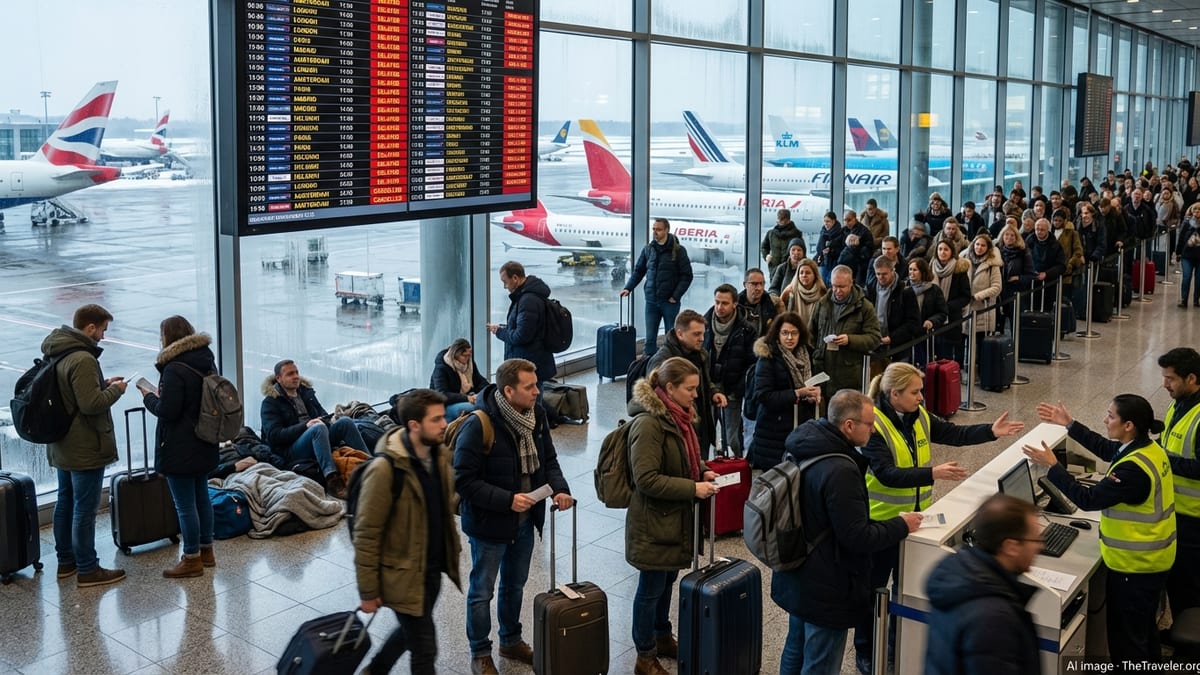
Thousands of air passengers across Europe faced hours of disruption on Sunday as a fresh wave of flight cancellations and delays swept through the United Kingdom, France, Spain, Finland and the Netherlands, with at least 159 services scrapped and more than 1,190 delayed at major hubs including London, Paris, Madrid, Helsinki and Amsterdam.
Storm Systems and Winter Weather Batter Key European Hubs
The latest round of disruption comes against the backdrop of an exceptionally volatile winter across Western and Northern Europe, with a series of powerful Atlantic storm systems hammering the region since January. A succession of deep low pressure systems has brought damaging winds, heavy rain and intermittent snow to the UK, France, the Low Countries and the Iberian Peninsula, repeatedly testing the resilience of airports and airlines.
In the Netherlands, Amsterdam Schiphol has been under particular pressure after officials and airline executives acknowledged that a de-icing bottleneck during a severe cold spell in early January forced widespread cancellations and delays. The airport has since come under scrutiny for its winter preparedness, with Air France-KLM linking tens of millions of euros in losses to the disruption and pledging a review of its ground operations and de-icing capacity.
Storm-driven winds and crosswinds have repeatedly crossed safe operational limits at exposed European airports, forcing air traffic controllers to reduce arrival and departure rates. When this happens during already busy morning and evening banks, even modest restrictions can trigger knock-on delays across the network, as late inbound aircraft ripple through subsequent rotations and crews hit duty time limits.
Sunday’s cancellations and delays were concentrated in the late morning and afternoon, when bands of heavy rain and gusty winds swept across parts of the UK and northern France, prompting temporary runway capacity reductions at London and Paris airports and forcing some operators to thin their schedules rather than risk last-minute diversions and go-arounds.
London, Paris and Amsterdam Bear the Brunt
London’s major airports once again emerged as flashpoints, with Heathrow and Gatwick recording dozens of delayed departures and arrivals as controllers imposed flow restrictions to maintain safe spacing in turbulent, low-visibility conditions. Airlines serving the UK capital, including SAS, JetBlue and easyJet, trimmed frequencies on short-haul European routes and consolidated some flights to reduce the number of aircraft cycling through congested airspace at peak times.
At Paris Charles de Gaulle and Orly, operators grappled with a combination of strong crosswinds, saturated ground conditions and lingering complications from earlier winter storms that have soaked northern France for weeks. Air traffic managers at France’s main approach control centers have at times been forced to reduce runway acceptance rates, leading to extended holding patterns over the Paris basin and delays that ran from 45 minutes to more than two hours on the busiest Sunday afternoon departures to Spain, Scandinavia and the UK.
Amsterdam Schiphol, one of Europe’s most important transfer hubs, continued to experience uneven operations as it works through the operational aftermath of its January de-icing crisis. Although Sunday’s weather was more manageable than the deep-freeze conditions that crippled the airport earlier in the winter, periodic showers and gusty winds again forced ground handlers to juggle aircraft on crowded aprons, lengthening taxi times and complicating the delicate choreography of turnarounds.
The combined effect across London, Paris and Amsterdam was visible on departure and arrival boards, where long strings of yellow and red “delayed” and “cancelled” indicators became a familiar sight throughout the day. For connecting passengers, even modest schedule changes at these hubs can be enough to break carefully timed itineraries, stranding travelers mid-journey and forcing costly, stressful rebookings.
Madrid, Helsinki and Nordic Routes Hit by Secondary Shocks
Madrid-Barajas, the main gateway to Spain and Latin America, also reported notable disruption as the wave of delays propagated across the continent. While conditions over central Spain were calmer than along the storm-battered Atlantic façade, knock-on effects from delayed inbound aircraft from northern Europe and the UK left Iberian and transatlantic departures running behind schedule, in some cases by several hours.
For Madrid, Sunday’s turbulence comes on top of broader instability in the European network triggered by an unusual pattern of winter storms, some of which have hammered Portugal and western Spain with hurricane-force gusts and heavy rain. These events have pushed airlines to adopt more conservative schedules on certain days, pre-emptively thinning frequencies in order to avoid the more chaotic, cascading delays that would otherwise follow.
Further north, Helsinki-Vantaa found itself once again on the front line of operational pressures. Finnair and other carriers operating in and out of Finland have spent much of the past year managing both harsh winter conditions and the lingering effects of industrial action, after aviation unions staged a series of strikes in 2025 that forced the cancellation of more than a thousand flights. While Sunday’s disruptions were driven mainly by weather and network imbalances rather than walkouts, the experience of those strikes has left both the airline and passengers wary of any sign of instability.
Nordic routes linking Helsinki, Stockholm, Copenhagen and Oslo to London, Paris and Amsterdam were among those most affected, as late-arriving aircraft from storm-exposed hubs forced airlines to retime departures or combine services. For business travelers and leisure passengers alike, the resulting uncertainty turned what should have been routine Sunday evening hops into extended ordeals.
Airlines from SAS to easyJet Struggle to Recover Schedules
The list of affected airlines read like a roll call of European and transatlantic carriers. Scandinavian operator SAS reported delays across its network, as services connecting Copenhagen and Stockholm to London and Paris were held in departure queues or forced into lengthy arrival holds. The airline, which has been undergoing financial restructuring and adjusting its long-haul and regional networks, has limited spare capacity to re-accommodate passengers when irregular operations hit.
Finnair, still contending with the structurally longer routings required after Russian airspace closed to many Western carriers, saw its carefully timed banks of Asian and European flights disrupted by delayed inbound traffic from hubs in Western Europe. When these arrivals miss their slots in Helsinki, the knock-on effect can quickly propagate to long-haul departures, as aircraft arrive late, require additional servicing and push crew duty times toward their regulatory limits.
Irish carrier Emerald Airlines, a regional operator that feeds larger networks under franchise and codeshare agreements, also found its tight schedules tested. With smaller aircraft operating high-frequency routes into slot-constrained airports, there is little slack when weather or air traffic control restrictions arise. Even a short ground stop or runway inspection at a major hub can cascade into missed rotations, and regional carriers often have fewer standby crews and spare jets to plug the gaps.
Low-cost giant easyJet, meanwhile, experienced widespread delays at its bases in the UK, France and the Netherlands. While budget airlines typically enjoy more point-to-point flexibility than legacy network carriers, their high aircraft utilization leaves them particularly vulnerable to disruptions. Once a morning departure runs significantly late, the same aircraft may carry that delay through multiple sectors during the day, producing knock-on effects for passengers boarding evening flights from secondary airports across Europe.
Transatlantic Links and JetBlue Customers Caught in the Middle
The turbulence in Europe also spilled across the Atlantic, with U.S. carrier JetBlue among those reporting disrupted services on routes linking New York and Boston to London and Paris. Transatlantic operations are highly synchronized, with narrow windows for landing and take-off slots at congested European hubs, and when storms prompt restrictions or runway closures, long-haul aircraft can be forced to divert, delay their departures or circle in holding patterns awaiting clearance.
For JetBlue, which has been building its European footprint with competitive fares and a boutique long-haul product, Sunday’s delays underscored the complexities of operating into Europe’s most congested airfields during an unsettled winter. Passengers on eastbound overnight services faced extended ground waits before departure, while some westbound flights left several hours late as crews and aircraft became entangled in earlier disruptions.
Transatlantic travelers are particularly exposed when irregular operations strike, because long-haul flights offer fewer daily frequencies and rebooking options. A cancellation or major delay can force passengers to wait an extra day for an available seat, especially on heavily booked weekend services. With Paris, London and Amsterdam all under pressure, standard contingency solutions such as rerouting via an alternative European hub were less effective than usual.
Airport staff at London Heathrow and Paris Charles de Gaulle reported long lines at rebooking desks and customer service counters, with some passengers facing waits of more than two hours just to speak to an agent. While most airlines now encourage travelers to use mobile apps and websites for rebooking, those tools can struggle when mass disruptions hit and available inventory tightens rapidly.
Passengers Face Missed Events, Extra Costs and Thin Compensation
For the thousands of travelers caught up in Sunday’s disruptions, the impact was measured not only in hours lost at airports, but also in missed connections, abandoned holidays and unexpected expenses. Families bound for half-term breaks in Spain and Portugal, business travelers en route to Monday meetings, and students returning to universities after winter travel all reported hurried changes of plan as flights shifted or disappeared from departure boards.
Accommodation quickly became a flashpoint in several cities as travelers whose flights were cancelled late in the day scrambled to find hotel rooms near airports. In major hubs such as London and Amsterdam, where large trade fairs and events were already pushing occupancy higher, last-minute bookers found prices surging for the few remaining rooms. Some passengers opted to bed down on terminal floors rather than pay elevated rates or attempt late-night journeys into city centers.
Questions of compensation and passenger rights also resurfaced. Under European Union and UK aviation regulations, travelers whose flights are significantly delayed or cancelled for reasons within an airline’s control may be entitled to fixed-sum compensation, as well as care including meals and hotel stays. However, airlines often argue that disruptions caused by severe weather or air traffic control restrictions fall under “extraordinary circumstances,” limiting their liability. Determining where Sunday’s events fall on that spectrum will likely be a point of contention between carriers and affected customers in the days ahead.
Consumer advocates reiterated calls for clearer, more uniform enforcement of passenger rights and for better real-time communication from airlines. Many travelers reported finding out about cancellations only after arriving at the airport, or receiving conflicting information from different channels as airline apps, websites and airport screens struggled to stay synchronized in fast-changing conditions.
Operational Lessons and What Travelers Can Expect Next
For Europe’s aviation sector, Sunday’s chaos offered another reminder that winter resilience remains a work in progress, particularly as climate change influences the intensity and frequency of Atlantic storms affecting the continent. Airports and airlines have already pledged to review de-icing capacity, staffing levels and coordination between air traffic controllers and ground services after a series of high-profile disruptions earlier in the season.
At Amsterdam Schiphol, the de-icing crisis of early January has spurred a deeper look at fluid logistics, equipment redundancy and staffing plans, with executives acknowledging that capacity planning did not keep pace with the severity of the weather event. Other northern hubs, including London and Paris, are likewise reassessing procedures for handling rapidly changing crosswinds and heavy rainfall without triggering disproportionate knock-on effects across their networks.
For passengers planning travel in the coming weeks, industry experts emphasize the importance of building flexibility into itineraries. That can mean allowing longer connection times through vulnerable hubs, avoiding the last flight of the day when possible, and considering travel insurance that covers weather-related disruption. Travelers are also urged to keep airline apps updated and to enable notifications, which can sometimes provide faster alerts than crowded airport screens.
While airlines expect conditions to stabilize as the current wave of storms eases, the experience of this winter suggests that further episodes of sudden disruption are likely before the season ends. For now, Europe’s aviation network remains under pressure, with Sunday’s tally of 159 cancellations and 1,190 delays serving as the latest illustration of how quickly severe weather, operational bottlenecks and high demand can combine to leave thousands of travelers stranded, rerouted or racing to salvage their plans.