

More news on this day
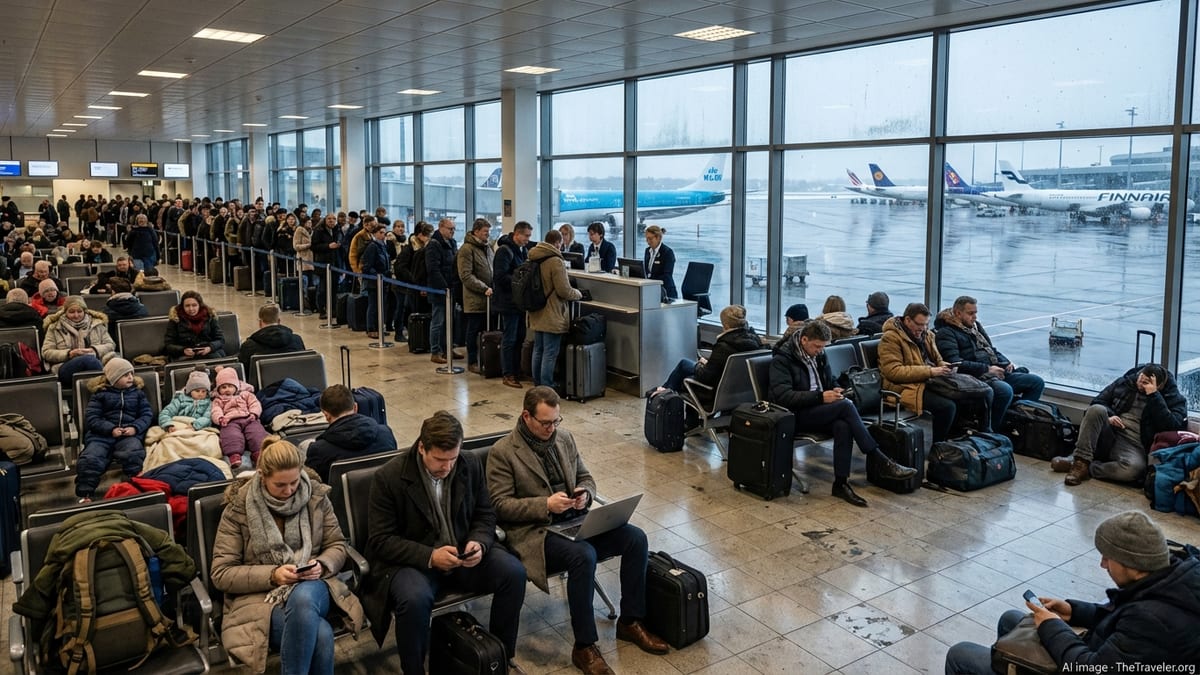
Hundreds of travelers were left sleeping on terminal floors and queuing for hours at check-in counters across Europe this weekend, as a powerful winter storm sweeping the Netherlands, the UK, France and several neighboring countries triggered 3,526 flight delays and 73 cancellations, disrupting operations for major carriers including KLM, Lufthansa and Finnair at hubs such as Paris and Oslo.
Severe Winter Weather Slams Key European Hubs
The latest wave of disruption began on 15 February 2026, when heavy snow, icy conditions and high winds moved across western and northern Europe, hitting major aviation corridors from the North Sea to the Baltic. Airports in the Netherlands, the UK, France, Germany, Norway and several central and eastern European states reported reduced visibility, frozen taxiways and persistent de-icing backlogs that quickly cascaded into widespread delays.
By late Sunday, operational data compiled by flight-disruption tracking services showed 3,526 flights delayed and 73 canceled across the affected region, a volume that pushed many already stretched airport and airline teams beyond their contingency plans. While some airports had anticipated the impact and trimmed schedules in advance, the intensity and geographic breadth of the storm meant recovery was slow and uneven.
Amsterdam Schiphol, Paris Charles de Gaulle, London Heathrow, Oslo Gardermoen and Frankfurt were among the hardest-hit hubs, serving both as origin points for disruption and as magnets for diverted traffic from smaller regional airports unable to operate safely. The result was a patchwork of bottlenecks that rippled through the European network, particularly for short-haul and connecting passengers.
Airport operators in several countries described the event as one of the most complex weather-related challenges of the season, citing the combination of snow, ice and intermittent freezing rain. Ground handling crews were forced to work in short, intense bursts between squalls, slowing turnaround times and forcing airlines to prioritize which flights could depart.
Hundreds Stranded Overnight in Terminals From Paris to Oslo
As schedules unraveled, hundreds of travelers found themselves stranded in terminals, particularly at major transfer hubs where missed connections rapidly piled up. At Paris Charles de Gaulle, long-haul passengers arriving from North America and Asia reported being rebooked multiple times as onward flights to Amsterdam, Oslo and other European destinations were successively delayed or canceled.
In Oslo, where snow and strong crosswinds complicated operations, some evening departures were pushed past crew duty-time limits, forcing airlines to cancel flights even after aircraft were prepared and de-iced. The timing left many travelers stuck overnight, with limited hotel availability near the airport as demand quickly outstripped the number of contracted rooms.
Similar scenes played out in Amsterdam and London, where terminal seating areas and quiet corners quickly filled with passengers laying out jackets and carry-on bags as makeshift beds. Airport authorities distributed water, snacks and, in some cases, thin camp-style mattresses, though some travelers said supplies ran out before everyone in line had been served.
For families with young children and elderly passengers, the combination of noise, crowding and uncertainty proved particularly challenging. Social media posts from stranded travelers described confusion over gate changes, long waits to speak with airline staff and difficulty securing accurate information on when operations might stabilize.
Major Carriers Scramble to Rebuild Schedules
The disruptions were especially acute for network carriers that rely on tightly timed waves of connecting flights. KLM, Lufthansa and Finnair all saw multiple rotations affected, with aircraft and crews scattered around Europe as the storm shifted from west to east.
At Amsterdam Schiphol, KLM cut dozens of short-haul services and consolidated lightly booked flights in an effort to protect its long-haul backbone. The airline focused on maintaining links to major intercontinental destinations while warning passengers that same-day connections within Europe could not be guaranteed. Travelers whose intra-European flights were canceled were offered rebooking on later departures, rail alternatives on certain routes or, in some cases, full refunds.
Lufthansa and its partners faced similar dilemmas at Frankfurt and Munich, where inbound flights from the UK, France and the Benelux countries arrived late or were diverted. With crew rosters quickly approaching regulatory limits due to extended duty hours in difficult conditions, the group preemptively canceled some rotations rather than risk last-minute turnbacks or unplanned crew overnights in already congested airports.
Finnair, which relies heavily on feed from across northern and western Europe into its Helsinki hub, reported knock-on effects even when Finnish airspace remained marginally more stable. Delays from cities such as Paris, Amsterdam and Oslo reduced the number of passengers able to make onward connections to Asia, forcing some services to depart with lighter loads and others to await late-arriving travelers, further compounding delays.
Countries Across Europe Grapple With Operational Limits
National authorities and airport operators in the Netherlands, the UK and France all activated winter-weather contingency plans as the storm intensified. In the Netherlands, Amsterdam Schiphol temporarily reduced inbound traffic flows, directing some flights to hold or divert in order to preserve runway capacity for de-icing operations and essential arrivals. Ground handling teams worked in rotations to prevent cold-related injuries, which in turn limited how many aircraft could be processed at once.
In the UK, where London Heathrow, Gatwick and several regional airports experienced a mix of snow showers and freezing fog, air-traffic regulators encouraged airlines to thin out schedules proactively. Despite these efforts, arriving aircraft encountered backlog-related holding patterns, consuming extra fuel and obliging carriers to balance safety considerations with the risk of diversions to alternative airports in continental Europe.
French airports around Paris faced both infrastructure and staffing constraints. While runways were kept open for much of the storm, taxiways and remote stands required repeated clearing. The need to shuttle passengers by bus between terminals and remote aircraft in icy conditions added further time to already stretched turnarounds. Staff shortages, particularly among ground handlers who had already been working extended shifts in earlier winter storms, exacerbated the challenge.
Elsewhere in Europe, from Germany and Poland to Greece and the Nordic states, airports implemented a mix of delays and targeted cancellations, each decision feeding back into the broader network. Even airports experiencing milder weather felt the impact as delayed inbound aircraft and crews disrupted their otherwise normal schedules.
Passengers Face Long Queues, Confusing Rules and Patchy Support
For travelers on the ground, the immediate reality was one of lines, uncertainty and conflicting information. At several major airports, check-in halls and transfer centers saw queues stretching far beyond normal crowd-control barriers, with waits of two to three hours reported for rebooking desks at the height of the disruption.
Many passengers turned to airline apps and websites, only to find that digital tools lagged behind fast-changing operational decisions. Gates were reassigned repeatedly as aircraft and crews were shuffled, and in some instances travelers discovered only at the boarding area that their flight had slipped from “delayed” to “canceled.”
Though European air passenger rights regulations require airlines to provide meals, refreshments and, when necessary, accommodation during extensive delays and cancellations, the practical delivery of this support remained uneven. In cities where hotel capacity is already tight on winter weekends, vouchers sometimes translated into long searches for available rooms, while others reported being advised to arrange and pay for their own accommodation and seek reimbursement later.
Travelers attempting to connect between different airlines, or on separate tickets, faced additional complexity. Some were told that onward legs counted as separate journeys and therefore were not automatically protected, leaving them to negotiate directly with each carrier while also trying to secure food and shelter for the night.
Economic and Operational Impact on the Aviation Sector
The storm-related chaos represents more than an inconvenience for passengers; it also carries a significant financial and operational toll for airlines and airports already grappling with tight margins and elevated demand. Each day of widespread delays translates into additional fuel burn, overtime pay for ground and flight crews, and the cost of passenger care obligations under European regulations.
For carriers such as KLM, Lufthansa and Finnair, the disruption has also meant the loss of high-yield connecting traffic, as travelers abandon complex itineraries in favor of more direct services or alternative modes like high-speed rail on shorter routes. Some corporate travel managers have begun advising employees to build in extra buffer days for critical trips through Europe’s busiest hubs during the storm-prone winter months.
Airports themselves must absorb the strain on infrastructure and staffing. De-icing fluid usage rises sharply during events of this magnitude, and equipment must be cycled intensively to keep taxiways and stands safe. Maintenance teams are often required to work extended hours to keep essential systems functioning in freezing conditions, from jet bridges and baggage belts to runway lighting and surface sensors.
Industry analysts note that the latest disruption comes on the heels of several other large-scale events in recent months, including strike-related cancellations and previous winter storms. Taken together, these incidents underscore the fragility of a system that operates close to capacity for much of the year, with limited slack to absorb shocks across multiple major hubs at once.
Calls Grow for Better Planning, Communication and Resilience
As the scale of the latest disruption became clear, passenger advocates and some aviation experts renewed calls for more robust contingency planning and clearer communication strategies. While severe winter weather is beyond the control of airlines and airports, critics argue that the frequency of major disturbances across the European network highlights the need for more conservative scheduling and closer coordination between carriers and air-traffic authorities.
One recurring complaint from stranded travelers has been the inconsistency of information provided across different channels. Airport display boards, mobile apps and call centers have not always been synchronized, leading passengers to rely on social media or third-party flight-tracking tools to piece together an understanding of their options. Analysts say investment in real-time data sharing and more transparent disruption dashboards could help ease some of the anxiety and confusion during major events.
There is also growing discussion around the balance between efficiency and resilience. In recent years, airlines have optimized fleets and crew rosters to reduce idle time, improving profitability but leaving less room to maneuver when weather, strikes or technical issues arise. Some observers suggest a modest increase in operational slack, such as additional standby crews or spare aircraft at key hubs, could significantly improve recovery times after large-scale disruptions.
For now, regulators in countries such as the Netherlands, the UK and France are focusing on short-term measures, urging operators to prioritize safety and passenger care as the immediate weather system moves through. Longer-term policy shifts, if they materialize, are likely to follow only after a fuller assessment of the winter season’s cumulative impact.
What Travelers Can Expect in the Coming Days
With forecasts suggesting that wintry conditions may linger over parts of northern and western Europe, travelers are being advised to brace for continued disruption, even as airlines and airports work to clear existing backlogs. Residual delays are expected to persist at key hubs including Amsterdam, Paris, London, Oslo and Frankfurt, especially during peak morning and evening travel banks.
Airlines are urging passengers with flexible plans to consider rebooking away from the most affected dates or choosing midweek departures, when schedules may be slightly less congested. Those who must travel are being encouraged to allow extra time for check-in and security, keep a close eye on airline notifications and, where possible, avoid tight connections that leave little margin for additional delays.
Travel advisers also recommend that passengers carry essential items such as medications, chargers and a change of clothes in their hand luggage, given the heightened risk of unplanned overnight stays. For those whose flights are significantly delayed or canceled, keeping receipts for meals, transport and accommodation can help smooth later reimbursement claims with airlines or travel insurers.
While the immediate priority for operators is to restore regular service, the longer-term question for Europe’s aviation sector is how to adapt to increasingly volatile weather patterns and a travel landscape that leaves little room for error. For the hundreds of travelers still waiting in terminal queues or trying to sleep under the fluorescent lights of crowded departure halls, the answer cannot come soon enough.