

More news on this day
European air travel was thrown into fresh turmoil today as hundreds of flights were delayed or cancelled across the Netherlands, Denmark, Greece and several other countries, with major carriers including KLM, Lufthansa and easyJet struggling to keep schedules on track at hubs such as Amsterdam Schiphol and Barcelona-El Prat.
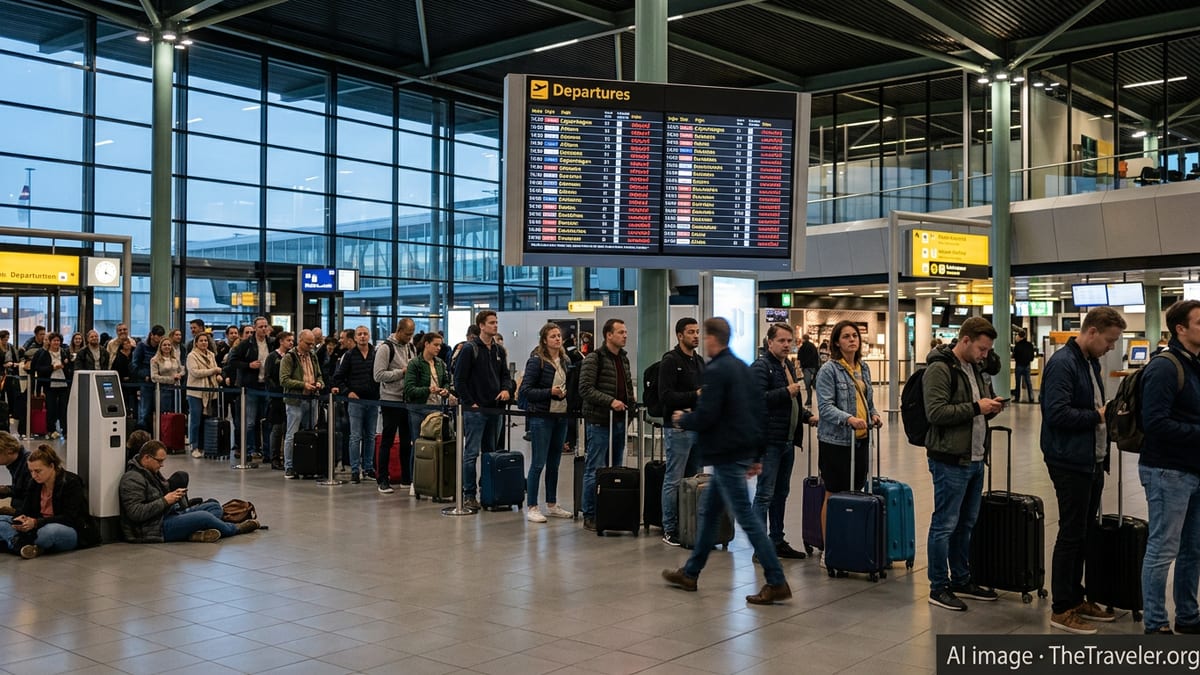
Hundreds of Flights Disrupted Across Key European Hubs
Operational data from aviation analysts indicates that more than 283 flights have been delayed and at least 82 cancelled across Europe, adding to a mounting wave of disruption that has left terminals crowded and departure boards flashing red at airports from Amsterdam to Athens and Barcelona. The latest figures come against a backdrop of broader instability in the network, with separate tallies for today alone pointing to 396 delays and 169 cancellations across major hubs in the Netherlands, Italy, France, Germany and Austria.
Amsterdam Schiphol is once again at the heart of the disruption. Reports show the Dutch hub recording around two dozen cancellations and more than 60 delays as airlines battle congestion, tight turnaround times and air traffic control pressures. Barcelona-El Prat, Madrid-Barajas, Rome Fiumicino, Milan Malpensa and Lisbon have all reported significant numbers of late or axed services, underscoring how widely the problems are now being felt across the continent.
In Northern Europe, Copenhagen, Oslo and Stockholm Arlanda have reported mounting delays and cancellations, while Vienna, Munich, Zurich and Frankfurt are contending with their own backlogs. Aviation analysts warn that even relatively small schedule changes at one hub are now rippling quickly through the system, stranding aircraft and crew in the wrong locations and forcing last-minute reshuffles.
Southern Europe has not been spared. Athens International Airport is among the worst affected in the region, with more than 20 cancellations and a similar number of delays reported, complicating travel plans for both leisure tourists and business travellers moving between Greece and the rest of Europe.
Major Carriers Struggle as KLM, Lufthansa and easyJet Face Strain
The latest wave of disruption is hitting a broad mix of full-service and low cost airlines. KLM, Lufthansa and easyJet are among the carriers named in operational summaries as experiencing elevated levels of delays and cancellations, alongside British Airways, Air France, Pegasus Airlines and Ryanair. Industry data suggests that for some airlines, disruptions today represent a continuation of a pattern seen since early January, when more than 1,000 flights were cancelled and over 2,000 delayed across 11 European countries.
KLM, which has its main base at Amsterdam Schiphol, is juggling a complex set of challenges. Recent figures show that the airline has already faced heavy disruption in recent months, and its latest travel alerts highlight ongoing schedule adjustments and the potential for short-notice changes as it responds to congestion and altered routings. The carrier continues to advise passengers to register contact details so they can receive real-time updates by text message or email.
Lufthansa, operating from hubs including Frankfurt and Munich, is also contending with mounting operational pressure. Earlier disruption triggered by airspace restrictions has forced a number of carriers, including Lufthansa, to reroute flights, extend journey times and reassign aircraft, compounding crew scheduling issues. Today’s cancellations and delays come on top of those earlier network shocks.
Low cost giant easyJet is likewise seeing a spike in affected services, particularly at London Gatwick, Amsterdam, Barcelona and other high-density leisure airports. Recent data points to several dozen easyJet flights cancelled or significantly delayed in a single day across Europe, as the airline grapples with the knock-on effects of congested airspace, packed schedules and limited slack in its fleet.
Middle East Airspace Closures and Congestion Fuel Ongoing Chaos
While no single cause fully explains today’s specific tally of 283 delays and 82 cancellations, aviation analysts highlight a combination of structural and immediate pressures. A series of airspace closures and restrictions over the Middle East, linked to ongoing regional conflict, has forced European and international airlines to redesign long haul routings, adding flight time and disrupting carefully balanced rotations.
KLM has confirmed that it is currently avoiding airspace over Iran, Iraq and Israel, as well as parts of the Gulf region, while suspending or trimming services to cities such as Dubai, Dammam and Riyadh. These changes have a direct impact on the positioning of aircraft and crew, and indirectly affect European feeder routes as airlines attempt to rebuild viable rosters around longer detours.
At the same time, peak travel demand and tight airport capacity are amplifying the problem. Reports from disruption trackers describe “airport congestion, air traffic control pressures and scheduling constraints” at key hubs, which reduce runway throughput and make it harder to recover when something goes wrong. With many European hubs already operating near their practical capacity at busy times, small delays are quickly cascading into missed slots, ground holds and diversions.
Industry observers note that this is not the first significant disruption episode of the winter season. In early January, a separate wave of operational problems saw over a thousand flights cancelled and more than two thousand delayed across France, the Netherlands, Spain, Denmark, Italy and other markets, with KLM, Air France, British Airways and Lufthansa among the hardest hit. Today’s events suggest that the system has yet to regain consistent stability.
Passengers in Netherlands, Denmark and Greece Face Long Queues
For travellers on the ground, the statistics translate into hours of uncertainty. At Amsterdam Schiphol, passengers reported long queues at check in and security, with some travellers learning of cancellations only after clearing formalities. Display boards showed clusters of delayed departures for European cities including Copenhagen, Vienna, Athens and Barcelona, as airlines attempted to reshuffle aircraft and crew.
In Denmark, Copenhagen Airport has recorded a rising number of delays and cancellations on both intra-Nordic and wider European routes. Travellers bound for destinations such as Amsterdam, Frankfurt and London have faced rolling estimated departure times, while some short haul services were pulled from the schedule entirely as airlines prioritised longer sectors or critical connections.
Greek travellers and visitors have also been caught up in the turmoil. Athens International Airport has logged more than 20 cancellations and a similar number of delays, affecting flights to and from major European capitals. With many of these routes operating near capacity, rebooking options have been limited, forcing some passengers to accept overnight stays or multi-stop itineraries in order to reach their destinations.
Across the wider network, travellers connecting through Barcelona, Madrid, Rome and Milan have encountered missed onward connections, crowded customer service desks and limited hotel availability near major hubs. Social media posts from stranded passengers show busy terminals and long lines at airline transfer counters as staff work through rebookings and compensation claims.
What Affected Travelers Should Do Now
Airlines and airports are urging passengers to check their flight status frequently and to avoid travelling to the airport until their departure is confirmed. Most major carriers, including KLM, Lufthansa and easyJet, are issuing real-time updates via mobile apps, text messages and email, with some proactively rebooking customers onto later services where seats are available.
Experts recommend that travellers whose flights are cancelled or heavily delayed keep all receipts for meals, hotels and ground transport, as they may be able to claim reimbursement under airline policies or regional passenger rights rules. In many cases, passengers on European routes whose flights are cancelled at short notice or delayed by several hours could also be entitled to additional financial compensation, depending on the cause of the disruption.
Passengers with upcoming trips in the next several days are advised to build in extra time for connections, especially when transiting major hubs such as Amsterdam, Paris, Frankfurt, London Heathrow or Barcelona, where disruption levels have been highest. Where possible, booking longer minimum connection times or opting for earlier flights in the day can provide a buffer if delays mount.
With no firm end date to the current wave of instability, industry observers say the best strategy for travellers is to stay flexible, monitor updates closely and be prepared for last-minute changes to itineraries. For now, Europe’s aviation network remains under strain, and both airlines and passengers are bracing for further turbulence in the days ahead.