

More news on this day
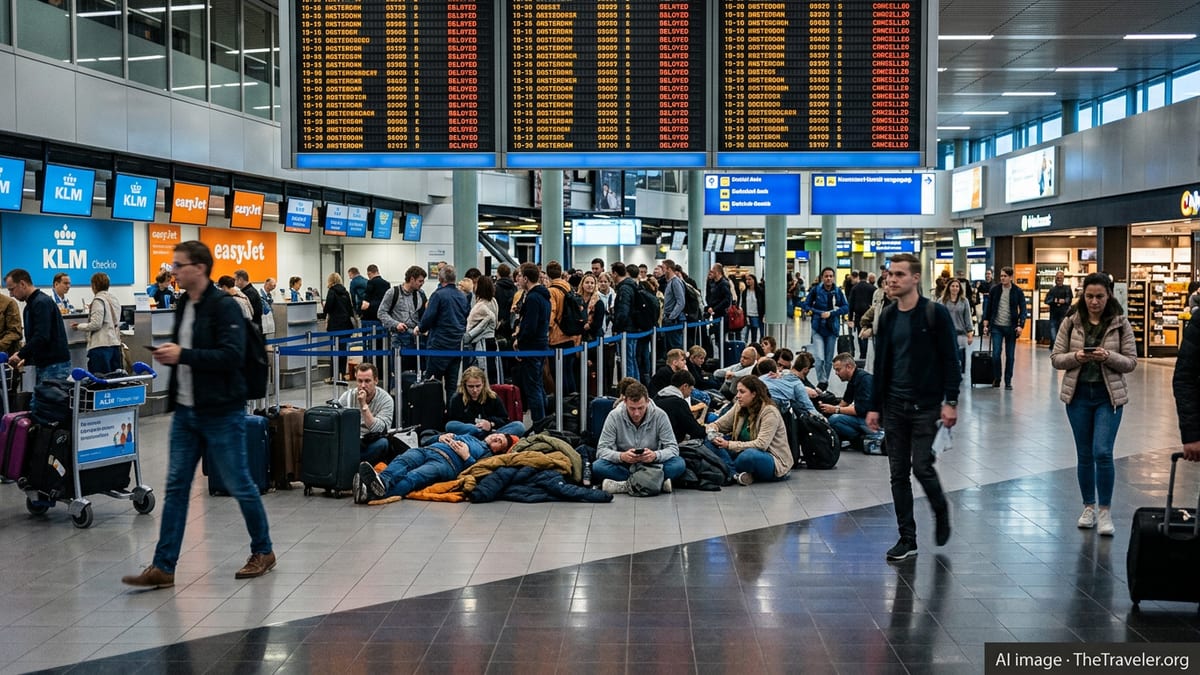
Hundreds of passengers have been left sleeping in terminals and scrambling for last-minute rebookings as a fresh wave of disruption ripples across Europe’s busiest air hubs, with weather, cyber incidents and knock-on effects from Middle East airspace closures converging during one of the peak travel weekends of the year.
Get the latest news straight to your inbox!
Storm systems batter northern and western Europe
New storm activity across northern and western Europe has emerged as a primary driver of the latest round of travel chaos. Publicly available tracking data for 7 April indicates that Storm Dave triggered at least 238 cancellations and nearly 1,500 delays at airports including Keflavik, Stockholm Arlanda, Dublin, London’s main airports and Frankfurt, pushing already crowded schedules beyond capacity.
These weather-related disruptions arrived on top of an already fragile operating environment. Data compiled by passenger-rights platforms and aviation analytics firms for early April shows that hundreds of flights were already running late across the continent in the days leading up to the storm, leaving little room for recovery once gusting winds and low visibility closed runways or forced aircraft into holding patterns.
Major hubs in the United Kingdom, Germany and the Nordic countries appear to be among the worst affected, with long queues forming at check-in and security as airlines attempt to manually rebook travellers on the limited number of available seats. Social media posts and traveller forums describe passengers stuck overnight in terminals after missing onward connections, as airport hotels quickly reached capacity.
While weather disruption is a regular feature of European aviation, analysts note that the clustering of intense storm systems during the late winter and early spring period has led to repeated schedule resets in 2026, leaving airlines and airports with little time to rebuild resilience between events.
System-wide strain leaves hubs struggling to recover
Reports from data providers that track flight movements indicate that the current wave of disruption is not confined to a single day. Over recent weeks, several separate events have pushed Europe’s aviation network close to breaking point, including widespread delays on 5 March and 11 March when more than a thousand flights across the region were cancelled or significantly delayed after earlier weather problems and staffing constraints.
In the latest episode, figures compiled on 6 and 7 April show more than 2,400 delayed flights and over 150 cancellations in a 24-hour period across Europe, affecting major hubs such as London, Paris, Amsterdam, Frankfurt and Copenhagen. Travel-industry coverage indicates that carriers including easyJet, KLM, Lufthansa, British Airways and several Nordic and Mediterranean airlines are all dealing with large backlogs of disrupted passengers.
At Copenhagen Airport, operational updates and local media coverage point to several hundred delayed departures and dozens of cancellations concentrated over a short window, making the Danish capital one of the epicentres of the current chaos. Similar patterns have been reported at Amsterdam Schiphol, where crowded terminal scenes reflect the difficulty of processing disrupted transfer traffic through a hub network that is still operating near peak capacity for the Easter holiday period.
The network effect means that delays at one hub can quickly cascade across the continent. When aircraft and crew are out of position, subsequent rotations are pushed back, even in cities far from the original weather or technical problem. This has resulted in travellers arriving hours late into southern European destinations after starting their journeys at northern hubs heavily affected by Storm Dave and earlier disturbances.
Cyber incidents and infrastructure issues add to disruption
Beyond the immediate weather problems, infrastructure and technology vulnerabilities are compounding the strain. Recent reporting in regional outlets highlights a cyber incident affecting a major aviation technology supplier that disrupted check-in and baggage systems at several European airports, including key hubs in the United Kingdom, Belgium and Germany.
According to publicly available accounts, the incident forced airlines and airport handlers in some locations to revert to manual procedures for boarding and baggage processing. This significantly slowed operations, contributing to long queues and missed connections as staff worked through backlogs using paper-based workarounds. While core flight-safety systems were not reported to be affected, the impact on passenger-facing processes was enough to create visible congestion in terminal areas.
The event follows several years in which Europe’s aviation infrastructure has been repeatedly tested by IT outages, including earlier global software problems that affected airports in Greece and other countries. Together, these incidents have raised fresh questions about the resilience of the digital systems that underpin everything from crew rostering and slot management to passenger check-in and security screening.
Industry analysts caution that as airlines and airports rely more heavily on integrated technology for day-to-day operations, relatively small failures in a single system can trigger disproportionate disruption, especially when they coincide with already busy travel peaks.
Airspace closures and longer routings ripple into Europe
The war involving Iran and Israel and associated security measures have also reshaped global flight paths, indirectly feeding into Europe’s travel turmoil. Economic and aviation assessments note that extensive airspace closures across parts of the Middle East have forced airlines to reroute long-haul services linking Europe with Asia and Africa, adding flight time and fuel costs.
These longer routings can cause aircraft and crews to arrive late into European hubs, compressing turnaround times and reducing the ability of airlines to absorb subsequent delays. Passenger-rights monitoring since late February points to cases in which long-haul flights have required unplanned refuelling stops in southern Europe, or have arrived outside normal connection windows, leaving travellers stranded or rebooked onto later services.
While the most immediate impact of the airspace closures has been felt at airports in the Gulf and wider Middle East, the knock-on effects are increasingly visible in Europe’s major transfer hubs. Congested early-morning arrival banks and late-evening departures create pinch points that can quickly overwhelm staffing, especially when combined with local weather issues or technical glitches.
Travel specialists suggest that until more predictable routings return on affected long-haul corridors, European carriers and airports will need to plan for higher schedule volatility, particularly on days when storms or labour challenges are already expected.
Travellers face uncertainty and limited options
For passengers caught up in the current disruption, the result has been a mix of uncertainty and limited alternatives. With many peak-period flights sold close to capacity, same-day rebooking options remain scarce on key routes, particularly from northern hubs such as Copenhagen, Amsterdam and London to Mediterranean destinations popular over the Easter and early spring break period.
Consumer advocates note that Europe’s air-passenger protection rules can provide compensation and care in some circumstances, but that these rights vary depending on the cause of disruption and whether it is deemed within an airline’s control. Weather-related cancellations may entitle travellers to rerouting or refunds, while technical or staffing problems can sometimes trigger additional compensation on eligible itineraries.
Information from passenger-rights organisations advises travellers to keep boarding passes, booking confirmations and receipts for meals or accommodation when delays extend overnight, and to check whether their situation qualifies for reimbursement. However, long queues at service desks and limited call-centre capacity during major disruption events can make it difficult to obtain clear guidance in real time.
As airlines and airports work to restore normal operations following the latest wave of storms and system issues, forecasters warn that further bouts of unsettled weather remain possible in the coming weeks. With airspace complexities and infrastructure risks still in play, Europe’s travellers may need to prepare for a continued period of elevated disruption across the continent’s busiest hubs.