

More news on this day
European airlines are accelerating a new wave of nonstop services to major Asian hubs, turning airports from Istanbul to Paris, Amsterdam and Munich into powerful bridges between continents and reshaping how passengers and businesses move across Eurasia.
Get the latest news straight to your inbox!
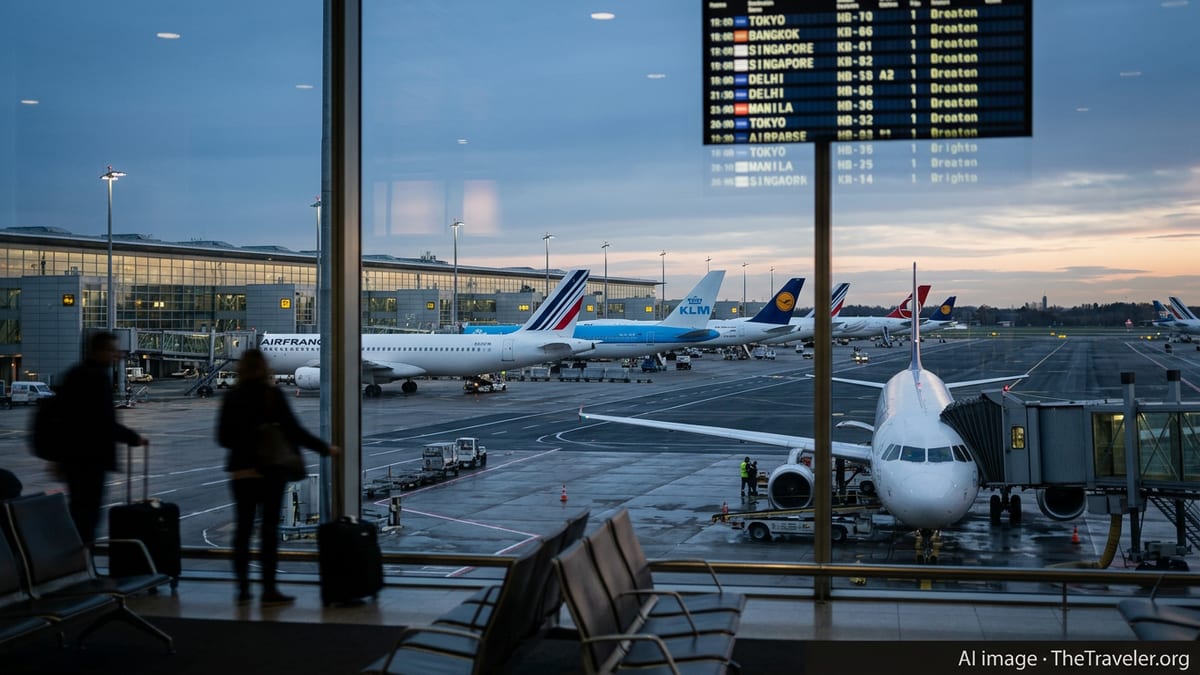
New Nonstop Routes Target Fast-Growing Asian Gateways
Recent route announcements show European carriers concentrating new capacity on Asia’s largest and fastest-growing hubs. Publicly available schedules indicate that Air France has rebuilt a substantial Asian network from Paris Charles de Gaulle, with regular nonstop flights to Tokyo Haneda, Osaka, Beijing, Shanghai, Hong Kong, Seoul, Bangkok, Singapore and Ho Chi Minh City, alongside a newer service to Manila that strengthens direct links into Southeast Asia. Winter schedule information also points to a ramp-up in frequencies on several of these routes, particularly to Bangkok and Singapore, in response to sustained leisure and business demand.
The Franco-Dutch group is also leaning into Thailand’s tourism boom. Industry bulletins and company releases describe the resumption of direct Paris–Phuket flights, giving European travelers a second Thai gateway beyond Bangkok and offering Asian passengers additional one-stop access into Air France’s broader European network. This move reflects a wider trend among European airlines of pairing traditional business-focused hubs with secondary leisure destinations in Asia.
Lufthansa Group is likewise sharpening its focus on India and wider Asia. Updated schedules show a new direct Lufthansa service between Munich and Bengaluru using Airbus A350 aircraft, arriving in Germany early in the morning to maximize onward connections across Europe and North America. This adds to an already dense web of nonstop services from Frankfurt and Munich into major Asian cities, and it complements an expanded codeshare arrangement between Lufthansa Group carriers and Air India that significantly broadens one-ticket connectivity between secondary Indian cities and European destinations.
KLM is expanding its own footprint in India with a new nonstop link between Amsterdam and Hyderabad, creating a direct bridge between a fast-growing technology hub and the Dutch carrier’s global network. Industry coverage notes that this route brings KLM’s Indian portfolio to four cities and forms part of a broader long-haul expansion that has lifted overall seat capacity and diversified the airline’s Asian presence beyond the most established markets.
Istanbul and Other Hubs Rise as Eurasian Transit Gateways
While Western European hubs consolidate traffic to East and Southeast Asia, Istanbul is emerging as one of the most prominent transit points between Europe and the broader Asian region. Data from airline and airport announcements highlights the rapid expansion of Turkish Airlines, which now serves more countries than any other carrier and uses its Istanbul hub as a high-frequency bridge between Europe, the Middle East and Asia. The strategy relies on funneling passengers from secondary European cities through Istanbul onto an extensive network of routes reaching into South Asia, East Asia and Central Asia.
New routes underline this approach. Recent coverage in Spanish media describes the launch of a direct Turkish Airlines service between Seville and Istanbul, marketed locally as a connection that opens access to more than 200 onward destinations. For mid-sized European cities that historically lacked nonstop links to Asian hubs, such services effectively plug them into a global network via one additional flight, widening options for tourism, trade and diaspora travel.
Other European carriers also position their hubs as stepping stones into Asia through carefully timed banks of flights. Amsterdam Schiphol, Paris Charles de Gaulle and Munich are scheduled to host arrivals from across Europe in the early evening and morning waves, feeding long-haul departures to Asian hubs later in the night or soon after sunrise. Airline timetable data suggests that early-morning arrivals from Asia are synchronized with departure banks across Europe, reducing connection times and making itineraries through these hubs more competitive with one-stop options via the Gulf.
For travelers, this hub-and-spoke model means a growing number of one-ticket journeys from smaller European airports to major Asian cities involving a single connection in Istanbul, Paris, Amsterdam, Frankfurt or Munich. For airlines and airports, it concentrates long-haul demand at key hubs while still extending reach into regional markets through shorter feeder flights.
India and Southeast Asia Become Strategic Focal Points
India and Southeast Asia have become central to European network planning as traffic rebounds and economic links deepen. Industry analyses note that India has climbed rapidly up the rankings of long-haul markets by volume, and bilateral talks between European and Indian authorities have yielded additional traffic rights in recent seasons. These agreements have allowed carriers such as Air France, KLM and Lufthansa to add new flights, upgauge aircraft and expand codeshare arrangements that knit together secondary Indian cities with European capitals.
The Hyderabad–Amsterdam and Bengaluru–Munich routes are emblematic of this shift. Both connect major Indian technology and innovation hubs directly to European centers with strong corporate travel demand. Timings are designed to appeal to business travelers and long-stay visitors, with overnight flights and early-morning arrivals that support same-day onward connections. Publicly available information shows that these services also appeal to visiting friends-and-relatives traffic, particularly among Indian diaspora communities in Europe and North America.
In Southeast Asia, European carriers are rebalancing their networks toward markets showing the strongest post-pandemic recovery. Thailand, Vietnam and the Philippines feature prominently. Besides the Paris–Phuket and Paris–Bangkok services, winter schedule documents highlight sustained operations from Paris to Ho Chi Minh City and the relatively new Paris–Manila link, which gives European travelers a nonstop option to the Philippines and plugs Manila into Air France-KLM’s transatlantic joint venture via Europe.
These moves coincide with broader capacity growth by Asian airlines at their own hubs in Bangkok, Singapore, Kuala Lumpur and Manila. As more carriers on both sides increase nonstop and one-stop options, European and Asian hubs are effectively knitting together overlapping networks, enhancing choice for passengers while intensifying competition on key city pairs.
Competitive Pressures and Partnership Strategies
The rise in direct Europe–Asia links is intensifying competition not only among European carriers, but also with Gulf, Asian and emerging long-haul operators. European airlines are responding through alliances, joint ventures and codeshares designed to fill aircraft more efficiently and extend their virtual networks into markets they do not serve with their own metal. The expanded partnership between Lufthansa Group carriers and Air India, for example, significantly boosts the number of European and Indian city pairs that can be sold on one ticket, even where only one partner operates the underlying flight.
Air France-KLM is pursuing a similar strategy through its membership in SkyTeam and bilateral arrangements with Asian partners, allowing the group to market itineraries beyond its own Asian gateways into domestic networks in countries such as Japan, China and South Korea. Published corporate documents emphasize that Asia has delivered some of the fastest long-haul growth for the group, and that strategic cooperation with local carriers is essential to capture flows beyond primary hubs.
At the same time, economic and geopolitical factors are shaping which Asian hubs see the most European growth. Restrictions on certain overflight corridors have made some routings more complex, while visa policies, airport slot availability and bilateral air-service agreements influence where additional capacity can be deployed. Industry observers note that when regulators expand traffic rights, carriers have moved quickly to announce new nonstop flights or upgauge existing routes, particularly into markets with strong tourism or technology sectors.
For passengers, the result is a denser web of direct and one-stop options linking European cities to Asian mega hubs and emerging gateways alike. For the airlines, these routes are part of a wider contest to capture growing long-haul demand, anchor their hubs as preferred transfer points and secure a larger share of the traffic that now increasingly flows directly between Europe and Asia.