

More news on this day
Geopolitical tensions and airspace restrictions in the Middle East are accelerating a shift in global aviation, with India emerging as a critical hub for nonstop and one-stop connections between Europe and Asia as European airlines rapidly expand services to the country while Gulf carriers trim or reroute operations.
Get the latest news straight to your inbox!
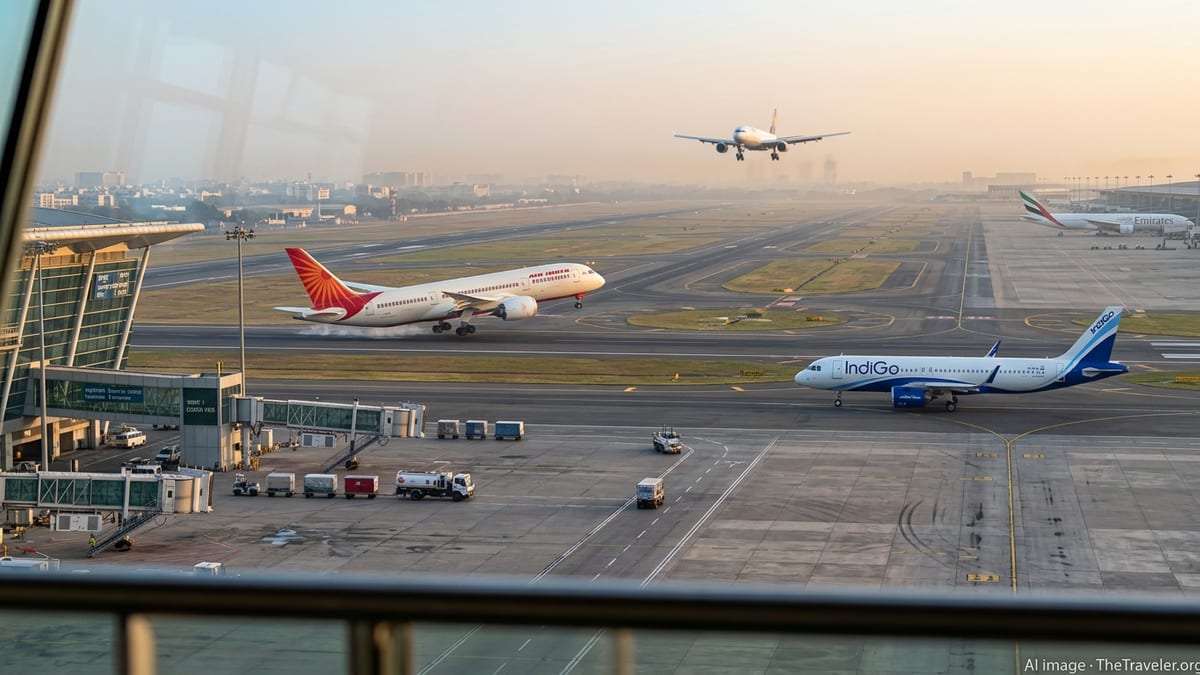
India’s Air Traffic Surge Redraws Global Route Maps
India’s aviation sector has been on a multi‑year growth trajectory, and recent data shows that momentum continuing despite macroeconomic headwinds. Industry reports based on figures from the Directorate General of Civil Aviation and international bodies indicate that India is now the world’s third‑largest air transport market by departing passengers, accounting for just over 4 percent of global air traffic in 2024. Domestic growth has moderated slightly since the post‑pandemic rebound, but traffic volumes remain at record highs.
International demand is rising even faster. Credit rating agencies tracking the sector forecast high‑teens growth in international passenger numbers for Indian carriers in the 2025 to 2026 financial years, outpacing domestic expansion. Airports Council International and other forecasting groups highlight India, alongside the United States and China, as one of the core engines of long‑term passenger growth, with projections that India will rank among the top global markets by 2040.
On the ground, India has been racing to add infrastructure to keep up with demand. Government and industry summaries show that the number of operational airports has more than doubled over the past decade, while new terminals and runways are being commissioned at major hubs. The opening of Navi Mumbai International Airport, Mumbai’s long‑awaited second international gateway, underscores a broader push to position Indian cities as primary transfer points rather than secondary spokes in Gulf‑centric networks.
Fleet orders by Indian airlines also reflect a structural shift toward long‑haul capability. Flag carrier Air India and low‑cost leader IndiGo have placed some of the largest aircraft orders in commercial aviation history, including hundreds of wide‑body and longer‑range narrow‑body jets. Analysts say these orders are intended in part to capture non‑stop and same‑alliance traffic that previously flowed through Gulf and European hubs, especially on Europe–India and North America–India corridors.
Middle East Conflicts Disrupt Traditional Gulf Hub Model
The rebalancing of traffic toward India has been accelerated by instability along historical transit routes. After years of adapting to Russian and Ukrainian airspace closures, airlines are now contending with new restrictions linked to the conflict involving the United States, Israel and Iran. Publicly available flight tracking and regulatory notices show that key segments of Middle Eastern airspace have become constrained or unavailable, forcing long detours on corridors that once relied heavily on Gulf hubs.
Industry coverage of the current disruption indicates that Indian carriers alone cancelled around 45 percent of their international flights over a roughly ten‑day period from late February to early March 2026 because of new curbs over parts of West Asia. Flights that did operate often faced extended routings, additional fuel burn and crew duty complications. Regulators have granted temporary relief on pilot duty time limits for certain long‑haul services to manage the operational impact of these elongated routings.
Gulf carriers, which built their business models around acting as super‑connectors between Europe, India and the rest of Asia, have also been affected. Analysts report a combination of selective capacity reductions, schedule thinning and aircraft redeployment as airlines respond to longer flight times and elevated operating costs. While these carriers continue to serve India, network planners in Europe and Asia are reassessing their reliance on Middle Eastern hubs as default connection points, particularly for premium and time‑sensitive traffic.
For passengers, the turbulence has translated into higher fares and reduced seat availability on some routes that depend on Gulf transit. Travel industry monitors note sharp spikes in prices on India–Europe and India–North America itineraries routed through the Gulf during peak disruption periods, alongside growing interest in itineraries that avoid the most affected airspace entirely. This has created a commercial opening for European and Indian carriers able to operate more direct or northerly routings.
European Airlines Add Capacity and New Gateways in India
European airlines have been steadily increasing their presence in India for several years, but the latest wave of schedule changes suggests a new level of strategic focus. Capacity data compiled by aviation analytics providers for the summer 2025 and 2026 seasons shows rising weekly seat counts between Europe and India, with full‑service European carriers growing faster than Gulf competitors on several trunk routes.
According to published route analyses, Air India has become the largest single airline by seats on Europe–India routes, helped by its merger with Vistara and an expanded wide‑body fleet. However, European network carriers such as Lufthansa, British Airways, Air France and KLM have also increased frequencies and upgauged aircraft on routes to Delhi, Mumbai and Bengaluru. Additional non‑daily or seasonal services to cities such as Hyderabad, Chennai and Ahmedabad are emerging as European airlines look beyond the traditional “Golden Triangle” of Delhi, Mumbai and Bengaluru.
Some European carriers are leaning on their own secondary hubs to diversify connectivity. Flights from Munich, Zurich, Vienna, Helsinki and other airports to Indian cities have been re‑timed or expanded to offer more competitive one‑stop connections to North America and continental Europe without relying on the Gulf. Aviation consultancies tracking schedules point out that these adjustments are designed to capture passengers who previously connected in Doha, Dubai or Abu Dhabi, as well as to attract India‑origin travelers seeking shorter total travel times.
At the same time, code‑share agreements and alliance partnerships are deepening. Star Alliance, SkyTeam and oneworld member airlines are using joint ventures and cooperative scheduling to create more seamless itineraries over European hubs. This allows European carriers to present India not just as an end point, but as a connecting market for traffic into Southeast Asia, Australia and the wider Asia‑Pacific region, especially as Indian airlines add their own long‑haul links.
India Positions Its Airports as Alternative Long‑Haul Hubs
While European carriers are expanding their Indian footprints, domestic policymakers and airport operators are moving to ensure that India itself can function as a hub, not only as an origin and destination market. Briefings from infrastructure agencies and industry groups show plans for major hub‑style developments at Delhi, Mumbai, Bengaluru and Hyderabad, including additional runways, expanded terminal capacity and upgraded airside technology aimed at improving turnaround times and on‑time performance.
Delhi and Mumbai have been operating near or above their initial design capacities for years, but new infrastructure is beginning to relieve some pressure. The launch of Navi Mumbai International Airport, combined with upgrades at the existing Chhatrapati Shivaji Maharaj International Airport, is intended to transform the Mumbai metropolitan area into a dual‑airport system able to handle tens of millions of additional passengers annually. Similar multi‑terminal and runway expansion programs are underway or planned in Delhi’s National Capital Region.
Regional airports are also being prepared to play a more prominent role in international connectivity. Policy statements and investment roadmaps highlight a strategy to develop the country’s northeast and southern states as gateways to Southeast Asia and the wider Indo‑Pacific, supported by new bilateral air service agreements and incentives for airlines to launch medium‑haul routes. This decentralization could eventually create a network of Indian mini‑hubs feeding long‑haul flights operated by both Indian and European carriers.
Industry observers note that India’s strong domestic market provides a unique foundation for hub development. With hundreds of millions of annual domestic passengers and high load factors on key trunk routes, Indian airports can sustain a dense web of feeder flights that make long‑haul services more viable. As more wide‑body aircraft join Indian fleets and as European partners expand schedules, India’s role in global air traffic flows is shifting from peripheral to pivotal.
Outlook: Europe–India Corridor Becomes Aviation’s Pressure Valve
Analysts view the current realignment as part structural and part cyclical. Structural drivers include India’s rising middle class, sustained GDP growth and long‑term infrastructure investment, all of which support a larger share of global air travel originating or connecting through the country. Cyclical factors, notably the latest phase of conflict in the Middle East and the resulting airspace closures, are amplifying these trends by temporarily reducing the convenience of traditional Gulf hubs.
Forecasts from international aviation bodies anticipate that India will climb further up the ranks of global passenger markets over the next decade, while Europe continues to function as a dense web of long‑haul and regional hubs. In that context, the Europe–India corridor is emerging as a pressure valve for the wider system, absorbing traffic that might previously have been funneled through a smaller number of Gulf mega‑hubs.
For travelers, the immediate future is likely to bring a combination of challenges and new options. Schedules remain vulnerable to sudden airspace changes, and fares on some routes are elevated compared with pre‑crisis levels. Yet the proliferation of nonstop and one‑stop itineraries between India and multiple European gateways is already widening choice, particularly for passengers in secondary Indian and European cities that historically relied on Gulf connections.
For airlines and airports, the shift represents both opportunity and test. European carriers are racing to capture share in a market that is growing rapidly but remains cost‑sensitive, while Indian operators are under pressure to translate record aircraft orders into reliable, globally competitive service. If current plans for capacity expansion and route diversification are realized, India’s emergence as a key hub for international air travel could prove to be one of the defining aviation stories of the coming decade.