

More news on this day
Thousands of air travelers across Europe are facing major disruption as dozens of flights are cancelled and hundreds more delayed at key hubs in the United Kingdom, France, the Netherlands, Italy and Turkey, affecting operations at London, Paris, Amsterdam, Milan, Istanbul and other airports.
Get the latest news straight to your inbox!
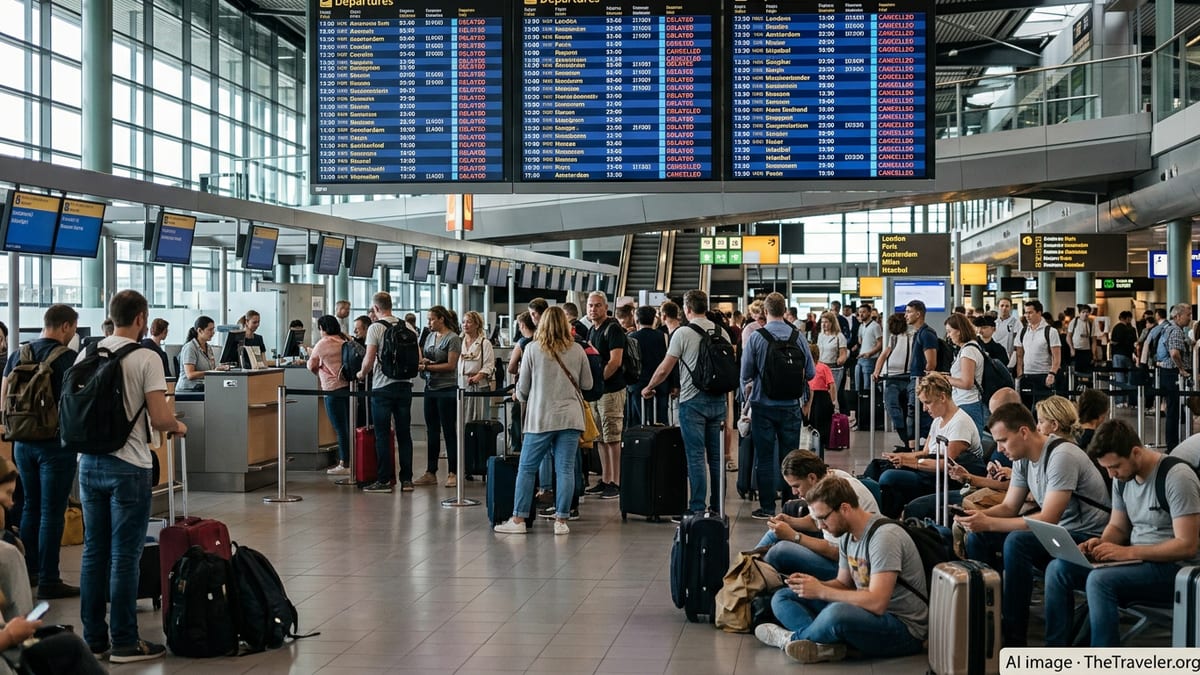
Widespread Cancellations and Delays Hit Major Carriers
Publicly available flight-tracking data and airport status boards indicate that 69 flights have been cancelled and around 670 delayed across Europe, stranding or rerouting thousands of passengers. The disruption is concentrated at some of the continent’s busiest hubs, including London Heathrow and Gatwick, Paris Charles de Gaulle and Orly, Amsterdam Schiphol, Milan Malpensa and Istanbul’s main international airport.
The irregular operations are impacting a broad mix of full-service and low-cost airlines. European groups such as Ryanair, Air France, KLM and British Airways have all reported affected services, alongside long-haul operators including Qatar Airways and other Gulf and transatlantic carriers. Many of the delays are stretching beyond three hours, triggering passenger-assistance obligations under European and UK air travel regulations in numerous cases.
According to published coverage and live airport feeds, cancellations are scattered across both short-haul intra-European routes and longer services connecting Europe to the Middle East, Asia and North America. The pattern suggests a combination of local airport constraints and wider network knock-on effects as aircraft and crews fall out of position.
The volume of delayed flights has led to heavy queuing at check-in areas, transfer desks and security lanes, particularly during the morning and late-afternoon peaks. Social media posts from travelers show crowded departure halls and long lines at rebooking counters, as passengers attempt to secure alternative connections or overnight accommodation.
Operational Strain at London, Paris and Amsterdam
London, Paris and Amsterdam, three of Europe’s most critical transfer hubs, are among the worst affected. Flight-status data shows waves of delays at London Heathrow and Gatwick, where British Airways and a range of partner airlines are coping with a busy schedule already close to capacity. Even relatively minor schedule disruptions can cascade quickly at these airports, amplifying the impact on connections.
In Paris, publicly available information points to delays at both Charles de Gaulle and Orly, impacting Air France and partner carriers across the SkyTeam alliance. Prior analyses from regional air traffic bodies have highlighted how congestion and staffing constraints can magnify disruption at French airports during periods of operational strain, particularly when capacity is reduced or weather complicates runway use.
Amsterdam Schiphol, a central hub for KLM and a key transfer point between Europe and intercontinental markets, is also experiencing a notable share of the delays. Recent seasons have already strained Schiphol’s operations during peak travel periods, and current disruption is once again exposing the sensitivity of hub-and-spoke networks to even localized interruptions in airport capacity.
For connecting passengers, the combination of delays at multiple hub airports is especially challenging. Missed onward flights can strand travelers far from their final destinations, forcing airlines to arrange complex rerouting via alternative cities or overnight hotel stays where accommodation can be secured at short notice.
Ripple Effects for Milan, Istanbul and Secondary Airports
The disruption is not confined to Europe’s largest hubs. Published airport information shows Milan and Istanbul among the cities coping with waves of late-running arrivals and departures, affecting both local point-to-point traffic and wider networks. At Milan’s main international airport, delayed inbound flights are in turn pushing back outbound departures as ground handling operations struggle to recover schedule gaps.
Istanbul, a critical bridge between Europe, the Middle East and Asia, is experiencing its own knock-on effects as airlines attempt to recover aircraft rotations and crew schedules. Long-haul carriers that rely on tight turnaround times are particularly exposed when earlier segments into Europe run significantly behind schedule.
Secondary airports that support overflow or low-cost services, including those around London and Paris as well as regional fields in Italy and the Netherlands, are also feeling the strain. While some report fewer outright cancellations, cumulative delays are eroding buffer times and complicating aircraft positioning, making it harder for airlines to restore normal operations by the following day.
For many passengers traveling through these smaller airports, the disruption can be just as severe, with limited alternative flights available and fewer on-site resources to handle sudden spikes in rebooking and customer service demand.
Passenger Rights and What Travelers Can Expect
The current wave of disruption is once again drawing attention to passenger protections under European and UK rules. Under the EU’s air passenger rights framework and comparable UK regulations, travelers on flights departing from European airports, or operated by European and UK carriers, may be entitled to assistance such as meals, refreshments and hotel accommodation in the event of long delays or cancellations.
Compensation payments in cash may also apply when disruptions are not linked to extraordinary circumstances, though the specific entitlements depend on distance, delay length and the reason for the disruption. Legal commentators and consumer organizations routinely advise passengers to retain boarding passes, booking confirmations and receipts for out-of-pocket expenses to support later claims.
Public guidance emphasizes that affected passengers should check official airline channels and airport information screens regularly, since rebooking options can change quickly as capacity opens on alternative flights. Many carriers are also enabling free date or route changes via their websites and mobile apps during periods of widespread disruption, reducing the need to queue at airport desks in some cases.
Consumer advocates note that, despite these formal protections, securing compensation or timely rebooking can be a slow and frustrating process, particularly when disruptions are large enough to overwhelm call centers and airport customer-service teams.
Prospects for Recovery Across European Networks
Industry observers indicate that while the raw number of cancellations is relatively modest compared with historic large-scale shutdowns, the sheer volume of delayed flights across several major hubs will likely take at least a full operational day to unwind. Aircraft and crew displaced from their planned rotations may continue to trigger schedule adjustments well into subsequent days, even after headline disruption appears to subside.
Airlines are expected to prioritize restoring core trunk routes linking London, Paris, Amsterdam, Milan and Istanbul with other major European and intercontinental destinations. Less frequent services, including some late-evening and early-morning departures, may be more vulnerable to further retiming as carriers rebalance fleets and attempt to reduce overnight strandings.
Travel analysts recommend that passengers with flexible plans consider adjusting nonessential journeys while operations stabilize, particularly those involving tight connections or itineraries that require transiting multiple hubs in a single day. For those who must travel, padding itineraries with longer connection windows and monitoring flight status closely remain key strategies for reducing the risk of severe disruption.
With European air travel volumes running close to or above pre-pandemic levels at many airports, the latest wave of delays and cancellations underscores how quickly normal operations can unravel when multiple hubs across different countries experience simultaneous strain. For thousands of passengers stuck in terminals from London to Istanbul, the immediate priority is simply finding a way to continue their journeys.