

More news on this day
Air passengers across northern and western Europe are facing a fresh wave of disruption, as airports in the United Kingdom, Italy, the Netherlands, Denmark and several other countries reported more than 1,800 delayed flights and nearly 100 cancellations in a single day, affecting major carriers including Lufthansa and Ryanair.
Get the latest news straight to your inbox!
Major Hubs Struggle Under Mounting Operational Strain
Recent operational data and travel-industry monitoring show that London Heathrow and Rome Fiumicino have been among the hardest-hit hubs, with hundreds of services arriving and departing behind schedule. Similar patterns are reported at Amsterdam Schiphol, Copenhagen, and other high-traffic airports, contributing to a continent-wide ripple effect that is complicating connections and itineraries.
Across the network, reports indicate a combined total of 1,813 delayed flights and 98 cancellations, underscoring how even a single day of disruption can cascade through tightly timed airline schedules. High passenger volumes at leading hubs, together with knock-on effects from earlier weather and labor disturbances, are leaving limited slack in the system when new issues emerge.
Published aviation coverage notes that this latest episode follows other days of heavy disruption at major European airports in the past week, including large backlogs of delayed and cancelled services in Germany, the UK, France and Italy. As aircraft and crews rotate through interconnected schedules, delays in one country are quickly transmitted to others, affecting travelers far from the original source of the problem.
Publicly available flight tracking snapshots from the same period show crowded arrival and departure boards across Europe, with many services pushed back by 30 minutes or more. In some cases, late arriving aircraft are then redeployed on subsequent sectors, compounding delays into the evening.
Lufthansa, Ryanair And Other Carriers Face Network-Wide Knock-On Effects
Among the airlines most exposed to the disruption are large network and low cost carriers with dense intra-European schedules. Lufthansa and Ryanair feature prominently in delay and cancellation statistics for the affected day, reflecting their extensive operations through key hubs such as London, Amsterdam, Rome and Copenhagen.
Recent reporting on European aviation highlights that Lufthansa is still recalibrating its network after a series of labor-related disruptions in March, which led to cancelled services and a backlog of rebooked passengers. These earlier events reduced operational buffers and left some rotations more vulnerable when new bottlenecks appeared at airports in the UK, Italy and the Netherlands.
Ryanair, which typically operates high-frequency, quick-turnaround flights across the continent, is likewise sensitive to conditions at congested hubs and in crowded airspace corridors. Industry analysis notes that any extended hold on the ground or in the air can push aircraft off schedule for the rest of the day, particularly during peak morning and evening waves when turn times are shortest.
Other major European airlines, including flag carriers and regional operators, are also experiencing rolling delays as they attempt to absorb the combined impact of airport congestion, prior weather disruptions and ongoing industrial actions in parts of the air traffic and ground handling system.
Netherlands, Denmark And UK See Travelers Caught In The Middle
In the Netherlands, Amsterdam Schiphol continues to act as a focal point for disruption, with published tallies showing close to 150 delayed and several cancelled flights recorded there on the day in question. As one of Europe’s busiest transfer hubs, any disruption at Schiphol can quickly affect passengers transiting between long haul and short haul services.
Denmark, with Copenhagen Airport as its primary international gateway, is also feeling the knock-on effects. Aviation coverage describes a pattern of delays building through the day, particularly on routes linking Copenhagen with London, Amsterdam and other northern European cities. Even modest schedule slippage at large partner hubs can leave aircraft and crews out of position for return legs into Scandinavia.
In the UK, London Heathrow’s role as a central hub for both transatlantic and European traffic means that its delays feed directly into regional airports around the country. When Heathrow departures leave late or inbound flights divert or cancel, domestic and short haul connections are often the first to be disrupted, leaving passengers in cities such as Manchester, Edinburgh or Belfast facing missed links and unplanned overnight stays.
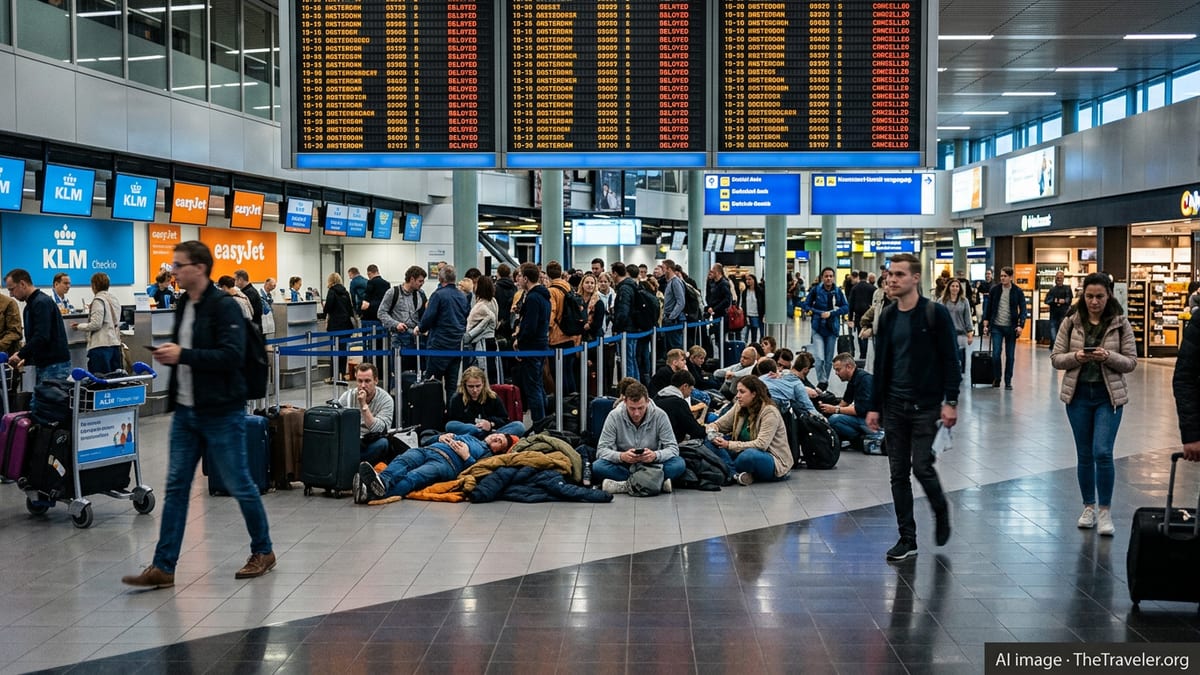
Travel media reports that similar pressure is visible at other European gateways, from Italy and Spain to the Nordic countries, as the knock-on effect of delays and cancellations shifts aircraft rotations around the region. For many travelers, the impact is felt less in the headline numbers and more in long queues at rebooking desks, crowded departure halls and uncertain arrival times.
Stormy Winter, Strikes And Structural Capacity Limits Fuel Chaos
The latest disruption comes on the heels of a difficult winter for European aviation, marked by intense storms, bouts of heavy snow and ice, and several rounds of strikes. Earlier in the year, severe weather brought widespread cancellations at Amsterdam Schiphol and other northern European airports, while strong wind events disrupted rail and road links that many passengers rely on to reach the airport.
At the same time, labor disputes in the aviation sector have periodically reduced capacity. Pilot and ground staff strikes in Germany and other countries have, in recent weeks, forced carriers such as Lufthansa to trim schedules and reassign aircraft. Separate air traffic control and ground handling disputes in France, Spain and Italy have also triggered slowdowns and targeted cancellations, particularly affecting cross-border services and flights passing through sensitive airspace.
Analysts quoted in industry-focused publications point to deeper structural issues, including the tight staffing margins that many airlines and airports continue to operate after the pandemic. With recruitment and training timelines still catching up to renewed demand, even routine irregular operations can quickly overwhelm resources, particularly at baggage handling and security checkpoints.
Looking ahead, travel risk advisories are already flagging potential further disruption tied to planned industrial action in European air traffic services. This could place additional strain on busy hubs such as London Heathrow, Amsterdam Schiphol, Rome Fiumicino and Copenhagen during upcoming holiday periods.
What Travellers Can Do As Disruptions Persist
Passenger rights frameworks such as EU261 provide compensation and care obligations in many circumstances where flights are significantly delayed or cancelled. Public guidance from regulators and consumer groups stresses that eligibility depends on the cause of the disruption and the length of delay, but passengers generally have the right to rerouting or reimbursement when services are cancelled.
Travel advisories recommend that passengers flying to or through hubs currently experiencing high disruption monitor their flight status closely on airline apps and departure boards. Many carriers now urge customers to use digital channels for rebooking or refunds, describing these as a faster alternative to waiting in line at airport counters when irregular operations occur.
Industry coverage also suggests building extra time into itineraries, especially when connecting between separate tickets or between low cost and full service airlines. Travelers heading through Heathrow, Schiphol, Copenhagen, Rome Fiumicino or other busy European hubs may benefit from allowing several hours between flights in case of knock-on delays.
With European aviation still working through the combined effects of winter weather, labor unrest and tight capacity, analysts anticipate that sporadic waves of disruption will continue through the spring. For travelers in the Netherlands, Denmark, the UK and beyond, flexibility and advance planning remain essential tools for navigating an increasingly unpredictable flight network.